 Rated 5 star on

Hallucinations: Preventing Confident Nonsense
Quick answer
AI hallucinations can't be eliminated, but the right setup makes them rare. Ground answers in your own sources and show where each came from. Pull prices and policies from your systems, not the model's memory. Let the AI say it doesn't know. Test with real questions and review high-stakes answers.
Generative AI sometimes states things that aren't true, and says them with complete confidence. It might invent a return policy, quote the wrong price or cite a source that doesn't exist. These "hallucinations" make businesses wary of AI. They can't be eliminated, but the right setup makes them rare.
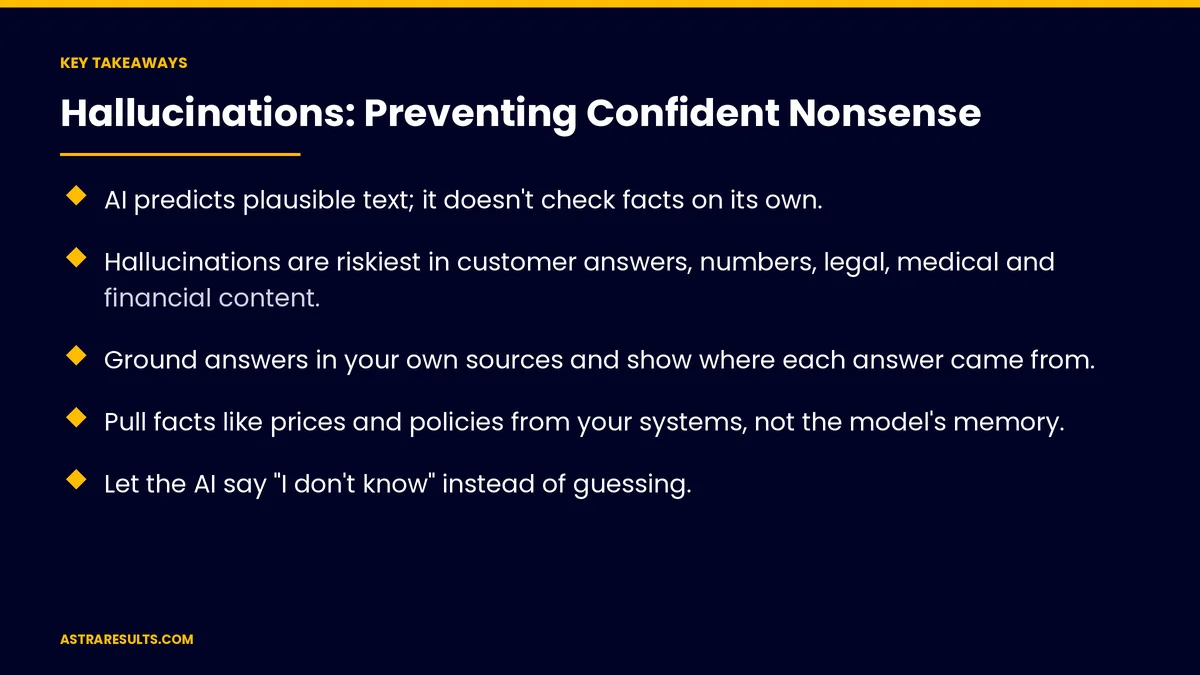
Key Takeaways
- AI predicts plausible text; it doesn't check facts on its own.
- Hallucinations are riskiest in customer answers, numbers, legal, medical and financial content.
- Ground answers in your own sources and show where each answer came from.
- Pull facts like prices and policies from your systems, not the model's memory.
- Let the AI say "I don't know" instead of guessing.
- Test with real questions and review high-stakes answers before they're used.
Published: October 19, 2026 | Reading Time: ~8 minutes | Category: Generative AI Services
This guide covers AI hallucinations: why they happen, where they're risky, grounding answers in your sources, pulling facts from your systems, keeping tasks narrow, letting the AI say it doesn't know, checks and review, testing, monitoring and what to measure. Put plainly: give the AI your facts, limit what it answers and check the answers that matter.
In This Playbook
- Why does generative AI make things up?
- Where they're risky
- Ground answers in your sources
- Where should an AI get prices and policies from?
- Keep tasks narrow
- Let the AI say "I don't know"
- Checks and review
- Testing
- Monitoring
- What to measure
- The first three months
Why does generative AI make things up?
AI predicts likely words. It generates text that sounds right.
No built-in fact check. It doesn't know what's true unless you give it facts.
Gaps get filled. When information is missing, it may invent something plausible.
The basics are covered in generative AI at work.
Where they're risky
Customer answers. Wrong policies or promises.
Numbers. Prices, dates and quantities.
Legal, medical and financial content. Errors carry real consequences.
Citations. In 2023, lawyers in Mata v. Avianca were sanctioned after filing case citations an AI tool had invented.
Product details. Specs and compatibility.
Ground answers in your sources
Give the AI your content. Help articles, policies and product data.
Answer only from that content. Not from general knowledge.
Show the source. Link to the article behind each answer, as in AI support inside the app.
Keep sources current. Outdated content produces outdated answers.
Where should an AI get prices and policies from?
Prices from your price list. Not from the model.
Order status from your order system. Looked up, not guessed.
Policies from one approved document. The same answer every time.
Rules for facts, AI for language. As weighed in GenAI vs traditional automation.
Keep tasks narrow
Summarize given text. Lower risk than open questions, as in meeting notes to action items.
Draft, don't decide. Let people send or approve.
Clear instructions. What to answer and what to refuse.
Let the AI say "I don't know"
Allow it explicitly. In the instructions.
Hand off to people. When the answer isn't in your content.
Better than a guess. A clear "let me connect you" builds trust.
Checks and review
Rule checks. Prices, dates and names compared with your systems.
People review high-stakes outputs. Legal, medical, financial and anything sent to many customers.
Flag low confidence. Uncertain answers go to a person.
Testing
A test set of real questions. With known correct answers.
Run it before launch. And after every change.
Include tricky questions. Ones your content doesn't answer.
Pilot safely. As covered in AI pilots that fail safely.
Monitoring
Let users report wrong answers. In the app or chat, as covered in integrating AI into a mobile app.
Review samples weekly. Especially new topics.
Fix the source. Most wrong answers trace back to missing or unclear content.
Security matters too. As covered in GenAI security.
What to measure
Accuracy on the test set. Before and after changes.
Unsupported answers. Claims not found in your sources.
"I don't know" rate. Too high means gaps in content; too low may mean guessing.
User reports. Wrong answers flagged.
Corrections made. To content and instructions.
The first three months
Days 1–30: sources and facts
Collect the content the AI should use, connect systems for prices and order status and write instructions that allow "I don't know."
Days 31–60: test
Build a test set of real questions, run it, fix content gaps and set review rules for high-stakes answers.
Days 61–90: launch and monitor
Launch with source links and user reporting, review samples weekly and track accuracy and unsupported answers.
How Astra prevents hallucinations
Astra Results Marketing builds generative AI that answers from your facts. We ground answers in your content, pull prices and policies from your systems, allow "I don't know," add checks and review for high-stakes outputs and test with real questions.
Engagements begin with an AI accuracy review through our generative AI services team.
Related reading
Frequently asked questions
What is an AI hallucination?
When an AI tool states something false with confidence, such as an invented policy, wrong price or nonexistent source.
Why do AI tools hallucinate?
They predict plausible text and don't check facts on their own, so they may fill gaps with something that sounds right.
Can hallucinations be eliminated?
Not entirely, but grounding answers in your sources, pulling facts from your systems and reviewing high-stakes outputs make them rare.
What does grounding mean?
Giving the AI your own content, having it answer only from that content and showing the source behind each answer.
Should the AI ever say "I don't know"?
Yes. Allowing it, and handing off to a person, is far better than a confident guess.
How do we know it's working?
Test with real questions that have known answers, monitor user reports and track unsupported answers over time.
Ready for AI that answers from your facts? Astra Results Marketing grounds AI answers in your content and systems, lets AI admit what it doesn't know and tests and reviews answers so confident nonsense doesn't reach customers. ▸ CALL (786) 321-2866 · ▸ REQUEST YOUR CONSULTATION





