 Rated 5 star on

GenAI Security: Data Leakage and Prompt Injection
Quick answer
Protect generative AI from data leakage and prompt injection with a few clear rules. Use business AI accounts with clear data terms, not personal ones. Make AI file access match user permissions. Limit what AI can do and require approval for important actions. Test for attacks, monitor use and keep an incident plan.
Generative AI tools now draft emails, summarize documents, answer customers and, increasingly, take actions. That brings two security risks most businesses haven't planned for. Sensitive data can leak out through careless use or poor setup, and hidden instructions can trick an AI into doing things it shouldn't. Both are manageable with a few clear rules.
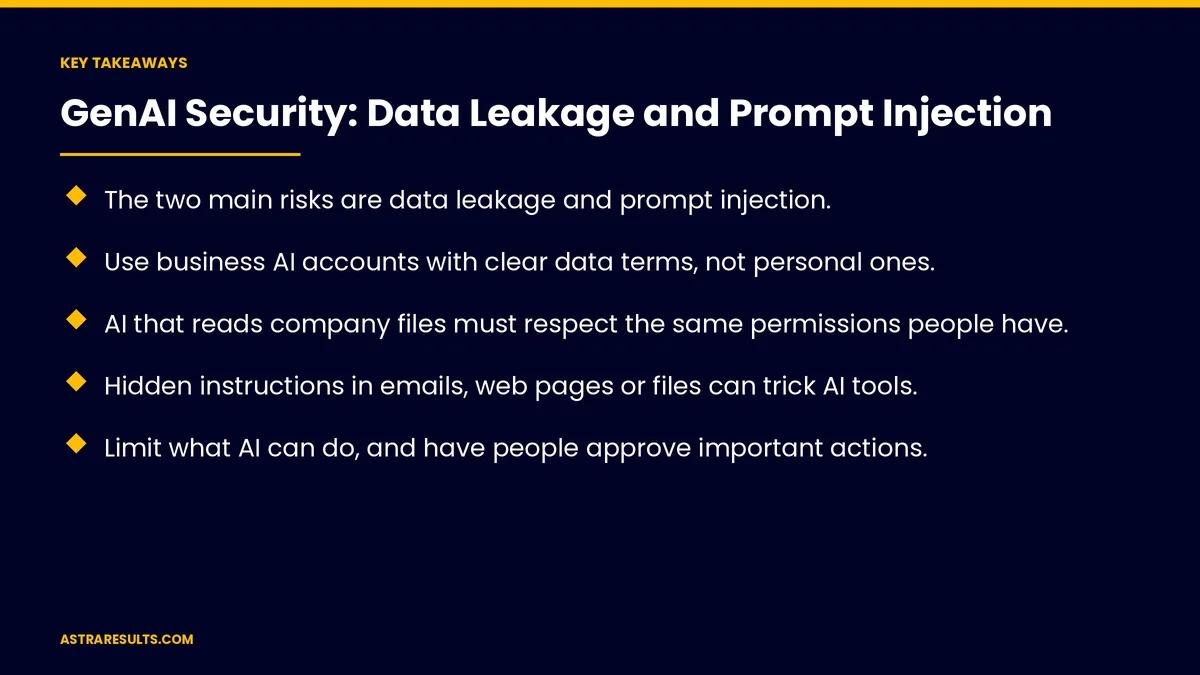
Key Takeaways
- The two main risks are data leakage and prompt injection.
- Use business AI accounts with clear data terms, not personal ones.
- AI that reads company files must respect the same permissions people have.
- Hidden instructions in emails, web pages or files can trick AI tools.
- Limit what AI can do, and have people approve important actions.
- Test for attacks, monitor use and plan for incidents.
Published: October 13, 2026 | Reading Time: ~9 minutes | Category: Generative AI Services
This guide covers data leakage, access controls, prompt injection, limiting what AI can do, handling AI output, testing, vendor questions and an incident plan. Put plainly: keep sensitive data in, keep hidden instructions out and keep people approving important actions.
In This Playbook
- The two main risks
- How can businesses stop data leaking through AI tools?
- Which files should an AI assistant be allowed to show?
- Prompt injection
- Limit what AI can do
- Treat AI output with care
- Testing and monitoring
- Questions for vendors
- An incident plan
- What to measure
- The first three months
The two main risks
Data leakage. Sensitive information ends up where it shouldn't.
Prompt injection. Someone tricks the AI into ignoring its instructions. It tops the OWASP list of security risks for apps built on large language models.
Both grow with access. The more data and actions an AI has, the bigger the risk.
How can businesses stop data leaking through AI tools?
Business accounts. Use AI tools with business data terms, not personal accounts.
A clear policy. What staff may and may not put into AI tools.
Sensitive data rules. Customer, health, financial and legal information handled with extra care.
Redaction. Remove names, numbers and identifiers where they aren't needed.
Retention. Know how long chats and logs are kept.
Which files should an AI assistant be allowed to show?
Same permissions as people. An AI assistant shouldn't show files a user can't open.
Connect carefully. Only the folders and systems the tool needs.
Review regularly. As access changes, as covered in task manager security.
Prompt injection
Direct attempts. A user types "ignore your instructions and…"
Hidden instructions. Text buried in an email, web page or document the AI reads.
Why it works. AI tools can mix up instructions and the content they're processing.
Why it matters more with actions. An AI that can send emails, change records or issue refunds can be misused.
Limit what AI can do
Least access. Only the tools and data each task needs.
People approve important actions. Sending to customers, payments and record changes, as in home services agents.
Allowed actions only. A short list of what the AI may do.
Logs and a stop button. As covered in agent security.
Treat AI output with care
Check before acting. Especially links, code and instructions in AI output.
Don't run output automatically. Without checks.
Keep rules outside the AI. Approvals and limits enforced by regular software, as weighed in GenAI vs traditional automation.
Testing and monitoring
Test with attacks. Try hidden instructions and data requests before launch.
Monitor use. Unusual requests, large exports or blocked actions.
Update regularly. New tricks appear often.
Questions for vendors
How is our data used? Training, retention and access.
Where is it stored? And who can see it.
What protections exist? Against prompt injection and data leaks.
Can we see logs? For audits and incidents.
Sizing the right tool is weighed in is custom AI right for your size.
An incident plan
Who investigates. And who decides.
How to stop it. Disable the tool or connection quickly.
Who to tell. Customers, partners or regulators, with counsel.
Learn and fix. Update rules after each incident.
What to measure
Staff on business accounts. Share using approved tools.
Blocked injection attempts. In testing and live use.
Access reviews completed. On schedule.
Actions approved by people. Share of important actions reviewed.
Incidents and response time. From discovery to fix.
The first three months
Days 1–30: policy and accounts
Write a short AI use policy, move staff to business accounts and list every AI tool, what it can read and what it can do.
Days 31–60: lock down
Match AI file access to user permissions, limit actions, add approvals for important ones and turn on logs.
Days 61–90: test and plan
Test with hidden instructions and data requests, set up monitoring and write the incident plan.
How Astra secures generative AI
Astra Results Marketing helps businesses use generative AI safely. We set up business accounts and policies, match AI access to user permissions, limit actions, add approvals and logs and test for prompt injection before launch.
Engagements begin with an AI security review through our generative AI services team.
Related reading
Frequently asked questions
What is data leakage in generative AI?
Sensitive information ending up where it shouldn't, such as staff pasting customer data into personal AI tools or an assistant showing files a user can't open.
What is prompt injection?
An attempt to trick an AI into ignoring its instructions, either typed directly or hidden in emails, web pages or documents the AI reads.
How do we prevent data leakage?
Use business accounts with clear data terms, write a use policy, redact sensitive details and match AI file access to user permissions.
How do we protect against prompt injection?
Limit what the AI can do, require people to approve important actions, keep rules outside the AI, test with attacks and monitor use.
Are AI agents riskier than chat tools?
Yes, because they can take actions. Give them only the access they need, require approvals and keep logs and a stop button.
What should we ask AI vendors?
How your data is used and stored, who can see it, what protections exist and whether you can see logs.
Ready to use generative AI without the security risks? Astra Results Marketing sets up business accounts and policies, limits AI access and actions, adds approvals and logs and tests for prompt injection before launch. ▸ CALL (786) 321-2866 · ▸ REQUEST YOUR CONSULTATION





