Rated 5 star on

Industry-Specific AI: Built Around Your Process
Quick answer
Generic AI handles what companies share; industry-specific AI handles what makes one company different, including the exceptions that happen twice a week and cost money each time. The decision is made workflow by workflow rather than as a company-wide verdict: buy the average, build the difference. Ownership of models, data and prompts is settled before work starts.
A generic AI tool is built for the average of a thousand companies. It handles what every company shares and stops at the parts that make a business what it is: the pricing logic nobody else uses, the compliance step the industry requires, the exception that happens twice a week and costs money every time.
Key Takeaways
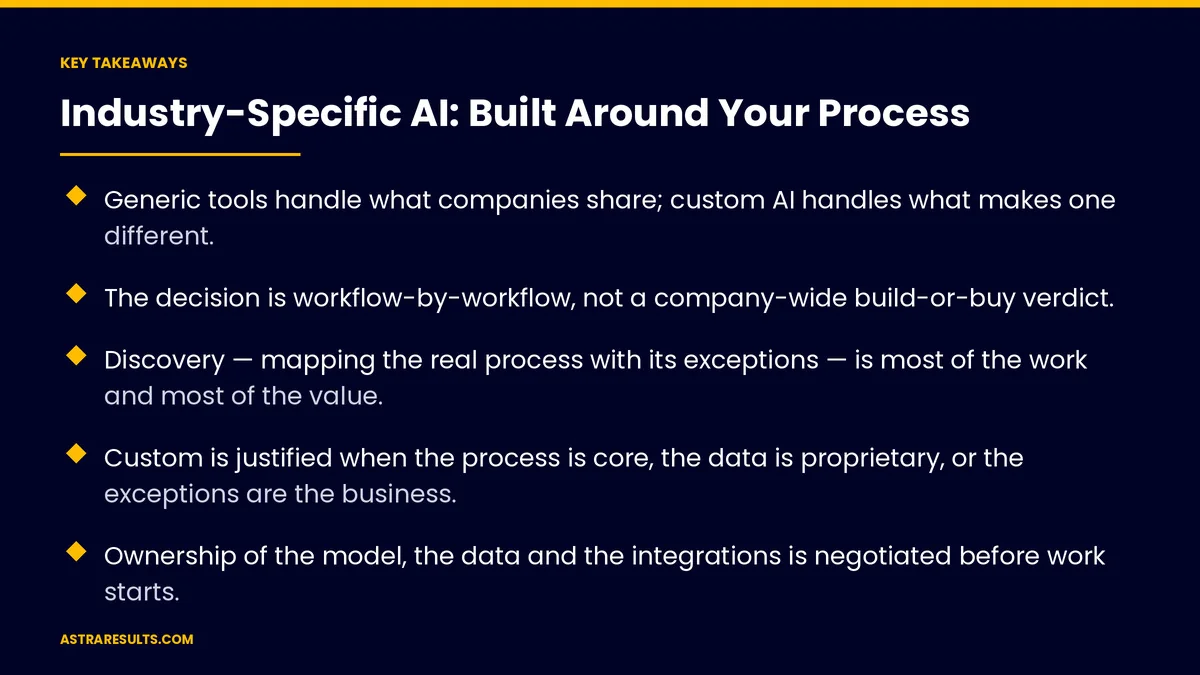
- Generic tools handle what companies share; custom AI handles what makes one different.
- The decision is workflow-by-workflow, not a company-wide build-or-buy verdict.
- Discovery — mapping the real process with its exceptions — is most of the work and most of the value.
- Custom is justified when the process is core, the data is proprietary, or the exceptions are the business.
- Ownership of the model, the data and the integrations is negotiated before work starts.
- Measure the operating metric the process exists to move, not model accuracy.
Published: September 15, 2026 | Reading Time: ~13 minutes | Category: Industry AI
Industry-specific AI starts from the other end. It begins with one company's actual process, including the exceptions, and builds only what that process needs. This guide explains when that is worth doing, how it is scoped, what it costs compared to buying, who owns what at the end, and how to tell whether it worked. Stated simply: buy the average, build the difference.
Guidance for owners and operators. Nothing here is legal, financial or technical advice. Regulated industries carry requirements for record-keeping, disclosure, professional judgment and data handling that vary by sector and jurisdiction and must be reviewed with counsel before any AI system touches a regulated process.
In This Playbook
- When generic stops fitting
- Discovery: mapping the real process
- When custom is justified
- What industry-specific means
- What it costs and how it is scoped
- Ownership: settle it before work starts
- Regulated industries
- Measuring it
- How custom projects fail
- Ninety days, in order
- Astra's part in it
When generic stops fitting
Most businesses should buy most of their software. The question is where that stops.
- The signs. People maintaining spreadsheets alongside the tool to hold what it cannot. A workflow that the tool forces into the wrong shape. Exceptions handled entirely by hand because the tool has no concept of them. Data re-keyed between systems because none of them was built for this business.
- The blunt test. If three competitors could use the same tool the same way, buy the tool. If the way this business does it is the reason customers choose it, that part may be worth building.
- Where it usually lands. A company buys a CRM, an accounting system and a scheduling tool, and builds the AI layer that connects them to the way it quotes, schedules and delivers.
- The trap on both sides. Building what could have been bought wastes money. Forcing a core differentiator into a generic tool wastes the differentiator, the case for which sits in choosing the workflow first.
Discovery: mapping the real process
The build is the easy half. Discovery is where projects succeed or fail.
- What gets mapped. The trigger, every step, every decision and who makes it, every handoff, every system touched, and — most importantly — every exception and what happens to it.
- Who is in the room. The people who do the work, not only the people who manage it. The exceptions live with the former.
- What discovery reveals. Almost always, that the process has undocumented variants, that two teams do it differently, and that a step everyone assumed was required exists because of a system limitation that no longer applies.
- The uncomfortable output. Sometimes discovery concludes that the process should be simplified before anything is automated, and that the simplification captures most of the value. A good partner says so.
- Why it is worth the fee on its own. A documented process with its exceptions is an asset whether or not software follows, the mechanics of which are in the readiness conditions.
When custom is justified
Four conditions, of which at least two should hold.
- The process is core. It is how the business competes, not how it does admin. Custom scheduling for a business whose promise is reliability; custom quoting for one whose promise is speed.
- The data is proprietary. Years of the company's own outcomes — which jobs ran over, which customers renewed, which configurations failed — that no vendor has and no generic model learned from.
- The exceptions are the business. The eighty percent that fits the generic tool is the easy eighty percent, and the twenty percent it cannot handle is where the margin and the risk live.
- The integration burden is the real cost. Several systems that must agree, where the value is in the connective logic rather than in any one function.
- When none hold. Buy, configure well, and spend the money on demand or intake instead.
What industry-specific means
The phrase is used loosely. Three different things hide inside it.
- Vertical software with AI features. A product built for one industry, sold to many companies in it. Often the right answer: the industry's shared requirements are already handled.
- Configured generic AI. A general platform tuned with the company's documents, terminology and rules. Faster and cheaper than building, and sufficient for many knowledge and document workflows.
- Genuinely custom. Built for one company's process, on its data, integrated with its systems. Justified by the four conditions above.
- The sequence that saves money. Try configured generic first for most workflows. Build only where configuration provably cannot reach.
What it costs and how it is scoped
- Discovery is scoped and priced separately, and its output is a document the business owns whether or not it proceeds.
- Build is scoped in phases with a working system at the end of each. A first useful phase is typically weeks, not quarters.
- Integration is the largest variable. Connecting to a modern system with an interface is straightforward; connecting to a twenty-year-old system without one is a project of its own.
- Ongoing costs: model usage, hosting, monitoring, and the maintenance that every system needs when the business changes.
- The scoping discipline. Phase one does the narrowest useful thing and proves it. A project that must be complete before it is useful is a project that will be cancelled before it is complete.
Ownership: settle it before work starts
The question that gets skipped and later costs the most.
- The model. If it was trained on the company's data, who owns the trained model? Can the vendor use it for other clients, including competitors?
- The data. The company's, always. Including anything derived from it. Including after the relationship ends.
- The integrations and code. Who holds the repository, the credentials, the deployment? Can another team take over?
- The exit. What the company receives if it leaves: the code, the data, the documentation, the model weights or equivalent access.
- Why now. Every one of these is cheap to agree before work starts and expensive to argue about afterward, the mechanics of which are in the ownership principle.
Regulated industries
Some sectors carry requirements that change the design rather than adding a disclaimer.
- Record-keeping. What the system decided, on what basis, and when — retained in a form a regulator or auditor can review.
- Professional judgment. Where a licensed professional must make or approve a decision, the system prepares and the professional decides, with the approval recorded.
- Disclosure. Whether customers must be told they are interacting with an automated system, and in what terms.
- Data handling. Where regulated data may be processed and stored, and by whom.
- The approach. Counsel maps the requirements for the specific process before the design, because retrofitting compliance into a built system is expensive and sometimes impossible.
Measuring it
Model metrics are diagnostics. Operating metrics are the point.
- The operating metric. The number the process exists to move: quote turnaround time, first-time-fix rate, days sales outstanding, on-time delivery, cost per unit processed. Recorded before the project starts.
- Adoption. Whether the people who were supposed to use it do. A system with excellent metrics and no users has failed.
- Exception rate. How often the system hands back to a human, and whether that falls as it learns the edge cases.
- Time to value. How long from start to the first measurable improvement.
- Total cost against the baseline. Build, run and maintain, compared to the cost of the process before, according to judging by the decision improved.
How custom projects fail
- Building before mapping. The system faithfully implements a process nobody had agreed on.
- Scope that must be complete to be useful. Eighteen months, no working output, cancelled at month fourteen.
- No named owner inside the business. The vendor builds what it understood; nobody internal is accountable for whether it fits.
- Ignoring the exceptions. The system handles the easy eighty percent, the hard twenty percent still goes to people, and nobody counted that the hard twenty percent was where the hours were.
- Ownership discovered at the end. The company cannot take the system elsewhere, and the vendor knows it.
Ninety days, in order
Days 1–30: discovery
The candidate process mapped with the people who do it, including every exception. The operating metric and its current value recorded. Build-or-configure assessed against the four conditions. Ownership terms agreed in writing. Regulatory requirements mapped with counsel where relevant.
Days 31–60: phase one
The narrowest useful slice built and integrated. Run in parallel with the current process. Exceptions logged. The named internal owner reviewing weekly.
Days 61–90: prove and decide
The operating metric compared to its recorded baseline. Adoption and exception rate measured. Phase two scoped only if phase one moved the number.
Astra's part in it
Astra Results Marketing scopes discovery separately and hands over the process map whether or not the build proceeds, because a documented process with its exceptions is worth having on its own. It recommends configured generic tools where those will reach, and builds only where they provably cannot.
Ownership of the model, the data, the code and the integrations is agreed in writing before work starts, and everything belongs to the client. Phases are scoped so the first one is useful on its own, and success is judged on the operating metric recorded before the project began. Engagements begin with a process discovery through our business consulting team.
Related reading
Frequently asked questions
When should a business build custom AI instead of buying a tool?
When at least two of four conditions hold: the process is core to how the business competes rather than admin, the data is proprietary years of its own outcomes, the exceptions are where the margin and risk live, or the value is in connective logic across several systems. The real test is whether three competitors could use the same tool the same way. If so, buy it.
What does discovery involve and why does it matter so much?
Mapping the trigger, every step, every decision and decider, every handoff, every system touched, and every exception — with the people who do the work, not only those who manage it. Discovery almost always reveals undocumented variants, two teams doing it differently, and steps that exist because of a system limitation that no longer applies. Sometimes it concludes the process should be simplified before anything is automated.
What does "industry-specific AI" mean?
Three different things: vertical software with AI features built for one industry and sold to many companies in it, often the right answer; configured generic AI tuned with a company's documents, terminology and rules, which is faster and cheaper and sufficient for many workflows; and custom systems built for one company's process on its data. The money-saving sequence is to try configured generic first.
Who owns the model and the data?
Settle it in writing before work starts. The data is the company's always, including anything derived from it and after the relationship ends. For the model, agree explicitly whether a vendor may reuse something trained on the company's data for other clients, including competitors. Also agree who holds the code, credentials and deployment, and what the company receives if it leaves.
How should a custom AI project be scoped?
In phases where each produces a working system, with phase one doing the narrowest useful thing and proving it. A project that must be complete before it is useful will be cancelled before it is complete. Discovery is priced separately, integration is the largest variable — a modern system with an interface is straightforward, a twenty-year-old one without is its own project — and ongoing costs include usage, hosting, monitoring and maintenance.
What should be measured?
The operating metric the process exists to move — quote turnaround, first-time-fix rate, days sales outstanding, cost per unit processed — recorded before the project starts. Plus adoption, because a system with excellent metrics and no users has failed; exception rate and whether it falls as edge cases are learned; time to first measurable improvement; and total build, run and maintain cost against the prior process.
READY TO FIND OUT WHICH PART OF YOUR PROCESS IS WORTH BUILDING? Astra Results Marketing scopes discovery separately, recommends configured tools where they reach, builds only where they cannot, and agrees ownership of the model, data and code in writing before work starts. Astra Results Marketing · 1101 Brickell Ave, Miami, FL 33131 · +1 (786) 321-2866 · [email protected] Find us on Google · Yelp ▸ CALL (786) 321-2866 · ▸ REQUEST YOUR CONSULTATION