 Rated 5 star on

Restaurant Group SEO Beyond the Menu Page
Quick answer
Restaurant groups win local search by treating each location as its own place. Every location needs a unique page and an accurate Google Business Profile, including holiday hours. Menus should be real text, not only PDFs. Pages for private dining, catering, events and gift cards capture high-value searches. Reviews and Spanish pages help diners choose.
Many restaurant group websites have a homepage, a menu PDF and a list of addresses. Diners searching "brunch near me" or "private dining in Coral Gables" rarely find them. Local search rewards groups that treat each location as its own place, with its own page, profile and readable menu.
Key Takeaways
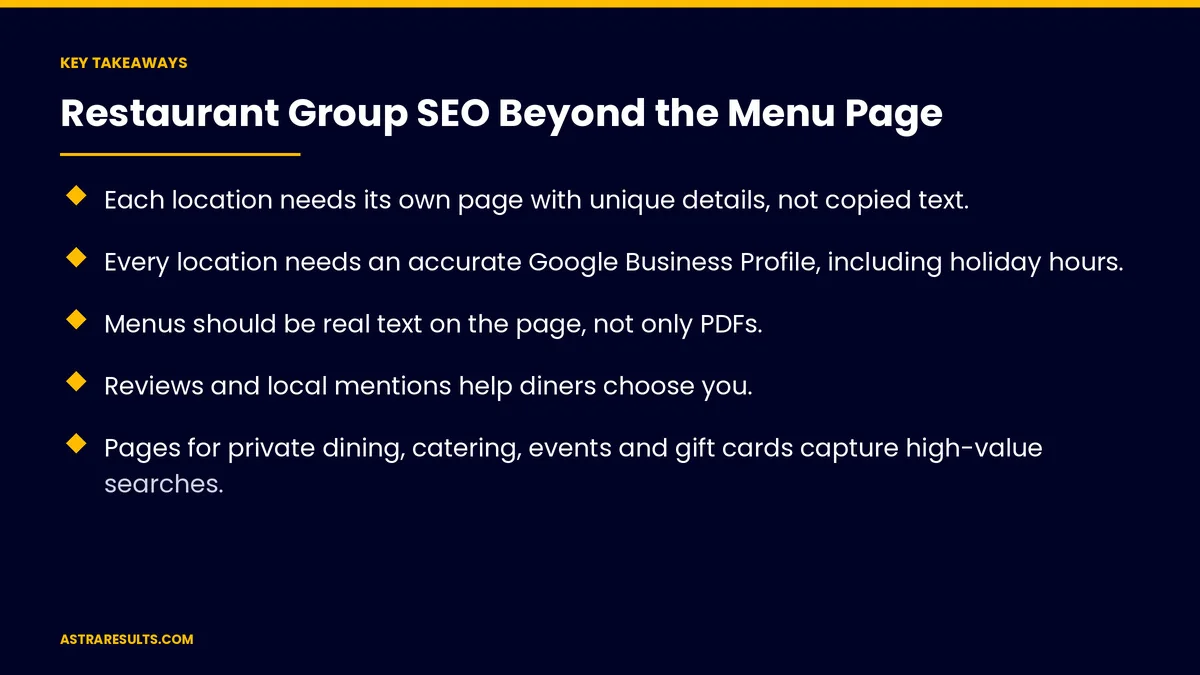
- Each location needs its own page with unique details, not copied text.
- Every location needs an accurate Google Business Profile, including holiday hours.
- Menus should be real text on the page, not only PDFs.
- Reviews and local mentions help diners choose you.
- Pages for private dining, catering, events and gift cards capture high-value searches.
- Send ordering traffic to your own system where you can.
Published: October 17, 2026 | Reading Time: ~9 minutes | Category: Search Engine Optimization
This guide covers SEO for restaurant groups: location pages, Google Business Profiles, menus as real text, structured data, reviews, events and private dining, catering and gift cards, Spanish content, AI answers, online ordering and what to measure. Put plainly: give every location its own page and profile, and make every menu readable by people and search engines.
In This Playbook
- Why restaurant groups miss local searches
- Location pages
- Google Business Profiles
- Menus as real text
- Structured data
- How should restaurants ask for reviews?
- Events, private dining, catering and gift cards
- Spanish content
- AI answers
- Should restaurant websites link to their own ordering?
- What to measure
- The first three months
Why restaurant groups miss local searches
One page for all locations. Search engines can't tell which location serves which neighborhood.
PDF menus. Harder for search engines and screen readers to read.
Outdated profiles. Wrong hours send diners elsewhere.
Generic content. Copied text across locations adds little.
Location pages
One page per location. Address, hours, phone, parking and directions.
Unique details. Neighborhood, atmosphere, patio, private rooms and the chef or manager.
Location menus. Items and prices that differ by location.
Photos of that location. Real dining rooms, not stock images.
Local search basics are covered in national vs local SEO.
Google Business Profiles
One profile per location. Verified and complete.
Accurate hours. Including holiday and special-event hours.
Menus, photos and attributes. Outdoor seating, reservations and dietary options.
Reservation and ordering links. Pointing to the right places.
Profile best practices are covered in Google Business Profile for Miami practices.
Menus as real text
Text on the page. Dish names, descriptions and prices that search engines can read.
Keep a PDF if needed. But not as the only version.
Dietary labels. Vegetarian, gluten-free and allergen notes.
Update easily. Menus change, so make editing simple.
Structured data
Restaurant details. Address, hours, cuisine and price range marked up for search engines.
Menu links. So search engines find each location's menu.
Consistent details everywhere. Name, address and phone the same across directories and maps.
How should restaurants ask for reviews?
Ask happy guests. After the visit, with a simple link.
Reply to reviews. Thank guests and address problems calmly.
Location by location. Each location builds its own reputation.
Events, private dining, catering and gift cards
Private dining pages. Room capacities, menus and inquiry forms.
Event pages. Wine dinners, holidays and live music, with dates.
Catering. Menus, ordering steps and delivery areas.
Gift cards. Easy to find and buy online.
Local links. Press coverage, community events and partners, as covered in backlinks in 2026.
Spanish content
Spanish menus and pages. For Miami's many Spanish-speaking diners.
Written naturally. Not word-for-word translation, as covered in bilingual marketing beyond translation.
Matching details. Same hours, prices and policies in both languages. Tourist areas may add Portuguese, as in search ads for Orlando tourism.
AI answers
Clear facts. Cuisine, neighborhood, price range, hours and specialties stated plainly.
Questions diners ask. "Best brunch in Brickell" or "restaurants with private rooms near Coral Gables."
Getting cited is covered in getting cited by ChatGPT and Google AI.
Should restaurant websites link to their own ordering?
Link to your own ordering. Direct orders cost less than delivery app commissions.
Make it easy to find. On location pages and profiles.
Apps for regulars. As covered in restaurant apps in React Native.
Group-wide view. Orders and data across locations, as in restaurant group AI.
What to measure
Local search visibility. By location.
Profile actions. Calls, directions and website clicks.
Reservations and orders. From search, by location.
Private dining inquiries. And catering orders.
Review volume and rating. By location.
The first three months
Days 1–30: fix the basics
Audit every location's Google Business Profile, fix hours and links, and make sure name, address and phone match everywhere. Turn menu PDFs into text pages.
Days 31–60: build location pages
Create a unique page for each location with details, photos, menus and links. Add structured data and Spanish versions.
Days 61–90: grow demand
Add private dining, event, catering and gift card pages, start review requests and pursue local press and partner links. Track profile actions, reservations and inquiries by location.
How Astra handles restaurant group SEO
Astra Results Marketing builds search programs for restaurant groups. We create unique location pages, fix and manage Google Business Profiles, turn menus into readable text, add structured data and build pages for private dining, catering and events.
We add Spanish content, encourage reviews and track reservations and orders by location. Engagements begin with a location and search review through our search engine optimization team.
Related reading
Frequently asked questions
Does each restaurant location need its own page?
Yes. A unique page per location, with address, hours, menu, photos and neighborhood details, helps diners and search engines find the right location.
Are PDF menus bad for SEO?
They're harder for search engines and screen readers to read. Put menus on the page as text, and keep a PDF only as an extra.
How important are Google Business Profiles for restaurants?
Very. Accurate hours, menus, photos, attributes and reservation links on each location's profile drive calls, directions and visits.
Should we create pages for private dining and catering?
Yes. These pages capture high-value searches and inquiries, with capacities, menus and simple inquiry forms.
Do Spanish menus help?
In Miami, yes. Spanish menus and pages serve many diners, written naturally with the same details as the English versions.
What should restaurant groups measure?
Local visibility, profile actions, reservations and orders from search, private dining inquiries and reviews, all by location.
Ready to fill more tables from local search? Astra Results Marketing builds location pages, manages Google profiles, turns menus into readable text and adds private dining, catering and Spanish pages for every restaurant in your group. ▸ CALL (786) 321-2866 · ▸ REQUEST YOUR CONSULTATION





