 Rated 5 star on

Restaurant Group AI: Menu, Labor, Waste as One Model
Quick answer
Restaurant groups can drive prep lists, staffing, supplier orders and menu decisions from one item-level demand forecast by daypart. The forecast learns from sales history, reservations, weather and local events. Seeing each dish's popularity and margin together improves menu choices. Chefs and managers review every plan. Track food cost, labor cost and waste by location.
In most restaurant groups, the menu, the schedule and the prep list are planned from different numbers. The chef preps for a busy Friday, the manager schedules for a slow one, and the extra food ends up in the bin. Connecting them to one forecast of what guests will order lets each decision pull in the same direction.
Key Takeaways
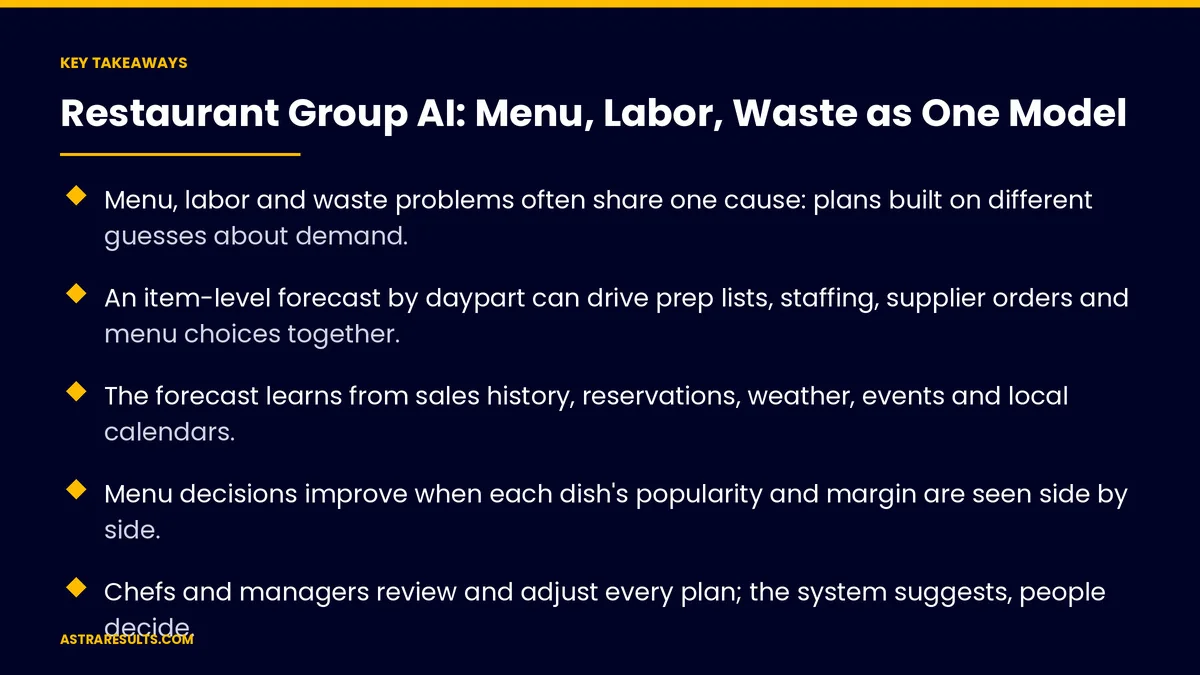
- Menu, labor and waste problems often share one cause: plans built on different guesses about demand.
- An item-level forecast by daypart can drive prep lists, staffing, supplier orders and menu choices together.
- The forecast learns from sales history, reservations, weather, events and local calendars.
- Menu decisions improve when each dish's popularity and margin are seen side by side.
- Chefs and managers review and adjust every plan; the system suggests, people decide.
- Measure food cost, labor cost, waste and forecast accuracy by location.
Published: October 30, 2026 | Reading Time: ~9 minutes | Category: Industry-Specific AI
This guide explains how multi-location restaurant groups use AI to build one item-level demand forecast, then use it for prep, staffing, ordering and menu decisions, while chefs and managers stay in charge. Put plainly: forecast what guests will order, then let prep, labor, ordering and the menu all follow the same forecast.
In This Playbook
- Why menu, labor and waste belong together
- The forecast at the center
- Prep and waste
- Labor
- Ordering
- Menu decisions
- Group-level view
- People stay in charge
- What should a restaurant group AI measure?
- The first three months
Why menu, labor and waste belong together
They share one input. How many guests will come, and what they'll order.
Separate plans disagree. Prep, schedules and orders built from different guesses waste food and hours.
Small errors compound. Over-prepping one dish across ten locations adds up fast.
One forecast aligns them. When everyone plans from the same numbers, decisions support each other.
The forecast at the center
What it predicts. Orders by menu item, by location and by part of the day: lunch, dinner and late night.
What it learns from. Item-level sales history, reservations, weather, holidays, local events and school calendars.
How it improves. Each day's actual sales are compared with the forecast, and the model adjusts.
Clean data first. Point-of-sale, recipes, inventory and labor data must line up, and the costs of each stage of that setup are covered in what data infrastructure costs.
Prep and waste
Prep lists from the forecast. How much of each component to prepare for each daypart.
Shelf life built in. Items that spoil quickly are prepped closer to service.
Waste logged and learned from. What gets thrown away feeds back into the forecast.
Waste alerts. Flag items consistently over-prepped at a location.
Labor
Staffing from expected covers. Cooks, servers and support staff matched to the forecast for each shift.
Station-level needs. A dish-heavy menu at one location may need different kitchen staffing than another.
Drafts, not orders. Managers adjust and publish schedules, following labor rules. Day-to-day scheduling help is covered in restaurant agents.
Ordering
Supplier orders from the forecast. Ingredients needed for forecast dishes, minus what's on hand.
Group buying. Combine orders across locations where it saves money.
Central kitchens. Plan commissary production for all locations from one forecast.
Approval stays with people. Orders above set limits always need a manager.
Menu decisions
Popularity and margin together. See how often each dish sells and what it earns after food cost.
Find the stars and the drags. Popular, profitable dishes to feature; low sellers with thin margins to rethink.
Price with care. Menu pricing follows the methods in price optimization.
Use table time too. Revenue per available seat hour, as covered in revenue management, shows how dishes affect table turns.
Chefs decide. The data informs the menu; the chef shapes it.
Group-level view
Compare locations fairly. Judge each against its expected results, as in location performance models.
Share what works. Recipes, prep methods and schedules from the best performers.
Test menu changes. Try a change in a few locations before rolling it out.
Guest feedback. Reviews and comments by dish help explain the numbers, as in restaurant engagement.
People stay in charge
Suggestions, not commands. The system proposes prep, schedules and orders; chefs and managers approve.
Local knowledge counts. A manager knows about the private event or the road closure the data doesn't.
Easy overrides. Adjustments are quick, and the reasons are logged so the forecast learns.
Built around your process. The general approach is covered in industry-specific AI.
What should a restaurant group AI measure?
Food cost percentage. By location, before and after.
Waste. Pounds or dollars thrown away, by item and location.
Labor cost percentage. Against covers served.
Forecast accuracy. By item and daypart.
Item margins. Changes after menu decisions.
The first three months
Days 1–30: connect the data
Bring item-level sales, recipes and costs, inventory counts, waste logs and labor data together for every location. Record baseline food cost, labor cost and waste.
Days 31–60: forecast and prep
Build the item-level forecast by daypart and test it against recent weeks. Start forecast-based prep lists and waste tracking at two or three locations, with chefs reviewing every list.
Days 61–90: labor, ordering and menu
Add staffing drafts and supplier order suggestions. Review dishes by popularity and margin with the chefs. Compare food cost, labor cost and waste against the baseline, then expand to more locations.
How Astra builds restaurant group AI
Astra Results Marketing builds AI for restaurant groups that ties menu, labor and waste to one demand forecast. We connect sales, recipes, inventory, waste and labor data, forecast orders by item and daypart, and turn that forecast into prep lists, staffing drafts, supplier orders and menu insights.
Chefs and managers approve every plan, and results are measured in food cost, labor cost and waste. Engagements begin with an operations and data review through our industry-specific AI team.
Related reading
Frequently asked questions
What does "one model" mean for a restaurant group?
One forecast of what guests will order, by item, location and daypart, used for prep, staffing, supplier orders and menu decisions, so they all plan from the same numbers.
What data does the forecast need?
Item-level sales history, recipes and costs, inventory counts, waste logs, labor data, reservations, weather, holidays and local events.
Will AI decide our menu?
No. It shows each dish's popularity and margin and how it affects prep and table time. Chefs decide what stays, changes or goes.
How does this reduce waste?
Prep lists match forecast demand, quick-spoiling items are prepped closer to service, and waste logs feed back into the forecast so over-prepping drops over time.
Can it help with staffing?
Yes. It drafts schedules from expected covers by shift and station. Managers adjust and publish them, following labor rules.
Where should a group start?
With clean data and an item-level forecast tested at two or three locations, starting with prep lists and waste tracking before adding staffing, ordering and menu analysis.
Ready to plan menu, labor and prep from one forecast? Astra Results Marketing builds restaurant group AI that forecasts orders by item and daypart, turns it into prep lists, staffing drafts, supplier orders and menu insights, and keeps chefs and managers in charge. ▸ CALL (786) 321-2866 · ▸ REQUEST YOUR CONSULTATION





