 Rated 5 star on


Why Impression Share Is a Vanity Metric
Quick answer
Impression share measures how often your ads show, not whether they bring customers. Chasing a high share often pays for low-value clicks. Lost share from budget and from ad rank mean different things. Share does matter for your brand name and proven searches. Otherwise, watch cost per lead, lead quality and revenue.
Impression share tells you how often your ads appeared out of all the times they could have. It's easy to read as a scorecard: 90 percent sounds better than 40. But showing up for every search can drain the budget without adding leads. What matters is the searches that turn into customers.
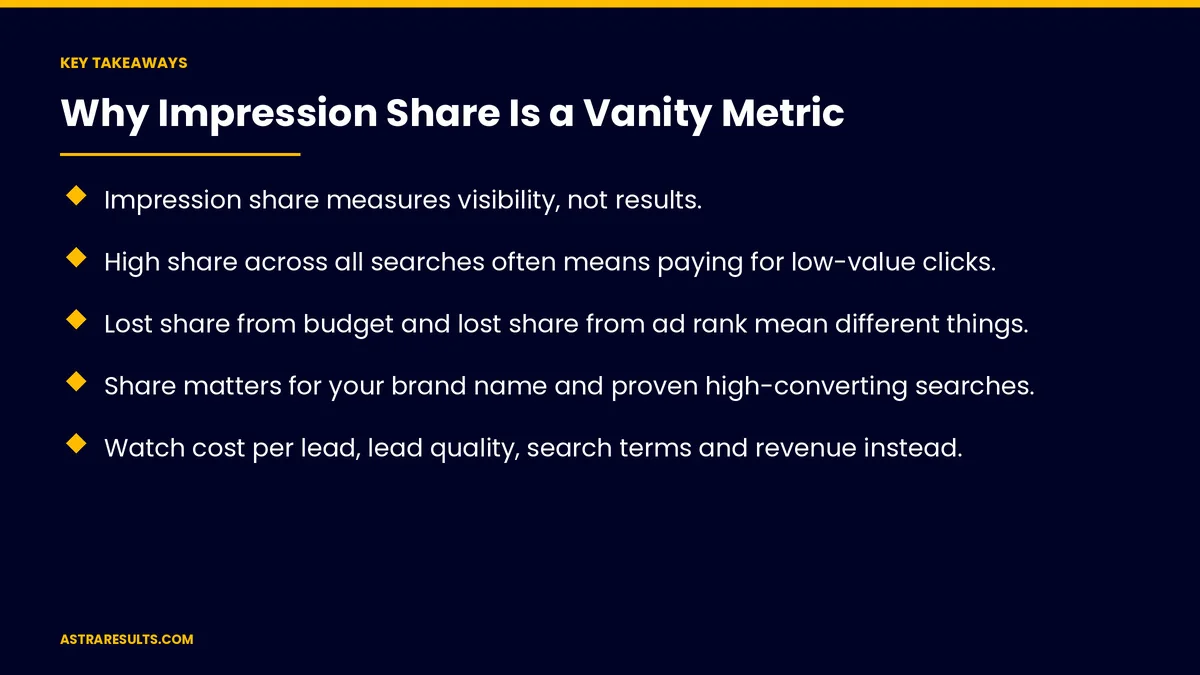
Key Takeaways
- Impression share measures visibility, not results.
- High share across all searches often means paying for low-value clicks.
- Lost share from budget and lost share from ad rank mean different things.
- Share matters for your brand name and proven high-converting searches.
- Watch cost per lead, lead quality, search terms and revenue instead.
- Report to owners in leads and revenue, not visibility.
Published: October 31, 2026 | Reading Time: ~8 minutes | Category: Pay-Per-Click Advertising
This guide covers impression share in paid search: what it measures, lost share from budget versus ad rank, why chasing it wastes money, when it does matter, what to watch instead, using search terms, bidding strategies and reporting to owners. Put plainly: chase leads and revenue, not visibility, and protect share only on searches that pay.
For the broader principle, see why impressions and rankings are not the goal.
In This Playbook
- What impression share measures
- Lost share: budget versus rank
- Why chasing it wastes money
- When it does matter
- What to watch instead
- Using search terms
- Bidding strategies
- Reporting to owners
- What to measure
- The first three months
What impression share measures
Appearances you got. Out of the times your ads were eligible to show.
Visibility only. Not clicks, leads or sales.
Easy to misread. A higher number isn't always better.
Lost share: budget versus rank
Lost to budget. Ads stopped because money ran out.
Lost to rank. Ads lost the auction on bid or quality.
Different fixes. More budget for one, better ads and pages for the other.
Why chasing it wastes money
Low-intent searches. Showing for people who won't buy.
Loose keyword matching. Ads triggered by loosely related searches.
Overpaying for the top. Higher positions cost more per click.
Budget spread thin. Less left for the searches that convert.
When it does matter
Your brand name. Protect it so competitors don't take those clicks.
Proven high-converting searches. Losing share there loses real leads.
Peak seasons. When demand spikes for your best services.
What to watch instead
Cost per lead. Calls, forms and bookings, tracked as in call tracking.
Lead quality. Leads that become customers, as in lead scoring.
Booked jobs and revenue. As in tracking LSA leads.
Lost share on profitable searches only. The share worth protecting.
The same trap in organic search. As in why your blog gets traffic and no leads.
Using search terms
Review what triggered ads. Real searches, weekly.
Add negative keywords. Block searches that never convert.
Move budget to winners. Searches with the best cost per lead.
Matching pages help. As covered in message match.
Bidding strategies
Share-based bidding can raise costs. It bids to appear, not to convert.
Conversion-based bidding. Targets leads or value, when tracking is solid.
The full playbook is in Google Ads for service businesses.
Reporting to owners
Leads, cost per lead and revenue first. Visibility second, if at all.
Plain language. As in monthly website reports.
Regional examples. As in Google Ads for Tampa Bay service companies.
What to measure
Cost per lead. By campaign and search term.
Lead-to-customer rate. From ads.
Revenue from ads. Compared with spend.
Brand impression share. The share worth protecting.
Wasted spend. Search terms that never convert.
The first three months
Month one: track what counts
Confirm call and form tracking, connect leads to outcomes and split lost share into budget and rank.
Month two: cut waste
Review search terms weekly, add negative keywords and move budget to searches with the best cost per lead.
Month three: report differently
Report leads, cost per lead and revenue first, and protect share only on brand and proven searches.
How Astra reports paid search
Astra Results Marketing runs paid search for leads and revenue, not visibility. We track every lead, cut wasted searches, protect share where it pays and report results in terms owners care about.
Engagements begin with an account review through our pay-per-click advertising team.
Related reading
Frequently asked questions
What is impression share?
How often your ads appeared out of all the times they were eligible to show.
Why is impression share a vanity metric?
Because it measures visibility, not leads or sales, and chasing it can pay for low-value clicks.
When does impression share matter?
For your brand name, proven high-converting searches and peak seasons for your best services.
What should we watch instead?
Cost per lead, lead quality, booked jobs, revenue and lost share on profitable searches only.
Should we use impression share bidding?
Rarely. It bids to appear, not to convert, and can raise costs.
What should we measure?
Cost per lead, lead-to-customer rate, revenue from ads, brand impression share and wasted spend.
Ready to stop paying for visibility that doesn't sell? Astra Results Marketing runs paid search for leads and revenue, cuts wasted searches and reports results owners care about. ▸ CALL (786) 321-2866 · ▸ REQUEST YOUR CONSULTATION





