Rated 5 star on


Why Impressions and Rankings Are Not the Goal
Quick answer
Impressions, rankings, followers, traffic and clicks are inputs: they can be bought, gamed, and reported without anything changing. Leads, appointments, customers, revenue and retention are outputs, and only a customer can produce one. Inputs are worth watching as diagnostics when an output falls, but a monthly report should lead with outputs.
Every month, thousands of business owners open a report that says impressions are up, rankings improved and followers grew. Every month, a meaningful share of those owners also notice that the bank balance did not move. Both things are true at once because the report is measuring inputs and the bank measures outputs.
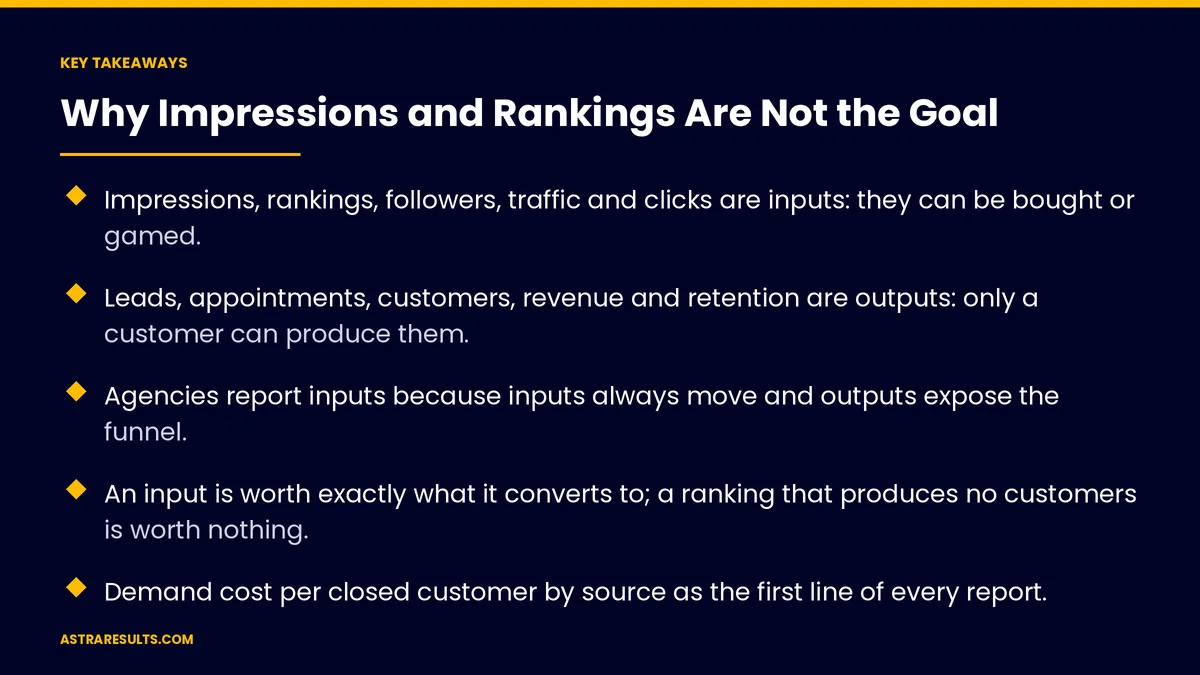
Key Takeaways
- Impressions, rankings, followers, traffic and clicks are inputs: they can be bought or gamed.
- Leads, appointments, customers, revenue and retention are outputs: only a customer can produce them.
- Agencies report inputs because inputs always move and outputs expose the funnel.
- An input is worth exactly what it converts to; a ranking that produces no customers is worth nothing.
- Demand cost per closed customer by source as the first line of every report.
- Keep inputs in an appendix as diagnostics, never as the headline.
Published: September 30, 2026 | Reading Time: ~11 minutes | Category: Measurement
This piece draws the line between the two, explains why the industry reports inputs so consistently, and lays out what an owner should demand instead. It is short on theory because the distinction is not complicated. It is just inconvenient. If you remember one thing: an input is something you can buy; an output is something a customer gives you.
Guidance for owners and operators. Nothing here is financial or legal advice.
In This Playbook
- Inputs and outputs
- Why the industry reports inputs
- What each input is actually worth
- The output chain
- The report to demand
- When inputs are the right thing to look at
- Vanity metrics, specifically
- What changes when outputs lead
- A three-month sequence
Inputs and outputs
The distinction is simple and it organizes everything else.
- Inputs are things the business or its vendors can make happen directly. Impressions, by spending. Rankings, by optimizing. Followers, by posting or paying. Traffic, by any of the above. Clicks, by bidding.
- Outputs are things only a customer can produce. A lead who gave a real name and number. An appointment kept. A payment made. A second purchase. A referral.
- The test. Could the business make this number go up tomorrow without a single customer doing anything? If yes, it is an input.
- Why the distinction matters. Inputs are necessary and not sufficient. A business needs impressions to get customers. It does not need impressions. It needs customers, explored in the four-stage engine.
Why the industry reports inputs
This is not a conspiracy. It is incentives.
- Inputs always move. Spend more and impressions rise. Optimize and rankings improve. A report full of inputs is a report full of good news, every month, regardless of whether the business grew.
- Outputs expose the funnel. Reporting customers by source shows exactly which channel is failing and where the intake leaks. That is uncomfortable for the vendor whose channel is failing and for the owner whose front desk is not answering.
- Inputs are the vendor's job. A PPC vendor controls clicks. It does not control whether the receptionist answers. So it reports clicks and treats what happens next as somebody else's problem, which in a split-vendor structure it is, explored in why one accountable team.
- Owners accept it. Because the report looks professional, the numbers are up, and questioning it requires knowing what to ask for.
What each input is actually worth
An input is worth exactly what it converts to, and nothing more.
- Impressions. Worth the customers they eventually produce, divided by the impressions it took. A million impressions that produced two customers cost whatever a million impressions cost, divided by two.
- Rankings. A first-page ranking for a term nobody searches, or that searchers with no intent to buy use, is worth nothing. A third-position ranking for a term that produces customers is worth a great deal. Position is not value; converted searches are.
- Followers. A follower who never buys, refers or reviews is a number. Ten thousand of them are a bigger number.
- Traffic. Visits are worth their conversion rate times customer value. Traffic that does not convert has a cost — hosting, attention, misleading reports — and no return.
- Clicks. A click is a purchase the business made. What it bought is a chance at a lead. The click's value is the lead's value times the probability the click became one.
The output chain
Outputs are not one number. They are a chain, and the chain shows where value leaks.
- Leads. Real contacts, by source. The first output, and the last one most reports show.
- Contacted. Leads a human or AI reached, and how fast. The speed number is where most businesses discover their largest problem, laid out in the intake standard.
- Appointments or quotes. Leads that turned into committed time.
- Customers. Appointments that became money.
- Retained. Customers who came back or stayed.
- The conversion rate between each link is the diagnostic. A business with plenty of leads and few customers has a conversion problem the impression report will never reveal.
The report to demand
- Line one: cost per closed customer by source. Total cost of a channel divided by the customers it produced, according to attribution by channel. This is the number that decides budget.
- Line two: conversion rate at each link of the chain, by source. So the leak is visible.
- Line three: speed to lead by hour of day. The intake metric.
- Line four: twelve-month customer value by cohort and source. So the "expensive" channel that produced customers who stayed gets credit.
- Line five: what changed, what will change next month, and why. A decision, not a description.
- Appendix: the inputs. Impressions, rankings, followers, traffic, clicks. Present, because they are useful diagnostics when an output moves. Never the headline.
When inputs are the right thing to look at
Inputs are not useless. They are diagnostic.
- When outputs move. Customers dropped this month. Did impressions drop, meaning demand fell? Did clicks hold but leads drop, meaning the landing page broke? Did leads hold but customers drop, meaning intake failed? Inputs answer the "why" behind an output change.
- Early in a channel's life. A new SEO effort will show ranking movement months before it shows customers. Rankings are a leading indicator during that period, as long as everyone agrees they are an indicator and not the goal.
- Awareness channels. Connected TV and brand video produce few first-contact leads and change branded search volume. That lift is an input worth watching, on its own terms.
- The rule. Inputs explain outputs. They do not replace them.
Vanity metrics, specifically
Some inputs are worse than useless because they actively mislead.
- Follower count. Almost uncorrelated with revenue for most businesses. Easily inflated. Reported constantly.
- Impression share. A measure of how ads showed relative to how often they could have. Useful for the platform. Nearly meaningless for the owner.
- Domain authority and similar scores. Third-party estimates of a site's strength, invented by tool vendors, not used by search engines. Fine as a rough diagnostic; harmful as a goal.
- Engagement rate. Likes and comments as a share of reach. Measures how entertaining the content was, not whether it sold anything.
- Total traffic. Without a conversion rate next to it, a number that can be doubled overnight by ranking for something irrelevant.
What changes when outputs lead
- Budget follows customers. Not clicks, not rankings.
- Intake gets fixed. Because the chain shows leads dying between "received" and "contacted."
- Vendors get compared on equal terms. On the same output, with the same definitions.
- Meetings get shorter. Twenty minutes on what moved revenue, ten on what did not, a decision. Not forty pages.
- The owner can read the report. Because it answers the only question they had: did this make money, and what do we do next?
A three-month sequence
Days 1–30: define the chain
Lead, contacted, appointment, customer, retained — written down with one meaning each. Source captured on every lead. The current report reorganized: outputs first, inputs in an appendix.
Days 31–60: compute the first outputs
Cost per closed customer by source, imperfectly. Conversion rate at each link. Speed to lead from the call log. The largest leak named.
Days 61–90: decide on outputs
The first budget decision made on cost per closed customer. The first vendor conversation held on outputs. The first month in which the report's line one is a number a customer produced.
How Astra reports
Astra Results Marketing reports outputs first: cost per closed customer by source, conversion at each link of the chain, speed to lead, and twelve-month value by cohort. Inputs sit in an appendix as diagnostics. The monthly review is a decision about next month's constraint, not a description of last month's impressions.
One team owns the whole chain, so there is no vendor whose job ends at the click. Engagements begin with a measurement audit through our business consulting team.
Related reading
Frequently asked questions
What is the difference between an input and an output?
An input is something the business or its vendors can make happen directly — impressions by spending, rankings by optimizing, followers by posting, clicks by bidding. An output is something only a customer can produce — a real lead, a kept appointment, a payment, a repeat purchase, a referral. The test: could this number go up tomorrow without a single customer doing anything? If yes, it is an input.
Why do agencies report impressions and rankings?
Because inputs always move — spend more and impressions rise — so a report full of inputs is full of good news every month. Outputs expose the funnel, showing which channel is failing and where intake leaks, which is uncomfortable for everyone. And in a split-vendor structure, the click is the vendor's job and what happens afterward is somebody else's, so the vendor reports clicks.
Are rankings worthless?
No. A ranking is worth exactly what it converts to. A first-page position for a term nobody searches, or that non-buyers use, is worth nothing; a third position for a term that produces customers is worth a great deal. Position is not value; converted searches are. Rankings are also a fair leading indicator early in an SEO effort, as long as everyone agrees they are an indicator and not the goal.
What should the first line of a marketing report be?
Cost per closed customer by source: the total cost of a channel divided by the customers it produced. It is the number that decides budget. Behind it: conversion rate at each link of the chain by source, speed to lead by hour of day, twelve-month customer value by cohort, and a decision about what changes next month. Inputs go in an appendix.
When are inputs the right thing to look at?
When an output moves and you need to know why: did impressions fall, did clicks hold but leads drop, did leads hold but customers drop? Early in a channel's life, when rankings move months before customers do. And for awareness channels like connected TV, where the honest measure is branded search lift rather than first-contact leads. Inputs explain outputs; they do not replace them.
Which metrics are actively misleading?
Follower count, nearly uncorrelated with revenue and easily inflated. Impression share, useful to the platform and meaningless to the owner. Domain authority and similar third-party scores, invented by tool vendors and not used by search engines. Engagement rate, which measures how entertaining content was, not whether it sold. And total traffic without a conversion rate beside it.
READY FOR A REPORT WHOSE FIRST LINE IS A NUMBER A CUSTOMER PRODUCED? Astra Results Marketing reports outputs first — cost per closed customer by source, conversion at each link, speed to lead — and keeps inputs where they belong, in the appendix. Astra Results Marketing · 1101 Brickell Ave, Miami, FL 33131 · +1 (786) 321-2866 · [email protected] Find us on Google · Yelp ▸ CALL (786) 321-2866 · ▸ REQUEST YOUR CONSULTATION