Rated 5 star on


Accounts Payable Automation for Growing Companies
Quick answer
Accounts payable automation reads invoices as they arrive, matches them against purchase orders and receipts, routes approvals to the right person, and schedules payment. It suits the work because invoices are high volume, rule-based and costly when wrong. Segregation of duties, approval limits and the audit trail must survive the change, and genuine exceptions still reach a person.
Accounts payable is where a growing company's administrative load becomes visible first. At twenty invoices a month a person handles it between other tasks. At two hundred it is a job. At six hundred it is a job plus overtime plus errors plus late payment fees plus a supplier relationship problem nobody noticed until a delivery stopped.
Key Takeaways
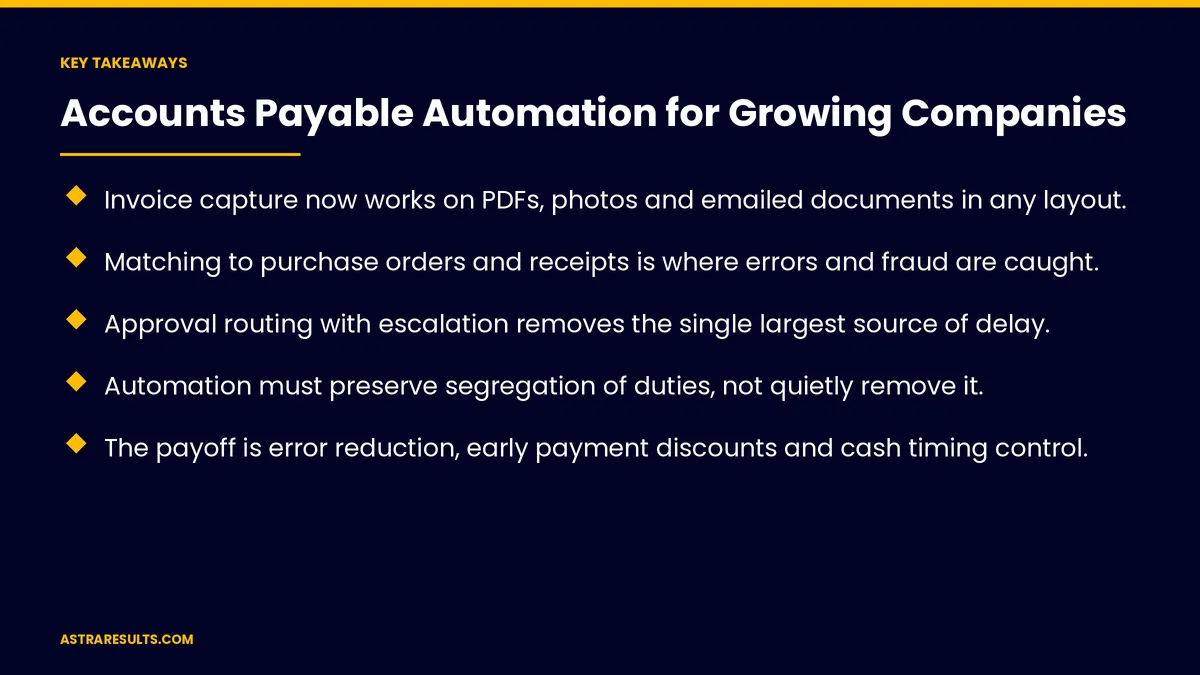
- Invoice capture now works on PDFs, photos and emailed documents in any layout.
- Matching to purchase orders and receipts is where errors and fraud are caught.
- Approval routing with escalation removes the single largest source of delay.
- Automation must preserve segregation of duties, not quietly remove it.
- The payoff is error reduction, early payment discounts and cash timing control.
- A person approves every payment; the software prepares, it does not pay.
Published: September 1, 2026 | Reading Time: ~12 minutes | Category: AI Automation
The work itself is almost entirely mechanical: read a document, check it matches what was ordered and received, get the right person to approve it, and schedule the payment. That combination — high volume, rule-based, costly when wrong — is what automation handles well. This piece covers how, and where a person must stay. Stated simply: nobody should be retyping an invoice in 2026.
Guidance for owners and operators. Nothing here is accounting, tax, legal or audit advice. Financial controls, segregation of duties, record retention and payment authorization requirements should be designed with the business's accountant and reviewed with counsel.
In This Playbook
- The four steps and where each breaks
- Capture: reading documents as they arrive
- Matching: where errors and fraud are caught
- Approval routing: the delay that costs money
- Controls that must survive automation
- What it returns
- When it is worth it
- The first 90 days
The four steps and where each breaks
- Capture. Getting the invoice into a system as structured data. Breaks when it arrives as a photo, a PDF attachment in a personal inbox, or a paper document handed to a technician.
- Match. Confirming the invoice corresponds to what was ordered and what was received, at the right price and quantity. Breaks when nobody has time to check, so invoices are paid on trust.
- Approve. Getting the right person to authorize it. Breaks by sitting in an inbox for a week while the discount window closes.
- Pay. Scheduling and executing payment. Breaks through late payments, duplicate payments and missed discounts.
- The pattern. Every step is rule-based with describable exceptions, which is the profile of work automation handles, as set out in what qualifies for automation.
Capture: reading documents as they arrive
- What changed. Extraction used to need a fixed template per supplier. Modern systems read varied layouts, including photographs of crumpled paper from a job site.
- What gets extracted. Supplier, invoice number, date, purchase order reference, line items, quantities, unit prices, tax, total and payment terms.
- Where it still struggles. Handwriting, poor photographs, and invoices where critical detail sits in a free-text note rather than a field.
- The confidence rule. Fields the system is unsure about are flagged for a person rather than guessed, and the threshold is set per supplier as trust accumulates, as covered in accuracy that is good enough.
- The intake channels. A dedicated email address, a supplier portal, and a mobile capture path for documents handed to field staff — all landing in one queue.
- The duplicate check. Same supplier, same invoice number, same amount — caught at capture, which is where duplicate payments are prevented rather than discovered.
Matching: where errors and fraud are caught
- Two-way matching. Invoice against purchase order. Does the price and quantity match what was agreed?
- Three-way matching. Invoice against purchase order against receipt. Did the goods or services arrive?
- Why it matters beyond arithmetic. Most payment fraud and most supplier overbilling is caught here, or not at all. A business paying on trust because nobody has time to match is carrying a risk it has not priced.
- Tolerances. Small variances within a defined threshold pass automatically; anything beyond goes to a person. The threshold is a business decision made with the accountant.
- What automation adds. The matching happens on every invoice rather than on a sample, and the exceptions surface immediately rather than at month end.
- The supplier master problem. Matching depends on clean supplier records. Duplicate supplier entries with slightly different names are a common cause of failed matching and duplicate payment, as explored in one identity per record.
Approval routing: the delay that costs money
- The usual state. Invoices emailed to a manager who is travelling, buried in an inbox, and surfaced when the supplier calls.
- What routing does. Sends the invoice to the right approver based on amount, department, project or supplier, with the matched documents attached so the decision takes a minute.
- Escalation. A defined wait, then a reminder, then escalation to a named alternate. Nothing sits indefinitely.
- Delegation. Approvers going on leave set a delegate, so the chain does not break for two weeks in August.
- The record. Who approved what, when, and on what basis — which is what an auditor asks for and what resolves a dispute.
- The measurable effect. Approval time is usually the largest component of invoice cycle time, and it is the one automation reduces most reliably, as detailed in approvals that route themselves.
Controls that must survive automation
This is the section to read with the accountant.
- Segregation of duties. The person who creates a supplier should not be the person who approves payment to it. Automation can preserve this or quietly destroy it, depending on how permissions are configured.
- Payment authorization stays human. The system prepares payment batches; a person with authority releases them. Automated payment without human release is a category of risk most businesses should not accept.
- Supplier bank detail changes. The highest-risk event in accounts payable. Any change to bank details should require verification through a channel other than the one that requested it, and this control should be strengthened by automation rather than bypassed by it.
- Audit trail. Every action logged with who, when and what changed — which automation does better than paper, provided the log is retained.
- Retention. Document and record retention periods are set by regulation and the business's accountant, not by software defaults.
- The review. Controls designed with the accountant before configuration, not adjusted afterward to fit what the software does easily.
What it returns
- Error reduction. Duplicate payments, wrong amounts and payments to the wrong supplier fall when matching happens on every invoice.
- Early payment discounts. Terms offering a discount for early settlement are frequently missed because approval took too long. Capturing them is often the clearest financial return.
- Late fee elimination. The reverse case.
- Cash timing. Visibility of what is due when, which allows deliberate payment timing rather than paying whatever surfaces.
- Staff capacity. The same team handles growth without adding headcount, which in a growing company is the point.
- Supplier relationships. Suppliers paid predictably give better terms and better service, which is a commercial benefit that rarely appears in the business case.
When it is worth it
- Volume. Below roughly a hundred invoices a month the case is weak unless errors are already costly. Above two hundred it is usually clear.
- Complexity. Many suppliers, multiple approvers, project-based coding or multiple entities strengthen the case at lower volume.
- Growth trajectory. A business doubling in eighteen months should build before the pain, not after.
- Current pain. Late fees, missed discounts, duplicate payments, a month-end scramble or an accountant charging for cleanup are all direct evidence.
- When to wait. A business with no purchase order process has nothing to match against, and creating that discipline is the first project.
The first 90 days
Days 1–30: measure and design
Invoice volume, cycle time from receipt to payment, late fees, missed discounts and duplicate payments over the last year. Controls and segregation of duties designed with the accountant. Supplier master cleaned of duplicates.
Days 31–60: capture and match
Capture running from a single intake address with confidence thresholds. Two-way or three-way matching configured with agreed tolerances. Run in parallel with the manual process, with every exception reviewed.
Days 61–90: approve and measure
Approval routing live with escalation and delegation. Payment preparation automated, release still human. Cycle time, exception rate and captured discounts compared to the baseline.
How Astra handles it
Astra Results Marketing designs the controls with the business's accountant before configuring anything, because automation that quietly removes segregation of duties has traded a real risk for a small convenience. Payment release stays with a person, and supplier bank detail changes are treated as the highest-risk event in the process.
Capture, matching and approval are built in that order and run alongside the manual process until the exception rate is understood. The business case is measured on captured discounts, eliminated late fees, duplicate payments prevented and cycle time, against a baseline recorded before anything changes. Engagements begin with an AP process review through our business consulting team.
Related reading
Frequently asked questions
What are the four steps of accounts payable and where do they break?
Capture breaks when invoices arrive as photos, personal-inbox attachments or paper handed to a technician. Matching breaks when nobody has time to check, so invoices get paid on trust. Approval breaks by sitting in an inbox while a discount window closes. Payment breaks through late payments, duplicates and missed discounts. All four are rule-based with describable exceptions.
How well does invoice capture work now?
Well enough for varied layouts including photographs of crumpled paper, extracting supplier, invoice number, dates, purchase order reference, line items, quantities, prices, tax and terms. It still struggles with handwriting, poor photographs and detail buried in free-text notes. Fields the system is unsure of are flagged for a person rather than guessed, with the threshold set per supplier as trust accumulates.
Why does invoice matching matter beyond arithmetic?
Because most payment fraud and most supplier overbilling is caught at matching or not at all, and a business paying on trust because nobody has time is carrying an unpriced risk. Two-way matching checks the invoice against the purchase order; three-way adds the receipt, confirming goods arrived. Automation matches every invoice rather than a sample, surfacing exceptions immediately.
What controls must survive automation?
Segregation of duties, which automation can preserve or quietly destroy depending on permissions. Human payment release, since the system should prepare batches and a person with authority should release them. Verification of supplier bank detail changes through a different channel than the one requesting them — the highest-risk event in AP. Plus a retained audit trail and retention periods set by regulation and the accountant.
What is the clearest financial return?
Usually early payment discounts, which are frequently missed because approval took too long, together with eliminated late fees. Behind those: fewer duplicate and incorrect payments, deliberate cash timing rather than paying whatever surfaces, staff capacity to absorb growth without hiring, and better supplier terms from being paid predictably.
At what volume is it worth doing?
Below roughly a hundred invoices a month the case is weak unless errors are already costly; above two hundred it is clear. Many suppliers, multiple approvers, project coding or multiple entities strengthen the case at lower volume, and a business doubling within eighteen months should build before the pain. A business with no purchase order process has nothing to match against, and creating that discipline comes first.
READY TO STOP RETYPING INVOICES? Astra Results Marketing designs the controls with your accountant first, keeps payment release with a person, and measures the case on captured discounts, prevented duplicates and cycle time. Astra Results Marketing · 1101 Brickell Ave, Miami, FL 33131 · +1 (786) 321-2866 · [email protected] Find us on Google · Yelp ▸ CALL (786) 321-2866 · ▸ REQUEST YOUR CONSULTATION