Rated 5 star on

Data Engineering: The Foundation Every AI Project Needs
Quick answer
Most businesses do not need a data warehouse. They need systems that agree on who a customer is, outcomes recorded rather than remembered, definitions everyone uses the same way, and connections between the tools that already hold the data. That work is usually the real first AI project, because every AI project is a data project underneath.
Ask an owner where their data is and the direct answer is a list: the CRM, the accounting system, the scheduling tool, two spreadsheets, an inbox, and whatever the operations manager keeps in her head. Each system is fine. None agree on what a customer is, and no question spanning two of them gets answered without a person.
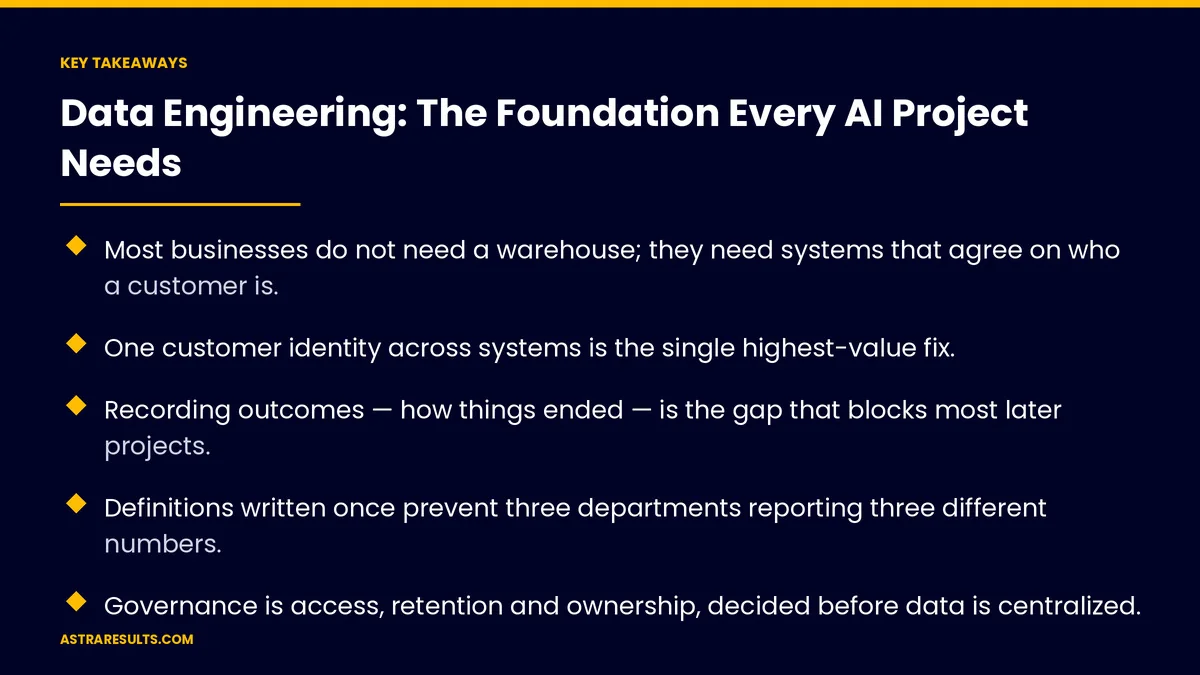
Key Takeaways
- Most businesses do not need a warehouse; they need systems that agree on who a customer is.
- One customer identity across systems is the single highest-value fix.
- Recording outcomes — how things ended — is the gap that blocks most later projects.
- Definitions written once prevent three departments reporting three different numbers.
- Governance is access, retention and ownership, decided before data is centralized.
- Build the smallest connection that answers a real question, then the next one.
Published: September 12, 2026 | Reading Time: ~13 minutes | Category: Data Engineering
Data engineering is the unglamorous work of fixing that. It is also, for most businesses, the actual first AI project — the one that has to happen before forecasting, scoring or automation can work at all. This guide covers what it involves, what is genuinely needed versus oversold, and how to sequence it. Reduced to a sentence: every AI project is a data project wearing a more exciting name.
Guidance for owners and operators. Nothing here is legal or technical advice. Storing, moving and processing personal, financial or health data is governed by privacy and sector rules that vary by jurisdiction and must be reviewed with counsel.
In This Playbook
- The state most businesses are in
- What you actually need, and what is oversold
- Job one: how is one customer identity built?
- Job two: why must outcomes be recorded?
- Job three: definitions everyone uses
- Job four: connecting the systems
- Job five: governance
- What it costs
- How to sequence it
- Signs it is working
- The first three months
- Astra's part in it
The state most businesses are in
- Systems that do not know about each other. The CRM has contacts, the accounting system has invoices, and nothing links a customer to what they paid.
- Multiple versions of a customer. The same person as three records with different spellings, plus a fourth in a spreadsheet.
- Outcomes nowhere. The business knows a lead came in. It does not record, in any system, whether that lead became a customer.
- Reports that disagree. Sales reports one number, finance another, marketing a third, all technically correct under different definitions.
- A person who is the integration. Someone exports, reconciles and rekeys, and the business runs on their spreadsheet.
- Why it matters now. Every AI capability — forecasting, scoring, churn, automation, retrieval — needs data that connects, examined in the readiness conditions.
What you actually need, and what is oversold
- Oversold for most businesses. A data warehouse. A data lake. A data science team. An enterprise platform with a six-figure implementation. These are real tools for real problems that most companies under $50M do not yet have.
- What is needed first. One identity per customer across systems. Outcomes recorded. Shared definitions. A place where the joined data can be queried. That is often a well-configured CRM plus one or two connections.
- When a warehouse helps. Several systems with meaningful volume, analysis that spans all of them, multiple people needing the same numbers, and data volumes a spreadsheet cannot hold. That threshold arrives later than vendors suggest.
- A quick test. Write down the five questions the business cannot answer today. Build the smallest thing that answers them. That is the scope.
Job one: how is one customer identity built?
The highest-value fix, and the one most often skipped.
- The problem. The CRM says Maria Gonzalez, the invoice says M. Gonzalez, the scheduling tool says the company name, and the review is under a personal email. Four records, one customer.
- The fix. A shared identifier — an internal customer ID — carried into every system, plus matching rules for records created before it existed.
- Deduplication. Merging the existing duplicates, which is tedious and is done once properly rather than repeatedly badly.
- Discipline going forward. New records created in one place and propagated, not created independently in three systems.
- What it unlocks. Every cross-system question: what this customer is worth, what they bought, whether they churned, which channel produced them, which is the subject of attribution by channel.
Job two: why must outcomes be recorded?
The gap that blocks more AI projects than any technical limitation.
- What is missing. Which leads closed and which did not, and why. Which customers left and when. Which quotes were accepted. Which forecast was right. Which job ran over.
- Why it is missing. Systems record what happened, not how it ended. A lead is created; nobody goes back to mark it lost.
- The fix. A required outcome field at each stage, with a short closed list of reasons. Updated by the people who know, the same day.
- The wait. A business that starts recording outcomes today has a usable history in six to twelve months. That is not a reason to delay; it is a reason to start now, laid out in what models learn from.
- The immediate return. Lost-reason analysis is useful on its own, long before any model exists.
Job three: definitions everyone uses
- The symptom. Three departments reporting three different revenue numbers, all defensible.
- The cause. No written definition of a lead, a qualified lead, a customer, revenue recognized, an active account or a churned one.
- The fix. One page. Each term, its definition, and the system of record for it. Signed off by the people who report on it.
- The enforcement. Reports built from the defined fields. Anything reported differently is reconciled or corrected, not argued about monthly.
- The side effect. Writing definitions surfaces disagreements that were costing money invisibly — two teams counting the same deal, or neither counting it.
Job four: connecting the systems
- The simplest version. Native integrations between tools that already speak to each other. Free or cheap, and sufficient more than expected.
- The middle version. An integration platform that moves records between systems on a schedule or on an event, with mapping and error handling.
- The heavier version. A central store where copies of each system's data land, are cleaned and joined, and can be queried together. This is the warehouse, and it is the right answer once the simpler versions stop scaling.
- The constraint nobody plans for. Old systems without interfaces. Connecting them is a project of its own, and sometimes the real answer is to replace them or to accept a manual export on a schedule.
- The working rule. Build the connection that answers a real question. Not the architecture diagram.
Job five: governance
Decided before data is centralized, because centralizing data concentrates risk.
- Access. Who can see what. Joining systems can expose salary data to people who could not see it before, purely as a side effect.
- Retention. How long each category is kept, and what is deleted. Keeping everything forever is a choice with legal consequences.
- Ownership. Which system is authoritative for each field, so conflicts resolve deterministically.
- Quality. Who is responsible when a field is wrong, and how it gets fixed at source rather than patched downstream.
- Privacy and consent. What was collected, on what basis, and what the business promised. Counsel maps the rules before data moves, according to confidentiality decided before deployment.
What it costs
- Tooling. Modest at the start. Native integrations and an integration platform cost less than most businesses expect. Warehouses cost more and arrive later.
- The real cost is the work. Deduplication, definitions, backfilling outcomes, mapping fields, and the discipline change in how records are created.
- The ongoing cost. Someone owns data quality. Not a full-time role in most companies, but a named responsibility with time attached.
- The comparison. Against the hours currently spent reconciling, rekeying and arguing about numbers, plus the cost of decisions made on wrong data.
- The sequencing benefit. Every later AI project gets cheaper and faster because the foundation exists.
How to sequence it
- Start with one question. The most valuable question the business cannot answer today. Often: what is a customer worth by acquisition channel?
- Connect only what that question needs. Two systems, one identifier, one outcome field.
- Answer it. Imperfectly. Then use the answer.
- Take the next question. Each one adds a connection or a field, and the foundation accumulates without a grand project.
- Resist the platform first. Businesses that start by buying a platform spend a year implementing and never answer question one.
Signs it is working
- Cross-system questions get answered in minutes, not by a person exporting.
- Reports reconcile without a meeting.
- The spreadsheet in the middle disappears, and with it the key-person risk.
- New tools connect easily, because the identity and definitions already exist.
- AI projects start faster, because the data question is already answered.
The first three months
Days 1–30: audit and define
Every system inventoried with what it holds and who owns it. The five questions the business cannot answer, written down. Definitions drafted for the terms in those questions. Governance decided: access, retention, authority, privacy with counsel.
Days 31–60: identity and outcomes
The customer identifier chosen and propagated. Duplicates merged. Outcome fields added at each stage with closed reason lists. The teams trained on same-day updating.
Days 61–90: connect and answer
The two or three systems needed for question one connected. The question answered and used in a decision. The data-quality owner named. The next question queued.
Astra's part in it
Astra Results Marketing starts with the questions the business cannot answer and builds the smallest connection that answers them, rather than selling a platform first. Customer identity and outcome recording come before anything else, because they unlock the most and cost the least.
Governance — access, retention, authority and privacy with counsel — is decided before data is centralized, since joining systems concentrates risk. Because the same team runs the marketing, intake and AI systems that both feed and consume this data, the foundation is built for what will be asked of it. Engagements begin with a data audit through our business consulting team.
Related reading
Frequently asked questions
Does a business need a data warehouse?
Most companies under $50M do not, yet. What they need first is one identity per customer across systems, outcomes recorded, shared definitions, and somewhere the joined data can be queried — often a well-configured CRM plus one or two connections. A warehouse helps when several systems carry real volume, analysis spans all of them, and multiple people need the same numbers.
What is the highest-value fix?
One customer identity across every system. The CRM says Maria Gonzalez, the invoice says M. Gonzalez, the scheduling tool says the company name and the review is under a personal email — four records, one customer. A shared internal ID carried everywhere, plus a one-time deduplication, unlocks every cross-system question: what a customer is worth, what they bought, whether they churned, which channel produced them.
Why does recording outcomes matter so much?
Because systems record what happened, not how it ended. A lead is created and nobody goes back to mark it lost, so the business cannot learn which leads close or which customers leave. The fix is a required outcome field at each stage with a short closed list of reasons, updated the same day. Lost-reason analysis is useful immediately, long before any model exists.
Why write definitions down?
Because three departments reporting three different revenue numbers, all defensible, is the normal state without them. One page with each term, its definition and its system of record, signed off by the people who report on it, ends that. Writing them also surfaces disagreements that were costing money invisibly — two teams counting the same deal, or neither counting it.
What governance decisions come first?
Access, because joining systems can expose salary data to people who could not see it before, purely as a side effect. Retention, because keeping everything forever is a choice with legal consequences. Authority, so conflicts between systems resolve deterministically. Quality ownership, so wrong fields get fixed at source. And privacy and consent, mapped with counsel before data moves.
How should the work be sequenced?
Start with the most valuable question the business cannot answer today, connect only what that question needs, answer it imperfectly, and use the answer. Each subsequent question adds a connection or a field, and the foundation accumulates without a grand project. Businesses that start by buying a platform spend a year implementing and never answer question one.
READY TO MAKE YOUR SYSTEMS AGREE ON WHO A CUSTOMER IS? Astra Results Marketing starts with the questions you cannot answer, fixes customer identity and outcome recording first, decides governance before centralizing, and builds only the connections those questions need. Astra Results Marketing · 1101 Brickell Ave, Miami, FL 33131 · +1 (786) 321-2866 · [email protected] Find us on Google · Yelp ▸ CALL (786) 321-2866 · ▸ REQUEST YOUR CONSULTATION