Rated 5 star on

Automation in Fort Lauderdale's Service Economy
Quick answer
Fort Lauderdale's service economy swings seasonally, runs on crews who are never at a desk, and carries documentation loads that often exceed the labour. That shape makes capacity the constraint, and automation adds capacity without hiring for a peak you then carry through the summer. Start with the quote-to-invoice cycle, where the most money leaks.
Fort Lauderdale runs on service businesses with a particular shape: seasonal demand that triples between summer and season, a workforce that is rarely at a desk, permits and inspections that gate the work, and a customer base that is half local and half arriving by boat or plane. The paperwork around the work is frequently larger than the work.
Key Takeaways
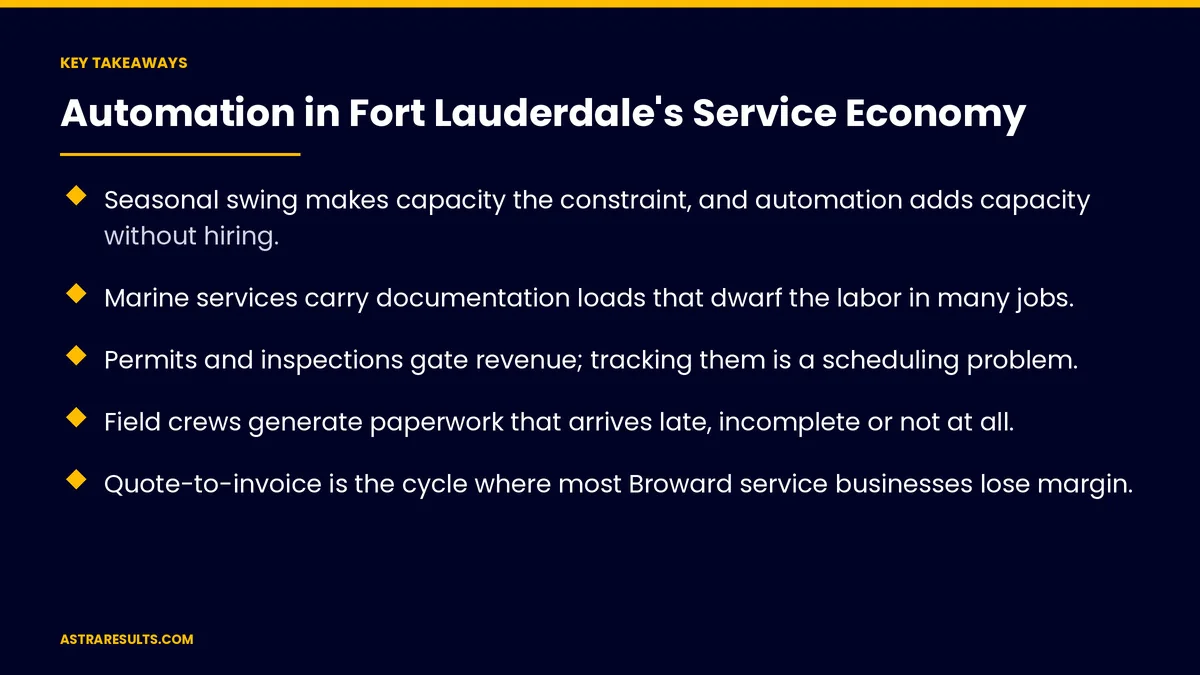
- Seasonal swing makes capacity the constraint, and automation adds capacity without hiring.
- Marine services carry documentation loads that dwarf the labor in many jobs.
- Permits and inspections gate revenue; tracking them is a scheduling problem.
- Field crews generate paperwork that arrives late, incomplete or not at all.
- Quote-to-invoice is the cycle where most Broward service businesses lose margin.
- Start with the process that fails in season, not the one that annoys you in July.
Published: September 6, 2026 | Reading Time: ~12 minutes | Category: AI Automation
That shape determines where automation pays here, and it is not where the generic advice points. This piece covers the specific bottlenecks in Broward's dominant service categories, why seasonal swing changes the case for automation, and what to do first. Put plainly: in a seasonal service economy, automation buys capacity you do not have to hire.
Guidance for owners and operators. Nothing here is legal advice. Permitting, licensing, marine regulations, employment and privacy requirements vary by jurisdiction and activity and should be reviewed with counsel and the relevant authorities.
In This Playbook
- What makes this market different
- Marine services: the documentation problem
- Hospitality and short-term rental operations
- Trades and construction services
- Property management and associations
- Which cycle leaks the most, quote to invoice?
- Seasonality changes the business case
- Where to start
- Three months, step by step
What makes this market different
- Seasonal amplitude. Demand that multiplies in season and falls away after, which makes fixed staffing either expensive in summer or inadequate in February.
- A workforce away from desks. Technicians, captains, crews and installers who generate information at the job and deliver it hours or days later.
- Permitting and inspection. Work that cannot start or cannot be billed until something is approved, with the tracking of that approval falling to whoever remembers.
- Transient customers. Owners who are elsewhere much of the year, communicating by message across time zones, approving work remotely.
- Thin administrative staffing. Businesses that added technicians as they grew but not the office capacity to match, so the owner or one coordinator holds everything.
- The implication. The constraint is administrative capacity in season, not demand, which changes what automation should target, as detailed in finding the binding constraint.
Marine services: the documentation problem
- The category. Yacht maintenance and repair, detailing, provisioning, delivery, brokerage support, dockage coordination, marine trades of every kind.
- Where the time goes. Not the work. The estimate, the owner or captain approval, the parts sourcing, the haul-out scheduling, the progress updates to an owner in another country, the photo documentation, the invoice with itemized labor and parts, and the warranty record.
- What automation addresses. Job records assembled from field photos and notes. Approval requests routed to the right person and chased. Progress updates generated from job status rather than composed by hand. Invoices drafted from the job record instead of rebuilt in accounting.
- The approval bottleneck specifically. Work stops while waiting for an owner or captain to say yes. An automated approval flow with escalation and a clear record of what was approved and when removes days from the cycle, as covered in approvals that route themselves.
- What stays human. The survey, the diagnosis, the judgment about whether a repair is worth doing, and the relationship with the captain.
Hospitality and short-term rental operations
- The category. Property management for vacation rentals, hotel services, cleaning and turnover, guest services, event and charter operations.
- The pattern. High-frequency, low-value transactions with tight timing. A turnover that is two hours late costs a booking.
- Where automation fits. Turnover scheduling triggered by checkout, with confirmation and exception handling. Guest messages answered instantly in the guest's language. Maintenance requests classified, routed and tracked to completion. Supplier reordering triggered by consumption.
- The bilingual dimension. Guests and staff operate in different languages, and instant multilingual response is a service improvement and a staffing saving at once, as explored in Spanish as a channel.
- The seasonal case. A system that handles turnover coordination at February volume without additional hires is what makes the season profitable rather than exhausting.
Trades and construction services
- The category. Marine contractors, pool, HVAC, electrical, roofing, remodeling, landscape — the businesses that keep Broward's building stock running.
- The permit problem. Applications submitted, corrections requested, inspections scheduled, approvals received. Each with a date, a dependency and a consequence for the schedule, and typically tracked in one person's head and a folder.
- What automation does here. Records permit status against the job, prompts the next action when a date passes, and alerts when an inspection window opens or a correction has gone unanswered. The system does not interact with the authority; it prevents the business from losing track of its own obligations.
- The field paperwork problem. Work orders, checklists, photos, signatures and materials used, captured at the job rather than reconstructed at 7pm, as detailed in field apps that survive.
- Change orders. The single largest margin leak in trades: work performed without written approval. An automated change order with a signature requirement before the work proceeds protects the margin and the relationship.
Property management and associations
- The category. Condominium and homeowner association management, commercial property, residential portfolios.
- The volume problem. Hundreds of small requests, each trivial and each requiring routing, tracking and closure.
- What automation handles. Request intake classified by type and urgency, routed to the right vendor, tracked to completion, with the resident informed at each step without anyone composing a message.
- The compliance dimension. Records of what was requested, when, what was done and by whom — which matters in disputes and in regulated association contexts, with requirements varying and best confirmed with counsel.
- Vendor coordination. Work orders issued, accepted, completed and invoiced, with the status visible rather than assembled by phone.
- The board reporting cycle. Monthly reporting assembled from the record rather than compiled the week before the meeting.
Which cycle leaks the most, quote to invoice?
Across all these categories, the same sequence loses the most money.
- Quote sent, no follow-up. A meaningful share of quotes receive one follow-up or none, and the second through fourth close a disproportionate share.
- Approval unrecorded. Work proceeds on a verbal yes, and the dispute at invoicing has no record to resolve it.
- Work completed, not documented. Photos on a phone, materials on a note, hours in memory.
- Invoice delayed. Days or weeks between completion and billing, which is a cash flow cost and a dispute risk as memories fade.
- Payment unchased. Ageing invoices that nobody follows because everyone is busy.
- What automation does to it. Each stage triggers the next, chases when it stalls, and builds the record as it goes — which is the full-cycle version of the approvals and handoffs case, as set out in where work stalls.
Seasonality changes the business case
- The usual automation case. Hours saved multiplied by a wage rate.
- The seasonal case. Capacity added at peak without hiring for a peak that lasts four months.
- Why that is a stronger argument here. A Broward service business staffing for season carries that cost year-round or scrambles to hire temporary help of variable quality. Automation is capacity that does not need onboarding.
- The timing of the project. Build in the off season, prove it in the shoulder, rely on it in season. Starting an automation project in January is starting it at the worst possible time.
- The metric. Jobs completed per administrative hour, compared season over season rather than month over month.
Where to start
- The process that fails in season. Not the one that irritates the owner in July — the one that breaks when volume triples.
- Usually one of three. Quote follow-up and approval, field documentation capture, or scheduling and dispatch coordination.
- Measured before. Cycle time from quote to invoice, and how many quotes get a second follow-up, recorded before anything changes.
- Built small. One workflow, one team, reversible, running alongside the current process until it earns trust, as covered in readiness before automation.
- Then the next. Each addition is cheaper because the connections exist.
Three months, step by step
Days 1–30: measure the season
The processes that broke last season listed by the people who lived them. Quote-to-invoice cycle time and follow-up rates measured. The systems holding job, customer and financial data identified. Privacy and record-keeping requirements confirmed with counsel.
Days 31–60: build one flow
The highest-impact workflow — usually quote follow-up with approval capture — automated with routing, chasing and record building. Run in parallel, reviewed weekly.
Days 61–90: prove and extend
Cycle time and follow-up rates compared to the baseline. Field documentation capture added if that was the second bottleneck. The season's capacity plan revised on the evidence.
How Astra handles it
Astra Results Marketing scopes automation around the seasonal peak rather than the annual average, because in Broward the constraint is administrative capacity in season and a project that helps in July but fails in February has solved the wrong problem.
The starting workflow is chosen from what broke last season according to the people who lived it, measured before anything changes, and built to run in parallel until it earns trust. Permitting and compliance record-keeping requirements go to counsel before any system touches them. Engagements begin with a seasonal process review through our business consulting team.
Related reading
Frequently asked questions
Why is automation's case different in a seasonal service economy?
Because the usual case is hours saved times a wage rate, while here it is capacity added at peak without hiring for a four-month peak. A business staffing for season carries that cost year-round or scrambles for temporary help of variable quality. Automation is capacity that needs no onboarding — and the project should be built in the off season, proven in the shoulder and relied on in season.
What is the bottleneck in marine services?
Documentation, not labor. The estimate, the owner or captain approval, parts sourcing, haul-out scheduling, progress updates to an owner in another country, photo documentation, the itemized invoice and the warranty record. The approval step is the sharpest: work stops while waiting for a yes, and an automated approval flow with escalation and a clear record removes days from the cycle.
How does automation help with permits and inspections?
By recording permit status against the job, prompting the next action when a date passes, and alerting when an inspection window opens or a correction has gone unanswered. The system does not interact with the authority — it prevents the business from losing track of its own obligations, which currently live in one person's head and a folder.
What is the largest margin leak in trades?
Work performed without written approval. A change order captured with a signature requirement before the work proceeds protects both the margin and the relationship, because the dispute at invoicing otherwise has no record to resolve it. The related leak is work completed but undocumented — photos on a phone, materials on a note, hours in memory.
Which cycle should a service business automate first?
Quote to invoice, because the same sequence leaks across every category here: quotes with one follow-up or none, approvals given verbally and unrecorded, work completed but undocumented, invoices delayed for days, and payments unchased. Each stage should trigger the next, chase when it stalls, and build the record as it goes.
How is the starting point chosen?
By identifying the process that fails in season rather than the one that irritates the owner in July — usually quote follow-up and approval, field documentation capture, or dispatch coordination. Measure cycle time and follow-up rates before anything changes, build one workflow for one team, keep it reversible, and run it alongside the current process until it earns trust.
READY FOR CAPACITY YOU DO NOT HAVE TO HIRE? Astra Results Marketing scopes automation around the seasonal peak, starts with the process that broke last season, measures before anything changes, and builds in the off season so it is ready when volume triples. Astra Results Marketing · 1101 Brickell Ave, Miami, FL 33131 · +1 (786) 321-2866 · [email protected] Find us on Google · Yelp ▸ CALL (786) 321-2866 · ▸ REQUEST YOUR CONSULTATION