Rated 5 star on


Nearshore Automation Teams From Miami
Quick answer
Overlapping working hours remove the overnight rework cycle, which is the main hidden cost of distance: a question asked at ten is answered at ten rather than tomorrow. Bilingual delivery matters when the product or its users operate in two languages. The time zone is the feature, and everything else still has to be good.
Miami sits in a useful position for building software and automation: the same working hours as most of the United States, an hour or two from most of Latin America, and a workforce where bilingual is the default rather than a hiring requirement. For companies burned by the overnight offshore cycle, that combination is the argument.
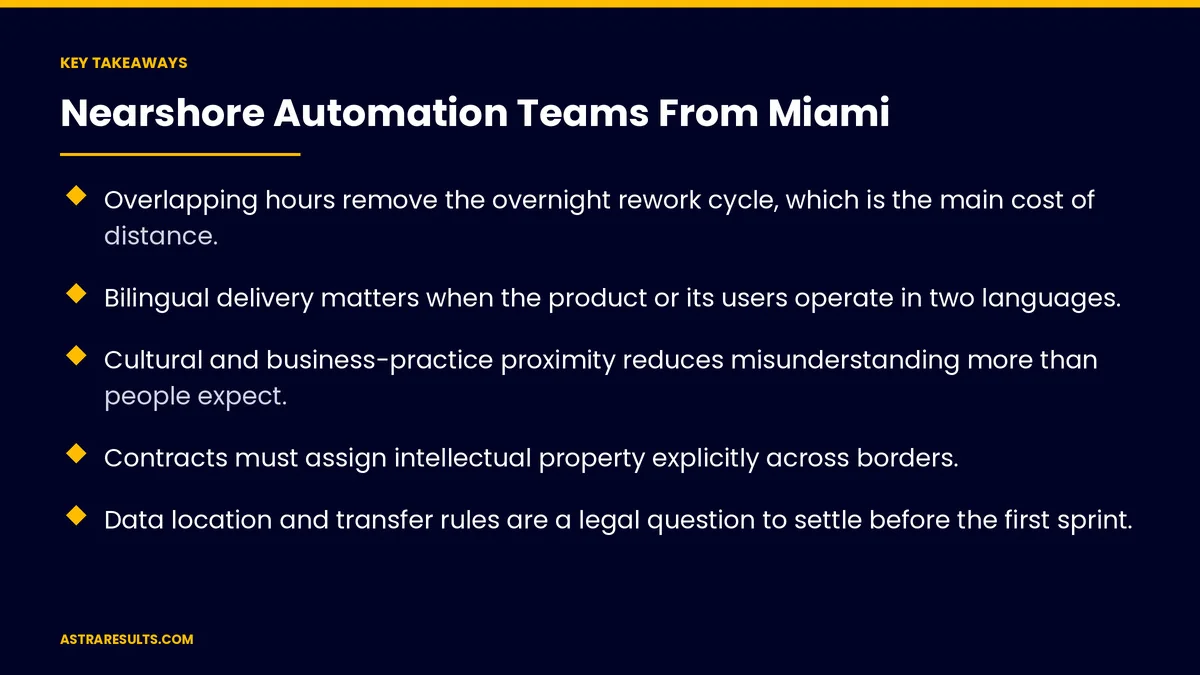
Key Takeaways
- Overlapping hours remove the overnight rework cycle, which is the main cost of distance.
- Bilingual delivery matters when the product or its users operate in two languages.
- Cultural and business-practice proximity reduces misunderstanding more than people expect.
- Contracts must assign intellectual property explicitly across borders.
- Data location and transfer rules are a legal question to settle before the first sprint.
- Handover documentation is what turns a vendor relationship into a transferable asset.
Published: September 19, 2026 | Reading Time: ~12 minutes | Category: Nearshore
It is also an argument that gets oversold. This piece covers what nearshore changes, what it does not, and the contract, data and handover questions that determine whether the arrangement is an asset or a dependency. Put plainly: the time zone is the feature; everything else still has to be good.
Guidance for owners and operators. Nothing here is legal, tax or employment advice. Cross-border contracting, worker classification, data transfer, intellectual property assignment and tax treatment vary by jurisdiction and require qualified counsel.
In This Playbook
- What the time zone buys
- Language, and when it is decisive
- Business practice proximity
- The contract questions
- Data: where it lives and who touches it
- Handover: the difference between asset and dependency
- Where nearshore does not help
- Choosing and evaluating a team
- A 90-day plan
- What Astra does here
What the time zone buys
- The overnight problem. With a twelve-hour gap, a question asked at 4pm gets answered tomorrow, and a misunderstanding costs a full day before anyone notices.
- What overlap changes. A clarification takes minutes. A demo happens live. A problem found in testing is fixed the same afternoon rather than the next morning.
- Where it matters most. Work with frequent decisions — automation and integration projects where the business's own process is being encoded and questions arise constantly, as detailed in discovery before building.
- Where it matters least. Well-specified, self-contained work with few decisions, which offshore delivery handles adequately.
- The plain accounting. Overlap does not make a mediocre team good. It removes a specific, expensive friction from a team that is already competent.
Language, and when it is decisive
- The obvious case. A product, an interface or a support operation serving Spanish-speaking users is better built by people who speak it natively, rather than translated afterward, as explored in why translation fails.
- The less obvious case. Internal communication. Requirements described in a second language lose nuance, and the nuance is usually the exception that matters.
- Where it does not matter. Purely technical work with no language-facing component and a clear specification.
- The practical test. If the business's own customers or staff operate in Spanish, a bilingual delivery team removes a translation layer from every conversation about the work.
- What to verify. Actual fluency in the specific roles that will talk to the business, not a claim about the company overall.
Business practice proximity
- What it means. Shared assumptions about how work is scoped, how decisions get made, how deadlines are treated and how disagreement is expressed.
- Why it reduces friction. Most delivery failures are communication failures rather than technical ones, and shared assumptions reduce the number of things that need explaining.
- The caution against overstatement. Latin America is not a single business culture, and practices differ substantially between countries and between companies within them.
- What to check. How the team handles a disagreement about scope, which reveals more than any capability deck.
The contract questions
Settle these before the first sprint, not after.
- Intellectual property assignment. Explicit, written, covering all work product, and valid in the jurisdiction where the work is performed. Assumptions that work under a domestic employment relationship do not carry automatically across borders.
- Confidentiality. Binding on the entity and on individuals, with terms that survive the relationship.
- Worker classification. Whether the team is employed by the vendor or contracted individually has consequences for both parties, and the analysis differs by country.
- Payment, currency and tax. Withholding, invoicing requirements and currency risk, confirmed with an accountant.
- Termination. Notice, what is delivered on exit, and whether the business can continue operating what was built.
- The posture. These are not formalities. They are the difference between an asset and a dispute, and they require counsel in both jurisdictions.
Data: where it lives and who touches it
- The question to answer first. What data the team will access — customer records, financial data, employee information, anything regulated.
- Transfer rules. Cross-border data transfer is regulated differently depending on the data type and the jurisdictions involved, and the requirements should be mapped with counsel before access is granted, as covered in governance before centralizing.
- The reduction principle. The safest arrangement is one where the team does not need production data at all — synthetic or anonymized data for development, with a narrow, logged path for the cases that genuinely require the real thing.
- Access hygiene. Named accounts rather than shared logins, least privilege, and removal on departure — the same discipline as any contractor, applied consistently.
- Subcontracting. Whether the vendor may subcontract, and to whom. A team that quietly subcontracts changes the entire data analysis.
Handover: the difference between asset and dependency
- The risk. A working system that only the vendor understands, which makes leaving expensive and renegotiation one-sided.
- What prevents it. Documentation written as the work proceeds rather than promised at the end. Code in repositories the business owns. Credentials in the business's control. An architecture description a competent outsider could follow.
- The diagnostic. Could another team take this over in a month? If the direct answer is no, the business has a dependency rather than an asset, as set out in documentation that transfers.
- The contractual hook. Handover documentation as a deliverable with acceptance criteria, not a line in a statement of work that nobody checks.
- The periodic drill. Occasionally have someone outside the delivery team make a small change following the documentation. It reveals the gaps while they are cheap to fix.
Where nearshore does not help
- A specification problem. If the business cannot describe what it wants, no delivery model fixes that, and proximity only makes the confusion faster.
- A management vacuum. An unmanaged nearshore team fails like any unmanaged team. Someone in the business owns the outcome.
- Very small projects. The contracting, onboarding and context transfer overhead can exceed the work for a small piece.
- Highly regulated data where transfer restrictions make the arrangement impractical, which counsel determines rather than the vendor.
- Work requiring physical presence. Anything needing someone on site.
Choosing and evaluating a team
- Ask about a failed project. What went wrong and what changed afterward. The answer separates mature teams from sales teams.
- Meet the people who will do the work, not the ones who present.
- Check retention. High turnover on the vendor's side becomes context loss on the business's side.
- Start small and real. A first project with genuine stakes, short enough to judge, with the handover test applied at the end.
- Verify the references you were not given. Ask for a client who stopped working with them, and note the reaction.
- Agree the escalation path before it is needed.
A 90-day plan
Days 1–30: settle the terms
Intellectual property assignment, confidentiality, classification, payment and termination agreed with counsel in both jurisdictions. Data access mapped, with production data excluded where possible. Named business owner assigned.
Days 31–60: run a real first project
Small, genuine, with frequent decisions so the overlap advantage is tested. Documentation produced as work proceeds. Communication cadence established in overlapping hours.
Days 61–90: test the handover
Someone outside the delivery team makes a change using only the documentation. Gaps closed. The decision to expand, adjust or stop made on that evidence and on delivery quality rather than on rate.
What Astra does here
Astra Results Marketing operates from Miami with bilingual delivery as the default rather than an add-on, which removes a translation layer from every conversation about the work for clients whose customers or staff operate in Spanish.
Intellectual property assignment, confidentiality and data access are settled with counsel before work begins, production data is excluded from development wherever possible, and handover documentation is a deliverable with acceptance criteria rather than a promise. The test applied at the end of every engagement is whether another team could take the work over. Engagements begin with a scope and contracting review through our business consulting team.
Related reading
Frequently asked questions
What does the time zone overlap buy?
It removes the overnight rework cycle. With a twelve-hour gap, a question asked at 4pm is answered tomorrow and a misunderstanding costs a full day before anyone notices. With overlap, a clarification takes minutes and a problem found in testing is fixed the same afternoon. It matters most on work with frequent decisions, like automation projects encoding a business's own process.
When does bilingual delivery matter?
When the product, interface or support operation serves Spanish-speaking users, since native construction beats translation afterward. Also for internal communication, because requirements described in a second language lose nuance and the nuance is the exception that matters. Verify actual fluency in the specific roles that will talk to the business rather than a claim about the company.
What contract terms need settling first?
Explicit intellectual property assignment covering all work product and valid where the work is performed, since domestic employment assumptions do not carry across borders. Confidentiality binding on both entity and individuals. Worker classification, which differs by country. Payment, withholding, invoicing and currency terms confirmed with an accountant. And termination terms covering what is delivered and whether the business can keep operating what was built.
How should data access be handled?
By determining first what data the team will touch, mapping cross-border transfer rules with counsel before granting access, and applying the reduction principle: the safest arrangement uses synthetic or anonymized data for development, with a narrow logged path for cases that genuinely need production data. Named accounts, least privilege and removal on departure apply as with any contractor, and whether the vendor may subcontract changes the whole analysis.
How do you avoid becoming dependent on the vendor?
Documentation written as work proceeds rather than promised at the end, code in repositories the business owns, credentials under business control, and handover documentation as a contractual deliverable with acceptance criteria. The test is whether another team could take it over in a month. A periodic drill — someone outside the delivery team making a small change from the documentation alone — reveals gaps while they are cheap.
When does nearshore not help?
When the business cannot describe what it wants, since proximity only makes the confusion faster. When nobody inside the business owns the outcome, because an unmanaged team fails regardless of location. On very small projects where contracting and context transfer overhead exceeds the work. With highly regulated data where transfer restrictions make it impractical. And for anything requiring physical presence.
READY TO SHORTEN THE FEEDBACK LOOP? Astra Results Marketing delivers from Miami with bilingual teams by default, settles intellectual property and data access with counsel before work begins, and treats handover documentation as a deliverable. Astra Results Marketing · 1101 Brickell Ave, Miami, FL 33131 · +1 (786) 321-2866 · [email protected] Find us on Google · Yelp ▸ CALL (786) 321-2866 · ▸ REQUEST YOUR CONSULTATION