Rated 5 star on

Property Management Automation: Leases and Renewals
Quick answer
In property management the money is lost on dates rather than on tasks. Extraction turns filed leases into a queryable calendar of renewal dates, notice windows, escalations and insurance expiries without anyone retyping them, then the system runs the renewal sequence on time. Pricing, legal notices and disputes stay with a person.
A property management business runs on a calendar nobody owns. Every lease carries renewal dates, notice windows, escalation clauses and insurance expiries, each sitting in a filed document. When a date is missed, the cost is lost rent, a tenancy on unintended terms, or a dispute the company cannot document.
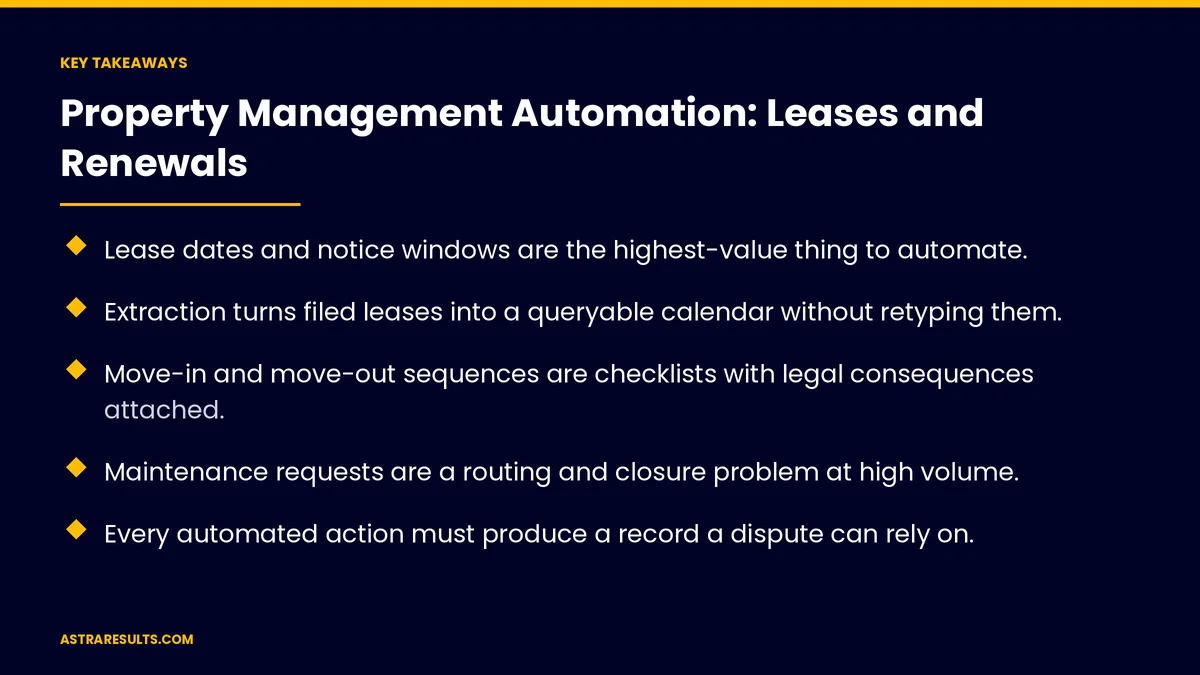
Key Takeaways
- Lease dates and notice windows are the highest-value thing to automate.
- Extraction turns filed leases into a queryable calendar without retyping them.
- Move-in and move-out sequences are checklists with legal consequences attached.
- Maintenance requests are a routing and closure problem at high volume.
- Every automated action must produce a record a dispute can rely on.
- Legal decisions stay with people; the system surfaces and documents.
Published: September 20, 2026 | Reading Time: ~12 minutes | Category: AI Automation
That is the shape of the automation opportunity here: not the work, but the dates and the records around the work. This piece covers where it pays, what the system must never decide alone, and the record-keeping that turns a dispute into a lookup. Put plainly: in property management, the money is lost on dates, not on tasks.
Guidance for owners and operators. Nothing here is legal advice. Landlord-tenant law, notice periods, deposit handling, habitability, fair housing and association governance vary substantially by jurisdiction and must be reviewed with counsel.
In This Playbook
- The calendar under every lease
- Renewals: the sequence that pays for the project
- Move-in and move-out
- Maintenance requests at volume
- Records: the part that matters in a dispute
- What the system must never decide
- Where to start
- What the first quarter looks like
- Working with Astra on this
The calendar under every lease
- What each lease contains. Start and end dates, renewal option windows, notice periods for either party, rent escalation dates, inspection obligations, insurance requirements and any option or break clauses.
- Where it lives. In a PDF, in a folder, with the important dates transcribed into a spreadsheet by whoever set it up, and increasingly out of date.
- What goes wrong. A renewal window passes and a tenancy rolls on at the old rent. A notice deadline is missed. An insurance certificate lapses unnoticed. Each is a direct financial cost with no work involved in preventing it.
- What automation does. Extracts the dates from the lease, holds them against the unit and tenant, and raises the task in time for the required notice period rather than on the date itself, as covered in extracting fields from documents.
- The lead time rule. Every date needs a preceding task, because the deadline itself is too late to be useful.
Renewals: the sequence that pays for the project
- The timeline. Decide the position, notify, negotiate, execute, update the records, inform the owner.
- Where it stalls. The decision on whether to renew and at what rent, which requires an owner instruction that nobody chased.
- What automation handles. Raising the owner decision request with the relevant data attached — current rent, market comparison the manager provides, payment history, maintenance cost — at the right lead time, chased until answered, escalated if not, as explored in approvals that route themselves.
- The tenant communication. Generated from the decision and the lease terms, in the tenant's language, sent within the notice window and recorded.
- The record update. New term, new rent, new dates, flowing into the calendar automatically rather than being retyped and occasionally mistyped.
- The measurable result. Renewals completed before the window closes, and the share of units rolling over unintentionally falling toward zero.
Move-in and move-out
- Why these matter disproportionately. They are where deposits, condition disputes and compliance obligations concentrate.
- The move-in sequence. Application, screening within the applicable rules, lease generation, deposit handling under the jurisdiction's requirements, condition report with photographs, key handover, utility transfer, and the welcome information.
- The move-out sequence. Notice acknowledged, inspection scheduled, condition compared against the move-in record, deductions itemized with evidence, deposit returned within the statutory period, and the unit turned.
- What automation contributes. The sequence itself — each step triggering the next, nothing skipped, each with its timestamp and its evidence attached.
- The deposit deadline specifically. Statutory return periods are strict and the penalties for missing them are disproportionate to the effort of remembering. This is a clock the system should own.
- What stays human. Screening decisions, deduction judgments and anything touching fair housing obligations, which are legal decisions requiring a person and counsel's guidance.
Maintenance requests at volume
- The shape of the problem. Hundreds of small requests, each trivial, each requiring classification, routing, tracking and closure — and each generating a tenant expectation.
- What automation handles. Intake in any channel and any language, classification by type and urgency, routing to the right vendor, tracking to completion, and tenant updates at each stage without anyone composing a message, as detailed in resolution over deflection.
- Emergency routing. Anything involving water, gas, electrical hazard, security or habitability escalates immediately to a person, on rules written before launch rather than inferred.
- Vendor coordination. Work order issued, accepted, scheduled, completed and invoiced, with status visible rather than assembled by phone.
- Recurring patterns. The same unit generating the same request repeatedly is a capital decision hiding in a maintenance log, and only visible if the log is structured.
- The owner report. Assembled from the record rather than compiled the week before a meeting.
Records: the part that matters in a dispute
- The principle. Every automated action produces a record, and the record is the reason to do this properly.
- What a dispute needs. What was requested, when, by whom, what was done, when, by which vendor, what it cost, what was communicated to the tenant and when.
- Photographic evidence. Condition at move-in and move-out, work before and after, timestamped and attached to the unit rather than sitting in someone's phone.
- Communication history. Every notice and message, with delivery evidence, in the language it was sent.
- Retention. For the period the jurisdiction requires, which is a legal question rather than a software default.
- The access question. Who inside the company can see and change records, which matters both for control and for any regulated context, as set out in governance before centralizing.
What the system must never decide
This section is the one to read with counsel.
- Screening outcomes. Decisions about applicants carry fair housing and consumer reporting obligations. A system may organize information; a person decides, on criteria applied consistently.
- Deduction and deposit judgments. What is normal wear and what is damage is a judgment with legal consequences.
- Notices with legal effect. Generated, yes. Reviewed and issued by a person, always.
- Anything about habitability or safety. Escalated immediately, never queued.
- Rent-setting. An owner instruction, not an algorithmic output, and any use of pricing data should be reviewed for the regulatory scrutiny this area now attracts.
- The general rule. The system surfaces, prepares and documents. People decide anything with legal weight, as covered in what software decides alone.
Where to start
- The lease calendar. Highest value, lowest risk, and it produces visible results within a month because missed dates stop.
- Then renewals. The sequence with the clearest financial return.
- Then maintenance intake and routing. The largest volume and the biggest effect on tenant experience.
- Then move-out. The most legally sensitive, built last with the most review.
- What to measure first. Units rolling over unintentionally, renewal decisions made inside the window, average days to close a maintenance request, and deposit returns inside the statutory period.
What the first quarter looks like
Days 1–30: the calendar
Leases processed into structured dates with lead-time tasks. Jurisdictional notice periods and deposit deadlines confirmed with counsel and encoded. The baseline recorded: missed windows, unintentional rollovers, maintenance closure times.
Days 31–60: renewals
The owner decision request automated with data attached, chased and escalated. Tenant communication generated within the notice window. Record updates flowing back into the calendar.
Days 61–90: maintenance and records
Intake, classification and routing live with emergency escalation rules tested. Photographic evidence attached to units. The first comparison against the baseline, and the move-out sequence scoped with counsel.
Working with Astra on this
Astra Results Marketing starts with the lease calendar because missed dates cost money without any work being involved, and lead-time tasks are what make a date useful rather than a notification.
Notice periods, deposit deadlines and record retention are confirmed with the client's counsel before being encoded, and the system is built to surface, prepare and document rather than to decide — screening, deductions, notices with legal effect and habitability matters all route to people. Engagements begin with a lease and process review through our business consulting team.
Related reading
Frequently asked questions
What should a property management business automate first?
The lease calendar. Every lease carries renewal windows, notice periods, escalation dates, inspection obligations and insurance expiries, usually transcribed once into a spreadsheet that drifts out of date. Missing one costs a month of rent or an unintended rollover with no work involved in prevention. Extraction turns filed leases into a queryable calendar, and every date gets a preceding task because the deadline itself is too late.
How does automation help with renewals?
By raising the owner decision request at the right lead time with the relevant data attached — current rent, comparison, payment history, maintenance cost — then chasing and escalating until answered, since that decision is where renewals stall. Tenant communication is generated from the decision and the lease terms within the notice window, and the new dates flow back into the calendar rather than being retyped.
Why do move-in and move-out matter disproportionately?
Because deposits, condition disputes and compliance obligations concentrate there. Automation contributes the sequence — each step triggering the next with timestamps and evidence attached — and should own the statutory deposit return clock, where penalties are disproportionate to the effort of remembering. Screening decisions, deduction judgments and fair housing matters stay with people.
How are maintenance requests handled at volume?
Intake in any channel and language, classification by type and urgency, routing to the right vendor, tracking to closure, and tenant updates at each stage without anyone composing a message. Anything involving water, gas, electrical hazard, security or habitability escalates to a person immediately on rules written before launch. Recurring requests from one unit are a capital decision hiding in the maintenance log.
What records does a dispute need?
What was requested, when and by whom; what was done, when and by which vendor; what it cost; and what was communicated to the tenant and when. Plus timestamped photographic evidence of condition at move-in and move-out attached to the unit rather than sitting on a phone, and every notice with delivery evidence in the language sent. Retention periods are a legal question, not a software default.
What must the system never decide alone?
Screening outcomes, which carry fair housing and consumer reporting obligations. Deduction and deposit judgments, where normal wear versus damage is a legal judgment. Notices with legal effect, which may be generated but must be reviewed and issued by a person. Anything about habitability or safety, escalated immediately. And rent-setting, which is an owner instruction rather than an algorithmic output.
READY TO STOP LOSING MONEY ON DATES? Astra Results Marketing turns leases into a calendar with lead-time tasks, confirms notice and deposit deadlines with your counsel before encoding them, and keeps every legal decision with a person. Astra Results Marketing · 1101 Brickell Ave, Miami, FL 33131 · +1 (786) 321-2866 · [email protected] Find us on Google · Yelp ▸ CALL (786) 321-2866 · ▸ REQUEST YOUR CONSULTATION