Rated 5 star on

The AI-Ready Business: What Readiness Actually Means
Quick answer
Readiness is not a technology state. It is five conditions, none of them technical: a process somebody can describe step by step, data that connects across systems, a named owner for the workflow, written rules for what the software may decide alone, and a first project small enough to fail without damaging anything.
Every business owner has now been told to "adopt AI." Almost none have been told what has to be true before that works. So companies buy a tool, point it at a messy process, and conclude six weeks later that AI does not work for them. The tool was fine. The business was not ready.
Key Takeaways
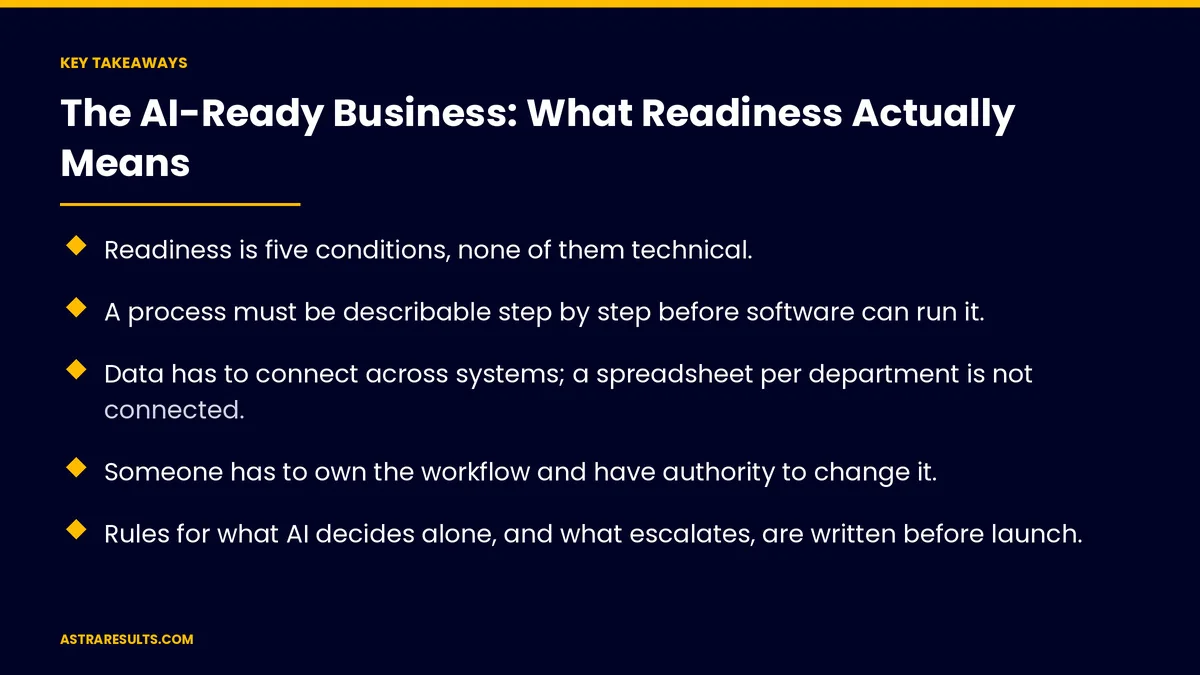
- Readiness is five conditions, none of them technical.
- A process must be describable step by step before software can run it.
- Data has to connect across systems; a spreadsheet per department is not connected.
- Someone has to own the workflow and have authority to change it.
- Rules for what AI decides alone, and what escalates, are written before launch.
- The first project is small, measurable and reversible.
Published: September 25, 2026 | Reading Time: ~12 minutes | Category: AI Strategy
Readiness is not a technology state. It is five plain conditions: a process someone can describe, data that connects, a person who owns the workflow, rules for what the software may decide alone, and a first project small enough to fail without damage. This piece explains each one and how to check it. If you remember one thing: AI automates what you can describe; it cannot fix what you cannot.
Guidance for owners and operators. Nothing here is legal, financial, employment or technical advice. Data, privacy, consent and sector rules vary by jurisdiction and industry and must be confirmed with counsel before any AI system touches customer or employee data.
In This Playbook
- Why "adopt AI" fails
- Condition one: a process someone can describe
- Condition two: data that connects
- Condition three: an owner for the workflow
- Condition four: rules for what AI decides alone
- Condition five: a pilot small enough to fail safely
- The readiness scorecard
- What readiness is not
- Ninety days, in order
- Astra's part in it
Why "adopt AI" fails
The failure pattern is consistent enough to describe in one paragraph.
A company hears it should use AI. Someone buys a subscription. It gets pointed at customer service, or scheduling, or documents. The process behind that function was never written down, lives in two people's heads, and has six exceptions nobody mentioned. The tool produces wrong answers because it was never told the right ones. Trust collapses. The subscription gets cancelled.
- The diagnosis. Nothing about that story is an AI problem. It is a readiness problem. The same company that "tried AI and it didn't work" could not have handed that process to a new employee either.
- The reframe. Treat AI like a very fast new hire who follows instructions literally. What would that hire need on day one? That list is the readiness checklist.
Condition one: a process someone can describe
AI automates what can be described. A process that exists only as tacit knowledge cannot be automated, by anyone.
- The test. Pick the workflow. Ask the person who does it to walk through it start to finish, including what happens when something is missing, wrong or unusual. If the walkthrough takes twenty minutes and produces a clear sequence, the process is ready. If it produces "it depends" every third step, it is not.
- What "described" means. Trigger, steps, decision points, exceptions, handoffs, done-state. Written, not remembered.
- The common discovery. The process has three versions, one per person who does it. Choosing one version is the first readiness task, and it has nothing to do with software, examined in fixing the process before automating it.
- The payoff. A described process is worth having even if no AI ever touches it.
Condition two: data that connects
AI works on data. If the data lives in disconnected places, the AI sees fragments.
- The typical state. Customers in one system, jobs in another, invoices in a third, emails in individual inboxes, and the real status of anything in a spreadsheet one person maintains.
- A quick test. Pick a customer. Can one query — or one screen — show their contacts, their purchases, their open issues and their history? If it takes four logins and a phone call, the data is not connected.
- What connected means at minimum. A shared identifier for each customer across systems. A place where records meet. Fields that are filled in.
- What it does not require. A data warehouse, a data science team, or a six-figure platform. For most businesses under $10M, connected means a CRM that other tools feed and a discipline of keeping it current, according to the attribution system.
- The sequencing in practice. Data engineering is the first AI project, disguised as plumbing.
Condition three: an owner for the workflow
Software does not own outcomes. People do.
- Who the owner is. A named person who is accountable for the workflow's result, has authority to change how it runs, and will be the one deciding whether the AI is doing the job.
- Why this is non-negotiable. An AI system without an owner drifts. Nobody notices when it starts producing worse answers. Nobody updates it when the business changes. Nobody is asked whether it is working.
- Who the owner is not. The IT person, unless they also own the business outcome. The vendor. The founder, for anything below the founder's level of attention.
- The diagnostic. Ask "who is responsible if this workflow produces a bad result next month?" If the answer is a committee or a shrug, the workflow is not ready.
Condition four: rules for what AI decides alone
Before launch, the business decides what the software may do without a human and what it must escalate.
- The two lists. Decisions the AI makes and executes: answering a hours question, booking an available slot, sorting a document into a category. Decisions the AI prepares and a human approves: issuing a refund, quoting a price outside a range, sending anything to a regulator, anything involving a complaint.
- The escalation path. Who the human is, how fast they respond, and what the customer sees while waiting.
- The kill switch. A way to stop the system in one action, tested before launch, known to more than one person.
- Why write it down. Because the argument about whether the AI should have done something happens after it did. The written rule turns that argument into a lookup.
- Compliance, briefly. Consent for recordings and messages, data retention, and sector-specific rules exist independent of the technology. Counsel confirms them before launch, not after a complaint.
Condition five: a pilot small enough to fail safely
The first project should be one the business can afford to get wrong.
- The right size. One workflow. One team. Measurable before and after. Reversible in a day.
- Good first pilots. After-hours inbound intake with human escalation. Sorting and routing inbound email. Drafting responses a person reviews before sending. Summarizing calls into CRM notes.
- Bad first pilots. Anything customer-facing without a human reviewing. Anything touching money without approval. Anything the business cannot measure. Anything the business cannot turn off.
- The measurement. The before number, written down, before the pilot starts. Hours spent, response time, error rate, whatever the workflow's honest metric is.
- The decision rule. At the end of the pilot, expand, adjust or stop — decided on the before-and-after numbers, not on enthusiasm.
The readiness scorecard
Score each condition one to five.
- Process. 1: lives in heads. 3: written but with gaps. 5: documented with exceptions and handoffs.
- Data. 1: spreadsheets per department. 3: a CRM most people update. 5: connected records, one customer view.
- Owner. 1: nobody. 3: someone, without authority. 5: named, accountable, empowered.
- Rules. 1: none. 3: informal. 5: written decide-alone and escalate lists, tested kill switch.
- Pilot. 1: "let's automate everything." 3: a candidate identified. 5: one workflow, before-metric recorded, reversible.
- Reading it. Anything under three on any condition is the first thing to fix, and it is almost never the technology.
What readiness is not
- It is not a data lake. Most businesses that "need a data warehouse first" need a CRM everyone updates.
- It is not an AI strategy deck. A strategy for a business with no described processes is a wish list.
- It is not hiring a data scientist. For the first several projects, the scarce skill is process documentation, not modeling.
- It is not waiting. The five conditions are achievable in weeks for one workflow. Readiness for everything is a mirage; readiness for one thing is a Tuesday.
Ninety days, in order
Days 1–30: score and choose
The readiness scorecard completed across the three or four workflows that consume the most time. The one with the best score and the clearest metric chosen as the pilot. Its process documented, with exceptions.
Days 31–60: connect and decide
The data the pilot needs connected, even if only for that workflow. The owner named. The decide-alone and escalate lists written. The kill switch built and tested. The before-metric recorded.
Days 61–90: pilot and judge
The system live on the one workflow with human escalation. Weekly review by the owner. The after-metric compared to the before. Expand, adjust or stop, decided on the numbers.
Astra's part in it
Astra Results Marketing runs the readiness assessment before proposing any AI project: the five conditions scored across the workflows that consume the most time, the pilot chosen for measurability and reversibility, and the process documentation and data connection done as the first phase — not skipped because they are unglamorous.
The rules for what the AI decides alone are written with the client before anything goes live, and the pilot is judged on before-and-after numbers. Engagements begin with the readiness assessment through our business consulting team.
Related reading
Frequently asked questions
Why do so many AI projects fail?
Because the business was not ready, not because the technology failed. A tool gets pointed at a process that was never written down, lives in two people's heads and has six unmentioned exceptions. It produces wrong answers because it was never told the right ones, trust collapses, and the subscription gets cancelled. The same company could not have handed that process to a new employee either.
What does "a process someone can describe" mean?
Trigger, steps, decision points, exceptions, handoffs and done-state, written down rather than remembered. The test is asking the person who does it to walk through it start to finish, including what happens when something is missing or unusual. If every third step is "it depends," the process is not ready, and choosing one version of it is the first readiness task.
Does readiness require a data warehouse?
No. For most businesses under $10M, connected data means a CRM that the other tools feed, a shared identifier for each customer across systems, and a discipline of keeping records current. The test is whether one screen can show a customer's contacts, purchases, open issues and history. Data engineering is the first AI project, disguised as plumbing, but it rarely requires a six-figure platform.
Who should own the AI workflow?
A named person accountable for the workflow's business result, with authority to change how it runs, who decides whether the AI is doing the job. Not the IT person unless they own the outcome, not the vendor, and not the founder for anything below the founder's attention. Without an owner the system drifts, nobody notices degraded answers, and nobody asks whether it is working.
What rules need to exist before launch?
Two lists: decisions the AI makes and executes alone — answering an hours question, booking an open slot, sorting a document — and decisions it prepares for human approval — refunds, prices outside a range, anything to a regulator, any complaint. Plus a named escalation human with a response time, and a kill switch tested before launch and known to more than one person.
What makes a good first pilot?
One workflow, one team, measurable before and after, reversible in a day. After-hours intake with escalation, inbound email routing, drafting replies a person reviews, and summarizing calls into CRM notes all qualify. Anything customer-facing without review, anything touching money without approval, or anything the business cannot measure or turn off does not. The before-number is written down before the pilot starts.
READY TO FIND OUT IF YOUR BUSINESS IS READY? Astra Results Marketing scores the five readiness conditions across your highest-time workflows, chooses a pilot that can fail safely, and does the process and data work first. Astra Results Marketing · 1101 Brickell Ave, Miami, FL 33131 · +1 (786) 321-2866 · [email protected] Find us on Google · Yelp ▸ CALL (786) 321-2866 · ▸ REQUEST YOUR CONSULTATION