Rated 5 star on

Connected TV Advertising for Local Brands, End to End
Quick answer
Connected TV delivers a full-screen, sound-on ad to streaming households, bought by geography and audience rather than by program or broadcast area. There is nothing to click, so the unit of measurement is the completed view, supported by lift in searches, calls and visits. It is the cheapest way to look established in a specific set of zip codes.
Television used to be the channel a local business could not afford and could not measure. Buying it meant a station rep, a rate card built around programs, waste across a whole broadcast area, and a rough guess about who saw anything. Most owners never considered it, correctly.
Key Takeaways
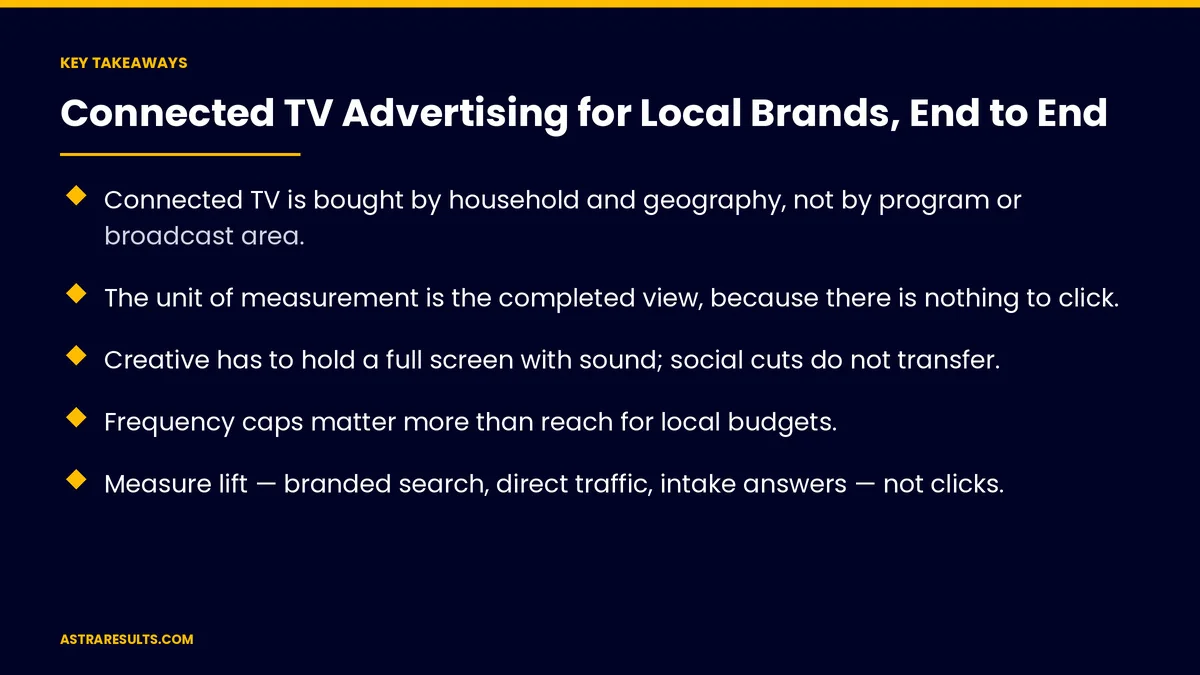
- Connected TV is bought by household and geography, not by program or broadcast area.
- The unit of measurement is the completed view, because there is nothing to click.
- Creative has to hold a full screen with sound; social cuts do not transfer.
- Frequency caps matter more than reach for local budgets.
- Measure lift — branded search, direct traffic, intake answers — not clicks.
- It builds demand; it does not capture it. Pair it with a channel that does.
Published: September 10, 2026 | Reading Time: ~13 minutes | Category: Connected TV
Connected TV changed the economics rather than the format. The ad is still full screen with sound on, but it is bought by household and area, delivered to streaming devices, and measured on completed views rather than estimated ratings. This guide covers what that means in practice for a business serving a city or a few counties. The short version: it is the cheapest way to look like a bigger company in a specific zip code.
Guidance for owners and operators. Nothing here is legal advice. Advertising claims, disclosure requirements and restrictions on targeting vary by industry and jurisdiction and should be reviewed with counsel.
In This Playbook
- What connected TV actually is
- Household targeting, plainly
- What it costs
- Creative that holds a full screen
- Frequency: the setting most people get wrong
- Measuring lift, not clicks
- Where it fits and where it does not
- Common mistakes
- Ninety days, in order
What connected TV actually is
- The delivery. Ads inside streaming content on televisions — smart TV apps, streaming devices, and ad-supported tiers of streaming services.
- What it is not. Video ads on social feeds, which are a different format with different behavior, and not online video on a phone, which is a separate buy.
- The format. Full screen, sound on, usually unskippable, in a viewing context where the person is settled rather than scrolling.
- The buy. By geography down to the zip code level, by household characteristics, and by frequency, rather than by program and broadcast region.
- Why it opened to local businesses. Minimum spends fell from tens of thousands to amounts a local advertiser can test with, and geographic precision removed the waste that made broadcast unaffordable.
Household targeting, plainly
- The geographic unit. Zip codes, radii, or defined service areas — which for a business serving three counties means not paying for the other twelve.
- Household characteristics. Broad attributes rather than individual identification, with the specifics varying by platform and subject to privacy rules that differ by jurisdiction.
- Retargeting. Reaching households that visited the website, which is among the more effective uses for a local business with modest budget.
- Customer lists. Reaching existing customers, or excluding them, depending on whether the campaign is retention or acquisition.
- The limits. Targeting is at the household, not the person. Everyone in the house sees it, which matters for both relevance and privacy expectations.
- The privacy dimension. Platforms differ on what data they use and permit, and rules are tightening in several jurisdictions. Verify before assuming a targeting capability exists.
What it costs
- The pricing model. Usually per thousand completed views, which behaves differently from a per-click channel because every impression is paid for whether or not anyone acts.
- The entry point. Meaningfully lower than broadcast, and within reach of a local business's monthly marketing budget as a test rather than a commitment.
- What drives cost. Audience specificity, geography, inventory quality, and the time of year. Premium inventory in a competitive season costs multiples of the same spot elsewhere.
- Production. A real cost unless the business already has usable footage, which is the argument for planning a production day that feeds several channels, as detailed in one shoot, many cuts.
- The comparison to run. Not cost per view against cost per click — they are different things. Cost per closed customer, computed with the business's own numbers, against every other channel.
Creative that holds a full screen
- Social cuts do not transfer. A vertical clip with burned-in captions, built to work silently in a feed, looks wrong on a television.
- What the format wants. Landscape, sound designed to be heard, and a pace that suits someone sitting down rather than thumbing past.
- The first three seconds. Not a hook to stop a scroll — nobody is scrolling — but a reason to keep watching rather than reach for the phone.
- Length. Fifteen and thirty seconds are the working lengths. Thirty gives room to say something; fifteen buys more frequency for the same money.
- What local brands should show. The actual work, the actual people, the actual place. Production polish matters less than recognizability, and a spot that could be any company in the category wastes the buy.
- The ending. A name and a location that lodge. There is no click, so the job is to be remembered and searched, as covered in awareness channels measured on their own terms.
Frequency: the setting most people get wrong
- Why it matters more than reach locally. A local budget cannot buy broad reach and high frequency at once. Choosing badly produces either a forgettable single impression or the same household seeing the spot fifteen times in a week.
- The irritation threshold. Repetition builds recall and then builds resentment. Where that turns depends on the creative and the category, and it is worth testing rather than guessing.
- Caps. Set per household per day and per week, deliberately, rather than left at the platform default.
- Rotation. Two or three creative variants extend the useful life of a flight before fatigue sets in.
- Flighting. Concentrated bursts around a season or a launch outperform a thin continuous spend for a local advertiser.
Measuring lift, not clicks
- The fundamental point. Nobody clicks a television. Any measurement framework built on clicks will conclude this channel does nothing, which is a measurement failure rather than a finding.
- Branded search volume. The most useful signal: searches for the business name during and after a flight, compared to before.
- Direct traffic. People typing the name or the URL.
- Intake answers. The source question at intake, with the option present before the campaign starts, as set out in capturing source at first contact.
- Geographic holdouts. Running in some areas and not others, then comparing. The cleanest available test for a local advertiser and worth the design effort.
- Completed view rate. A delivery diagnostic, not an outcome.
- The timeline. Lift shows over weeks, not days, which means judging a flight after ten days will mislead.
Where it fits and where it does not
- Fits. Businesses whose customers do not search until they need them — so demand has to be created before the need arises. Home services, healthcare, professional services, auto, hospitality.
- Fits. Markets where the business wants to appear larger and more established than competitors who only run search.
- Fits. Launches, new locations, and seasonal peaks worth building toward.
- Does not fit. A business that cannot yet answer its phone or convert its site traffic, which should fix that first, as explored in where the leaks are.
- Does not fit alone. Connected TV creates demand it cannot capture. It needs search and intake ready to receive the people it sends looking.
Common mistakes
- Running social creative. Vertical, captioned, silent-optimized video on a television.
- No frequency cap. Burning through the same households and annoying them.
- Judging on clicks. Or worse, on a platform-reported attribution model that credits any household that later visited the site.
- Thin continuous spend. Too little to register, spread across too long.
- Starting before the intake works. Creating demand that hits voicemail.
- Stopping too early. Cancelling at two weeks when lift takes longer to appear.
Ninety days, in order
Days 1–30: prepare
Service area defined at the zip code or radius level. Creative produced in landscape at fifteen and thirty seconds, showing real work and people. The source question live at intake, with the team told what to listen for. The pre-campaign baseline recorded for branded search and direct traffic.
Days 31–60: run a concentrated flight
Frequency caps set deliberately. Two or three creative variants rotating. A geographic holdout defined if the budget allows. Delivery checked for where ads ran.
Days 61–90: read the lift
Branded search and direct traffic compared to the baseline and to the holdout area. Intake answers counted. Cost per closed customer computed with the business's own numbers and compared to other channels, then the flight sized or stopped accordingly.
How does Astra run a connected TV campaign?
Astra Results Marketing produces landscape creative for the format rather than repurposing social cuts, sets frequency caps deliberately, and defines a geographic holdout where the budget allows so lift can be measured rather than asserted.
Because the same team runs the search and intake that catch the demand this channel creates, the pairing is designed rather than assumed, and the intake source question is in place before the first flight. Reporting leads with branded search lift, intake answers and cost per closed customer, not completed views. Engagements begin with a market and creative assessment through our connected TV advertising team.
Related reading
Frequently asked questions
How is connected TV different from regular TV advertising?
The format is the same — full screen, sound on, unskippable — but the buy changed. Instead of programs and a whole broadcast area, it is bought by zip code, service radius and household characteristics, delivered through streaming apps and devices, and measured on completed views rather than estimated ratings. Minimum spends fell far enough that a local business can test it.
What does it cost?
Usually priced per thousand completed views, with every impression paid for whether or not anyone acts. Entry is within reach of a local monthly marketing budget as a test. Cost rises with audience specificity, geography, inventory quality and season — premium inventory in a competitive period costs multiples of the same spot elsewhere. Production is a real cost unless usable footage already exists.
Can social video be used for connected TV?
No. A vertical clip with burned-in captions built to work silently in a feed looks wrong on a television. The format wants landscape, sound designed to be heard, and a pace suited to someone sitting down. Fifteen and thirty seconds are the working lengths, and what matters for local brands is showing the actual work, people and place rather than production polish.
Why does frequency matter more than reach?
Because a local budget cannot buy broad reach and high frequency at once, and choosing badly produces either a forgettable single impression or the same household seeing the spot fifteen times in a week. Caps should be set per household per day and week deliberately rather than left at platform defaults, with two or three creative variants rotating to delay fatigue.
How is connected TV measured?
By lift, not clicks — nobody clicks a television, so any click-based framework will conclude the channel does nothing, which is a measurement failure rather than a finding. The signals are branded search volume during and after a flight against a baseline, direct traffic, intake source answers captured from before the campaign starts, and geographic holdouts comparing areas that ran against areas that did not.
When is connected TV the wrong choice?
When the business cannot yet answer its phone or convert its site traffic, since creating demand that hits voicemail wastes the spend. And it never works alone: it creates demand it cannot capture, so search and intake must be ready to receive people who go looking. Thin continuous spend and stopping at two weeks are the other common ways the channel is judged unfairly.
READY TO LOOK LIKE THE BIGGER COMPANY IN YOUR ZIP CODE? Astra Results Marketing produces creative for the format, sets frequency deliberately, defines a holdout so lift can be measured, and makes sure search and intake are ready to catch the demand. Astra Results Marketing · 1101 Brickell Ave, Miami, FL 33131 · +1 (786) 321-2866 · [email protected] Find us on Google · Yelp ▸ CALL (786) 321-2866 · ▸ REQUEST YOUR CONSULTATION