Rated 5 star on


Growing an Online Store: The E-Commerce Playbook
Quick answer
E-commerce growth starts with contribution margin per order after every variable cost, because scaling a negative margin only loses money faster. Repeat purchase rate is the difference between a business and a treadmill. The product feed quietly decides paid performance, email and sms produce revenue without acquisition cost, and returns are a margin line.
E-commerce is the one marketing channel where the arithmetic is visible and unforgiving. A service business can carry a weak month on relationships. An online store either makes money on the unit or it does not, and scaling a negative unit economic simply loses money faster.
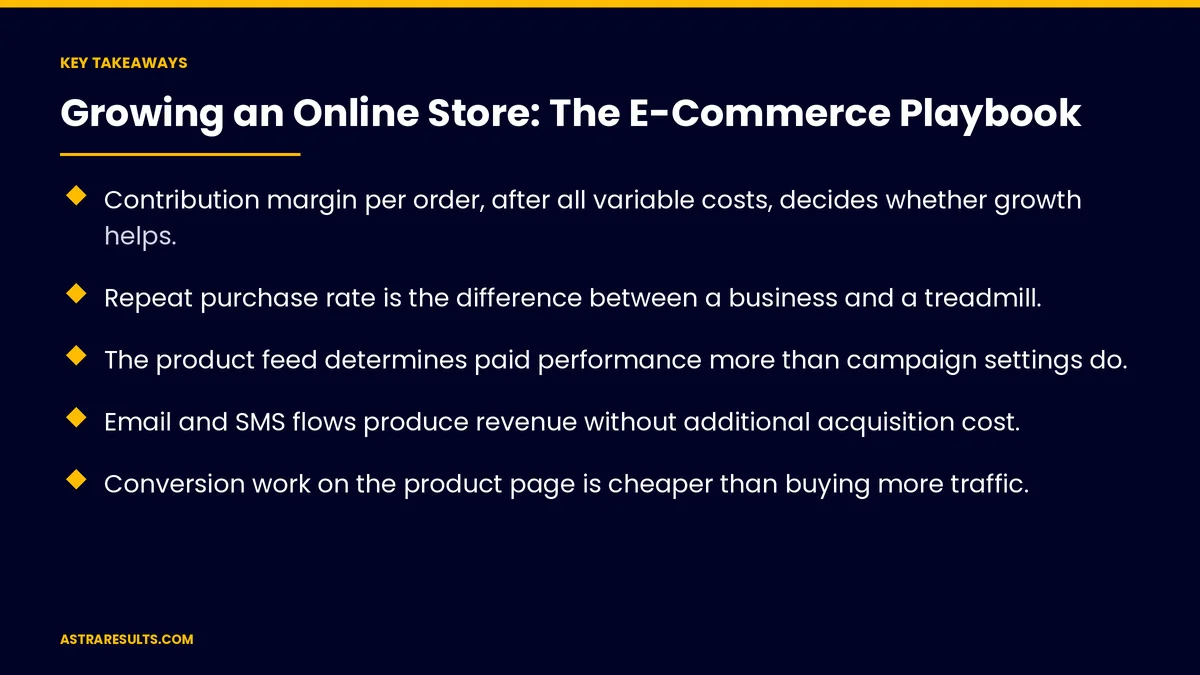
Key Takeaways
- Contribution margin per order, after all variable costs, decides whether growth helps.
- Repeat purchase rate is the difference between a business and a treadmill.
- The product feed determines paid performance more than campaign settings do.
- Email and SMS flows produce revenue without additional acquisition cost.
- Conversion work on the product page is cheaper than buying more traffic.
- Returns are a margin line and a product problem, not a customer service issue.
Published: September 14, 2026 | Reading Time: ~14 minutes | Category: E-Commerce
That makes the playbook different from every other channel. It starts with margin, not traffic. This guide covers the numbers that decide whether growth is worth having, the flows that produce profit without more ad spend, the feed and page work that quietly determines paid performance, and what returns cost. If you remember one thing: you cannot advertise your way out of a bad contribution margin.
Guidance for owners and operators. Nothing here is financial, tax or legal advice. Consumer protection, returns, pricing display, shipping and privacy requirements vary by jurisdiction and should be reviewed with counsel.
In This Playbook
- Start with contribution margin
- Repeat purchase is the whole business
- Why does the product feed decide paid performance?
- Email and SMS: revenue without acquisition cost
- Conversion work beats buying more traffic
- Returns are a margin line
- Where growth comes from
- Marketplaces and owning the customer
- A three-month sequence
- Astra's part in it
Start with contribution margin
- What it is. Selling price minus every variable cost of fulfilling that order: cost of goods, payment processing, packaging, shipping, fulfillment labor and expected returns.
- Why it comes first. It is the money available to pay for acquisition and overhead. If it is small, no amount of clever marketing fixes the model.
- What owners commonly miss. Shipping subsidies, payment fees, the discount codes redeemed, and the cost of returns. Each looks small and together they consume the apparent margin.
- The threshold question. How much can be spent to acquire a first order and still be profitable, either immediately or across the expected repeat purchases?
- What to do when it is too thin. Raise prices, change the mix toward better-margin products, increase average order value, or reduce fulfillment cost. These are product and operations decisions, and marketing cannot substitute for them.
- The link to everything else. Every channel decision that follows is judged against this number, computed with the business's own data rather than platform reports, as detailed in cost per closed customer.
Repeat purchase is the whole business
- Why it matters more than conversion rate. A store where nobody returns must buy every sale forever. A store with genuine repeat purchase earns compounding revenue from acquisitions already paid for.
- The number to know. What share of first-time buyers purchase again within the natural repurchase window for the category, which is weeks for consumables and months or years for durables.
- What drives it. Product satisfaction first, then delivery experience, then being asked at the right moment. Marketing can only influence the third.
- The cohort view. First orders grouped by month, tracked forward — revenue per customer at three, six and twelve months. This is the number that justifies acquisition spend above the first-order margin, as explored in cohort retention.
- The uncomfortable case. Some categories have no repeat purchase. Those businesses must make the money on the first order, and knowing that early prevents an expensive strategy built on retention that will not come.
Why does the product feed decide paid performance?
The least glamorous and most consequential work in e-commerce advertising.
- What the feed is. The structured file describing every product — title, description, image, price, availability, category, attributes — that shopping platforms read to decide when to show a product.
- Why it outranks campaign settings. Matching happens on feed data. A product whose title omits the terms people search will not show, regardless of bid.
- Titles. Written for how people search, front-loading the important attributes, rather than the internal product name.
- Images. The first image decides the click. Clean, consistent, showing the product clearly, meeting platform specifications.
- Attributes. Size, color, material, compatibility, condition — complete, because missing attributes remove products from filtered searches entirely.
- Availability accuracy. Advertising out-of-stock products wastes spend and damages account health.
- The maintenance. A feed is not set once. Prices, stock and new products change daily, and a stale feed decays quietly.
Email and SMS: revenue without acquisition cost
- Why they matter disproportionately. The audience is already acquired. The marginal cost of another message is near zero, so the revenue is high-margin.
- The flows that do most of the work. Welcome and first-purchase, abandoned cart, abandoned browse, post-purchase, replenishment for consumables, and win-back for lapsed customers. Automated, triggered by behavior, running continuously.
- Why flows beat campaigns. A flow reaches each person at the right moment in their own timeline. A campaign reaches everyone on the sender's timeline.
- The discount trap. Cart recovery that always offers a discount teaches customers to abandon carts. Recover with reassurance, shipping clarity and reminders first; reserve discounts for genuine win-back.
- SMS specifics. Higher open rates, tighter consent rules, lower tolerance for frequency. Consent requirements differ by jurisdiction and should be confirmed with counsel.
- What to track. Revenue per recipient, and flow revenue as a share of total, which in a healthy store is substantial.
Conversion work beats buying more traffic
- The arithmetic. Improving conversion rate raises revenue from traffic already paid for. It applies to every visitor, including those from channels not yet running.
- The product page. Images that answer what the customer cannot touch, specifications that remove doubt, reviews near the buy button, shipping and returns stated before the cart, as covered in proof where decisions happen.
- The checkout. Every field costs completions. Guest checkout, wallet payment options, no surprise costs late, and a clear total before commitment.
- Cost transparency. Shipping cost revealed at the last step is the most common cart abandonment cause that a store controls.
- Speed on a phone. Most traffic is mobile and most abandonment is silent.
- Search on site. For stores with many products, internal search is where high-intent visitors go, and poor results lose them.
Returns are a margin line
- Why they belong in a marketing playbook. Returns consume contribution margin directly and are frequently caused by information the product page failed to provide.
- The diagnostic. Return reasons, categorized. "Did not fit," "not as described" and "wrong item" each point somewhere specific — the size guide, the photography, the fulfillment process.
- What reduces them. Better images, honest descriptions, accurate sizing information, and reviews that mention fit or size.
- The policy tension. Generous returns raise conversion and raise return rates. The right point depends on the category and the margin, and it should be a deliberate calculation rather than a copied policy.
- The number that matters. Return rate by product and by acquisition channel, because some channels reliably produce customers who return more.
Where growth comes from
- More customers. Acquisition, judged against contribution margin and repeat value.
- More per order. Bundles, complementary products, thresholds for free shipping — increasing average order value is usually the fastest margin improvement available.
- More often. Replenishment timing, subscriptions where they genuinely fit, and reasons to return.
- Better margin. Price, product mix, supplier terms, fulfillment cost.
- Fewer losses. Returns, discounts given by default, and abandoned carts recovered.
- The sequencing. The last three are usually cheaper than the first, and most stores try the first one only.
Marketplaces and owning the customer
- The trade-off. Marketplaces provide demand and take margin, data and the customer relationship.
- The sensible posture. Use them for discovery and volume where the margin works, while building the direct channel where the relationship and the repeat purchase live.
- What direct gives. The customer's contact details, the ability to run flows, and the margin that funds everything else.
- The risk of dependence. A store whose entire revenue sits on one marketplace has an existential dependency on that platform's rules and fees.
- The practical split. Judge each channel on contribution margin after all its costs, including fees, and size accordingly.
A three-month sequence
Days 1–30: the numbers
Contribution margin per order computed after every variable cost including returns. Repeat purchase rate and cohort revenue at three and twelve months established. Return reasons categorized. The acquisition threshold calculated from those numbers.
Days 31–60: feed and flows
The product feed rebuilt with search-led titles, complete attributes and accurate availability, with a maintenance routine. The core email and SMS flows built or fixed, with discounting removed from early cart recovery.
Days 61–90: conversion and margin
Product pages fixed where return reasons and drop-off point. Checkout friction removed and shipping cost surfaced earlier. Average order value work started. Channels re-judged on contribution margin after fees.
Astra's part in it
Astra Results Marketing starts with contribution margin per order after every variable cost, because scaling a negative unit economic simply loses money faster, and says plainly when the fix is product, pricing or fulfillment rather than marketing.
Feed quality and lifecycle flows come before ad budget increases, since both produce revenue without additional acquisition cost. Returns are treated as a margin and product-page problem rather than a service issue, and every channel including marketplaces is judged on contribution margin after its own fees. Engagements begin with a margin and cohort analysis through our e-commerce marketing team.
Related reading
Frequently asked questions
Why does contribution margin come before traffic?
Because it is the money available to pay for acquisition and overhead, and scaling a negative unit economic loses money faster. It is selling price minus every variable cost: goods, payment processing, packaging, shipping, fulfillment labor and expected returns. Owners commonly miss shipping subsidies, payment fees, redeemed discounts and return costs — small individually, and together often the whole apparent margin.
What makes repeat purchase so important?
A store where nobody returns must buy every sale forever, while genuine repeat purchase earns compounding revenue from acquisitions already paid for. The number to know is what share of first-time buyers order again within the category's natural window, tracked as cohorts at three, six and twelve months. Some categories have no repeat purchase, and knowing that early prevents a strategy built on retention that will not come.
Why does the product feed matter more than campaign settings?
Because shopping platforms match on feed data, so a product whose title omits the terms people search will not show regardless of bid. Titles should be written for how people search rather than internal naming, images must be clean and specification-compliant since the first one decides the click, attributes must be complete because gaps remove products from filtered searches, and availability must be accurate.
Which email and SMS flows matter most?
Welcome and first purchase, abandoned cart, abandoned browse, post-purchase, replenishment for consumables, and win-back for lapsed customers — automated and triggered by behavior, so each person is reached at the right moment in their own timeline rather than the sender's. Avoid discounting in early cart recovery, which teaches customers to abandon carts; recover with reassurance and shipping clarity first.
How should returns be handled?
As a margin line and a product-page problem. Categorize return reasons: "did not fit," "not as described" and "wrong item" point respectively at the size guide, the photography and fulfillment. Better images, honest descriptions and accurate sizing reduce them. Generous policies raise both conversion and returns, so the right point is a deliberate calculation for the category and margin rather than a copied policy.
Where does growth come from?
More customers, more per order, more often, better margin, and fewer losses. Increasing average order value is usually the fastest margin improvement available, and reducing returns, default discounting and cart abandonment is usually cheaper than acquiring more customers. Most stores try acquisition only, which is the most expensive of the five.
READY TO KNOW WHETHER GROWTH IS WORTH HAVING? Astra Results Marketing computes contribution margin and cohort value first, fixes feed and flows before raising ad budget, and says plainly when the answer is pricing or fulfillment rather than marketing. Astra Results Marketing · 1101 Brickell Ave, Miami, FL 33131 · +1 (786) 321-2866 · [email protected] Find us on Google · Yelp ▸ CALL (786) 321-2866 · ▸ REQUEST YOUR CONSULTATION