Rated 5 star on


Business Consulting for Growth: The Astra Approach
Quick answer
Consulting earns its fee when the diagnosis produces one named constraint rather than a list of observations, and when the people who named it do the work of removing it. The numbers come from the company's own systems rather than from interviews alone. A recommendation nobody executes is an expensive opinion, however well researched it was.
Consulting has a credibility problem with owner-led businesses, and it is deserved. A firm arrives, interviews everyone, produces a deck of observations the owner already knew, recommends a transformation, invoices, and leaves. Nothing changes, because nobody was ever going to do the work in the deck.
Key Takeaways
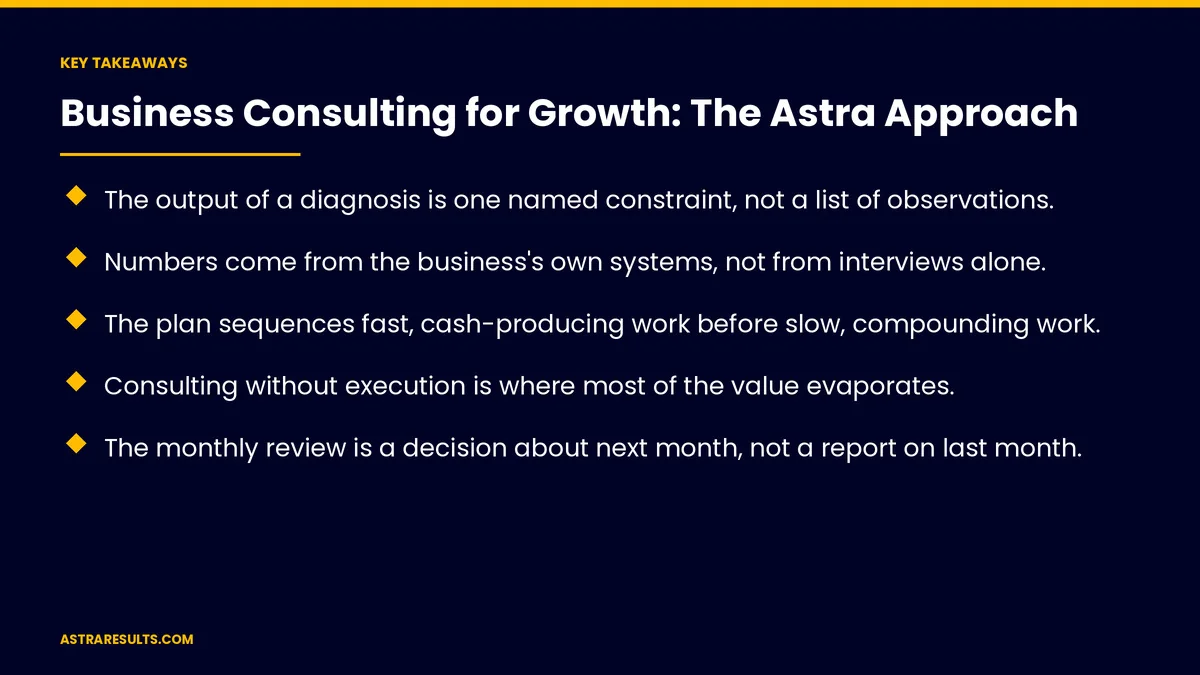
- The output of a diagnosis is one named constraint, not a list of observations.
- Numbers come from the business's own systems, not from interviews alone.
- The plan sequences fast, cash-producing work before slow, compounding work.
- Consulting without execution is where most of the value evaporates.
- The monthly review is a decision about next month, not a report on last month.
- If the recommendation is to do less, that should be said plainly.
Published: September 8, 2026 | Reading Time: ~13 minutes | Category: Consulting
The version that earns its fee looks different in one specific way: the diagnosis produces a single named constraint, and the same people who named it do the work of removing it. This piece describes that approach — what the diagnosis involves, how the constraint is identified, how the plan gets sequenced so it survives a slow month, and what the monthly review should contain. Put plainly: a recommendation nobody executes is an expensive opinion.
Guidance for owners and operators. Nothing here is legal, tax, financial or accounting advice. Decisions about structure, financing, employment and compliance require the relevant professionals.
In This Playbook
- What a diagnosis involves
- Finding the binding constraint
- Sequencing: what comes first and why
- Execution is where consulting usually fails
- The monthly review, done properly
- Pricing and what it buys
- Who this fits, and who it does not
- What to ask a consulting firm
- A 90-day plan
What a diagnosis involves
- The revenue model, reverse-engineered. What a customer is worth, how many the business closes, and what the current numbers say it would take to reach the target.
- The four stages, walked with data. Demand, conversion, retention and measurement, each with its real numbers rather than impressions, as detailed in the growth engine.
- The systems, not just the people. Interviews reveal what people believe. The CRM, the call log, the accounting system and the calendar reveal what happened. Both matter, and where they disagree is the finding.
- The money, traced. What is spent, where, and what each spend produced — which frequently cannot be answered, and that inability is itself a diagnosis.
- The constraint, named in one sentence. Not five priorities. The one thing whose removal unlocks the most, explained in a way the owner can repeat to their team.
- What it should not be. A deck of observations the owner could have written, or a recommendation to do everything better.
Finding the binding constraint
- The principle. A business grows at the speed of its slowest stage, so effort spent elsewhere is partly wasted until that stage moves.
- The usual suspects, in rough order of frequency. Leads arrive and are not answered fast enough. Quotes go out and are not followed up. Customers are acquired and never contacted again. Nobody can say which channel produced anything. Capacity is full and nobody has raised prices in three years.
- Why owners are wrong about their own constraint. Not from lack of intelligence — from proximity. The thing that has always been that way becomes invisible, and the thing that is noisy gets attention regardless of whether it matters.
- How it is confirmed. By arithmetic. If half of leads never get a response, the value of fixing that is calculable, and it is almost always larger than the value of the marketing change being discussed.
- When the constraint is not marketing. Sometimes it is pricing, capacity, staffing or a product problem. A consultant whose diagnosis always finds a marketing constraint is selling, not diagnosing.
Sequencing: what comes first and why
- Fast work first. Response time, follow-up cadence, negative keywords, review requests, landing page fixes. These change what happens to demand that already exists and produce cash within weeks.
- Slow work funded by it. Organic search, AI citation presence, content, brand, referral systems. These compound over quarters and need the patience that early wins buy.
- Why the order matters. A plan that starts with the slow work runs out of faith or money before it compounds, and gets cancelled a month before it would have worked.
- What gets cut. Channels and activities that cannot be measured and are not producing. Sometimes the strongest recommendation is to stop three things, which is unpopular and correct.
- Capacity as a constraint on the plan itself. A four-person business cannot execute eleven initiatives. The plan should fit the team that exists.
Execution is where consulting usually fails
- The gap. The strategy is sound, nobody in the business has time to implement it, and the consultant's engagement ended at the deck.
- The two honest models. Either the consultant executes alongside the business, or the plan is scoped to what the business can do with its current people.
- Why the same team should do both. The people who diagnosed the problem know why each recommendation exists, so when reality intervenes they can adapt without losing the intent, as set out in one accountable team.
- The handoff tax. Every transfer from strategist to implementer loses context and adds delay, and most plans die in that gap.
- The owner's role. Decisions, priorities and unblocking. Not implementation — an owner doing the implementation is the constraint the plan was supposed to remove.
The monthly review, done properly
- What it is. A decision about next month, based on what moved.
- What it contains. Cost per closed customer by source. Conversion at each stage against last month. Whether the named constraint moved. What the next constraint is. One decision.
- What it does not contain. Forty pages. Impressions. Rankings in isolation. Anything the owner cannot act on, as covered in inputs versus outputs.
- Length. Thirty minutes. A review that takes two hours is a report being read aloud.
- The uncomfortable part. Saying plainly when something did not work, and what is being changed as a result. A review where everything always went well is not a review.
Pricing and what it buys
- The diagnostic, priced separately. A defined piece of work with a defined output: the revenue model, the constraint, the sequenced plan. The business owns it whether or not it continues.
- Why paid diagnosis matters. A free diagnosis is a sales process, and it will find the constraint that matches what the firm sells.
- The engagement. Monthly, with the scope written down: what is being executed, by whom, and what is being measured.
- What should not appear. Marked-up media spend, undisclosed vendor commissions, or fees tied to activity rather than outcomes.
- The exit. What the business keeps if it stops: accounts, content, data, documentation. All of it, as a term rather than a favor.
Who this fits, and who it does not
- Fits. Owner-led businesses between roughly one and twenty million in revenue, where the owner is doing too much, growth has plateaued, and nobody can say which marketing works.
- Fits. Businesses preparing to raise or sell, where marketing needs to become a documented system, as explored in making marketing an asset.
- Fits. Multi-location groups where the center and the locations disagree about who owns what.
- Does not fit. Businesses wanting a specific channel executed with no interest in the diagnosis. That is a legitimate need and a different service.
- Does not fit. Businesses where the real problem is a product nobody wants, or a financial problem marketing cannot solve. Saying so is part of the job.
What to ask a consulting firm
- What is the deliverable of the diagnosis, specifically? If the answer is "a strategy," ask what it will name.
- Will you execute, or hand it over? And if handing over, to whom, with what support.
- What do you measure, and whose numbers? Platform reports and business outcomes are different.
- What happens to our accounts and data if we stop?
- Have you ever told a client the answer was to spend less? The answer reveals a great deal.
- Who is doing the work? The person in the meeting is often not the person on the account.
A 90-day plan
Days 1–30: diagnose
The revenue model built from the business's own systems. The four stages walked with real numbers. The money traced. The constraint named in one sentence and agreed with the owner.
Days 31–60: execute the fast work
The constraint addressed directly, usually in conversion or intake. Measurable within the month. Activities that cannot be measured and are not producing, stopped.
Days 61–90: start the slow work and review
Compounding work begun with the cash and confidence the fast work produced. The first monthly review run on the new numbers, with the next constraint identified and one decision made.
How does Astra consult?
Astra Results Marketing prices the diagnostic separately and hands over its output regardless of what follows, because a free diagnosis finds the constraint that matches what the firm sells. The output is one named constraint with the arithmetic behind it, not a list of observations.
The same team that diagnoses executes, so the reasoning survives contact with reality, and the plan is scoped to the people the business has. Media spend is never marked up, the client's accounts and data remain theirs, and the monthly review is thirty minutes ending in a decision. Engagements begin with a paid diagnostic through our business consulting team.
Related reading
Frequently asked questions
What should a growth diagnosis produce?
One named constraint, in a sentence the owner can repeat to their team, with the arithmetic behind it — not a deck of observations the owner already knew or a recommendation to do everything better. Getting there means reverse-engineering the revenue model, walking demand, conversion, retention and measurement with real numbers from the business's own systems, and tracing what each spend produced.
Why are owners usually wrong about their own constraint?
Proximity rather than judgment. The thing that has always been that way becomes invisible, while the noisy thing gets attention regardless of whether it matters. Confirmation comes from arithmetic: if half of leads never get a response, the value of fixing that is calculable and almost always larger than the marketing change being discussed.
Why does sequencing matter so much?
Because a plan that starts with slow compounding work runs out of money or faith before it compounds, and gets cancelled a month before it would have worked. Fast work — response time, follow-up, negative keywords, review requests — changes what happens to demand that already exists and produces cash within weeks, which funds and protects the patient work behind it.
Where does consulting fail?
At execution. The strategy is sound, nobody in the business has time to implement it, and the engagement ended at the deck. The two honest models are that the consultant executes alongside the business, or the plan is scoped to what the current team can do. Every handoff from strategist to implementer loses context and adds delay.
What should the monthly review contain?
Cost per closed customer by source, conversion at each stage against last month, whether the named constraint moved, what the next one is, and one decision. Thirty minutes. Not forty pages, not impressions, not rankings in isolation. And plain acknowledgment when something did not work — a review where everything always went well is not a review.
What should a business ask before hiring a consultant?
What the diagnosis will specifically name. Whether the firm executes or hands over, and to whom. What they measure and whose numbers those are. What happens to accounts and data if the relationship ends. Who is doing the work rather than attending the meeting. And whether they have ever told a client the answer was to spend less.
READY FOR A DIAGNOSIS THAT NAMES ONE THING? Astra Results Marketing prices the diagnostic separately, hands over its output either way, names a single constraint with the arithmetic behind it, and executes with the same team that found it. Astra Results Marketing · 1101 Brickell Ave, Miami, FL 33131 · +1 (786) 321-2866 · [email protected] Find us on Google · Yelp ▸ CALL (786) 321-2866 · ▸ REQUEST YOUR CONSULTATION