Rated 5 star on


Marketing for Companies Raising Capital
Quick answer
Investors fund repeatable acquisition rather than growth that cannot be explained. The first number a sophisticated investor computes is customer acquisition cost by channel with a payback period attached, followed by cohort retention and pipeline predictability. Those numbers have to exist and survive questioning, which means the measurement work starts a year before the raise.
When a company prepares to raise money, the founder polishes the deck, the CFO cleans the books, and marketing keeps doing what it was doing. That is a mistake. Investors read marketing as a system, and what they read there decides whether the growth story in the deck is believable.
Key Takeaways
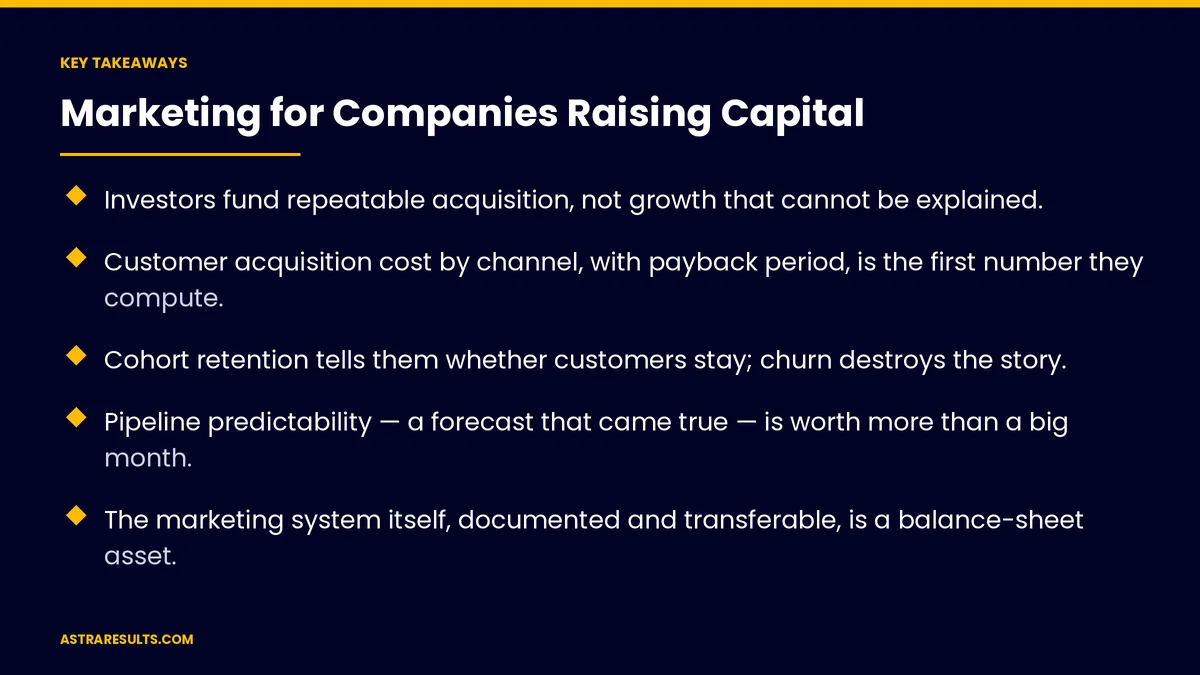
- Investors fund repeatable acquisition, not growth that cannot be explained.
- Customer acquisition cost by channel, with payback period, is the first number they compute.
- Cohort retention tells them whether customers stay; churn destroys the story.
- Pipeline predictability — a forecast that came true — is worth more than a big month.
- The marketing system itself, documented and transferable, is a balance-sheet asset.
- Start twelve months before the raise, because cohorts take that long to mature.
Published: September 17, 2026 | Reading Time: ~12 minutes | Category: Capital Readiness
This piece explains what a sophisticated investor looks for in a company's marketing, how to make those numbers exist and hold up, and how to sequence the work so the raise lands on a machine rather than a promise. Put plainly: investors do not fund growth; they fund repeatable acquisition.
Guidance for founders and operators. Nothing here is legal, securities, tax or financial advice. Any fundraising activity is subject to securities law and should be conducted with qualified counsel and advisors.
In This Playbook
- What investors read
- What belongs in a fully loaded acquisition cost?
- Cohort retention: do they stay
- Pipeline predictability
- The marketing system as an asset
- What to stop doing before a raise
- The twelve-month sequence
- What the data room should contain
- Working with Astra on this
What investors read
The deck says the company grew forty percent. The investor's next question is always the same: how, and can it happen again.
- The unspoken test. Is growth a system or a series of fortunate events? A company whose customers arrived through a founder's network, a viral moment and one lucky partnership has revenue but no acquisition machine. The investor is buying the machine.
- What "machine" means. Known channels, known costs, known conversion rates, known retention, and a forecast that has historically come true. Each of those is a marketing number, detailed in the four-stage engine.
- Where it shows up in diligence. The data room request list. Investors ask for acquisition cost by channel, cohort data, pipeline history and channel concentration. A company that cannot produce those in a week has already answered the question.
What belongs in a fully loaded acquisition cost?
CAC is the first number an investor computes, and the first place a story falls apart.
- The honest definition. All costs of acquiring customers in a period — media, agency, salaries of the people doing the acquiring, tools — divided by the customers acquired. Not media spend divided by leads.
- By channel. Blended CAC hides everything. A company with a cheap referral channel and an expensive paid channel has a blended number that describes neither. Investors want the breakdown, which is the subject of attribution by channel.
- Trend. Is CAC rising as the company scales? Rising CAC is normal; unexplained rising CAC is a red flag. The explanation — saturating a channel, moving into a harder segment — has to exist.
- Payback period. How many months of gross margin from a customer repay the cost of acquiring them. Under twelve is comfortable for most models. Over twenty-four needs a very good retention story.
- The trap. Founder-sourced customers counted at zero CAC. They are not free; they are unrepeatable, which is worse.
Cohort retention: do they stay
Acquisition is half the story. Whether customers stay is the other half, and it is where weak stories die.
- The cohort view. Customers acquired in a given month, tracked forward: how many are still customers, how much they spend, at three, six and twelve months.
- What good looks like. Flattening curves. A cohort that loses thirty percent in the first quarter and then stabilizes is a business. A cohort that keeps declining is a leaky bucket that acquisition is refilling.
- Retention by channel. The most important cross-cut and the least common. It routinely shows that the "expensive" channel produced customers who stayed and the "cheap" channel produced customers who left. That changes the CAC conversation completely.
- Why marketing owns this. Retention is driven by who you acquired and what happened after. Both are marketing's job in a full-funnel model.
- The time problem. Twelve-month cohorts require twelve months. A company that starts tracking cohorts three months before a raise has three months of cohorts. Start early.
Pipeline predictability
A forecast that came true is worth more than a big month.
- The record. Monthly forecast versus actual, for as many months as exist. Investors trust a company that predicted eighteen and got seventeen over one that predicted ten and got twenty-five, because the first one understands its machine.
- What makes a forecast possible. Stable conversion rates at each stage, a known lead volume by channel, and a sales cycle that has been measured. Each is a marketing or intake number.
- Channel concentration. A company with sixty percent of customers from one channel has a concentration risk, and investors price it. Diversification is not about having many channels; it is about not being one algorithm change from zero.
- The intake layer. Speed to lead, booked rate and show rate are the levers that turn lead volume into predictable pipeline, as covered in the intake standard. A company that answers every lead in five minutes has a more predictable funnel than one that does not, and that predictability is what the investor is buying.
The marketing system as an asset
Investors distinguish between a company with marketing spend and a company with a marketing system.
- What a system looks like in diligence. Documented channels with owners. Written intake scripts. A CRM with clean source data. Dashboards that the team uses. A content library that ranks and gets cited. Accounts and data in the company's name.
- Why it matters for valuation. A system transfers. If the founder left tomorrow, would customers keep arriving? A system says yes. A founder's Rolodex says no.
- Brand and organic as assets. Rankings, AI citations, reviews and a recognizable brand are assets that took time to build and that a competitor cannot buy quickly. They reduce dependence on paid acquisition, which improves CAC and payback.
- The account ownership check. Investors ask who owns the ad accounts, the domain, the analytics, the content. If the answer is an agency, that is a finding, according to the ownership principle.
What to stop doing before a raise
Some common practices actively damage the story.
- Vanity spending. Awareness campaigns with no measurement plan, in the months before a raise, look like burning cash to inflate top-of-funnel.
- Discount-driven growth. A spike in customers acquired with heavy discounts produces a cohort that does not retain, and the investor will find it.
- Channel sprawl. Launching four new channels to show "growth initiatives" fragments budget and produces no channel with enough data to defend.
- Reporting theater. Forty-page reports of impressions and followers. Investors read them as evidence that the company does not know what matters.
- Founder-only selling. If every large deal required the founder, the machine does not exist yet.
The twelve-month sequence
Cohorts take a year. The work starts a year before the raise.
Months 1–3: instrument
Attribution installed. Definitions written. CAC computed fully loaded by channel. Cohort tracking started. Forecast versus actual begun. Accounts moved into the company's name.
Months 4–6: fix the machine
Intake answered in minutes. Conversion at each seam improved. The weakest channel cut or fixed. The strongest channel scaled with CAC monitored.
Months 7–9: build the assets
Organic and AI search visibility. Reviews and referral systems. Content that compounds. Brand consistency across every surface.
Months 10–12: prove predictability
Three consecutive months of forecast versus actual within a defensible margin. Cohort curves flattening. The data room built from live dashboards, not from a scramble.
What the data room should contain
- CAC by channel by month, with the cost definition stated.
- Payback period by channel and blended.
- Cohort retention curves by acquisition month and by channel.
- Forecast versus actual for every month available.
- Channel concentration as a share of customers and revenue.
- Speed to lead and conversion by stage, from the CRM.
- The marketing system document: channels, owners, scripts, tools, and who owns each account.
- One page that tells the story the numbers support, and nothing the numbers do not.
Working with Astra on this
Astra Results Marketing builds the acquisition machine investors are buying: attribution installed so CAC by channel is honest, cohort tracking started early enough to mature, intake fixed so pipeline becomes predictable, organic and brand assets built to reduce paid dependence, and every account and dataset in the company's name.
The data room is assembled from live dashboards rather than a pre-raise scramble. Engagements begin with a capital-readiness diagnostic through our business consulting team, and Astra does not provide securities, legal or financial advice.
Related reading
Frequently asked questions
What do investors look for in marketing?
Whether growth is a system or a series of fortunate events. They want known channels with known costs, known conversion rates, known retention, and a forecast that has historically come true — because they are buying the acquisition machine, not last year's revenue. A company that cannot produce CAC by channel, cohort data and pipeline history within a week has already answered the question.
How should customer acquisition cost be calculated?
All costs of acquiring customers in a period — media, agency fees, the salaries of the people doing the acquiring, tools — divided by customers acquired, and broken out by channel because blended CAC hides everything. Alongside it, payback period: how many months of gross margin repay the acquisition cost. Founder-sourced customers are not zero-CAC; they are unrepeatable, which investors consider worse.
Why does cohort retention matter so much?
Because it shows whether acquisition is building a business or refilling a leaky bucket. Customers acquired in a given month are tracked at three, six and twelve months; flattening curves are a business, continuously declining ones are a warning. Retention by channel is the most important cross-cut and routinely shows the expensive channel produced the customers who stayed. Twelve-month cohorts take twelve months, so tracking must start early.
What is pipeline predictability and why is it valued?
A record of monthly forecast versus actual. Investors trust a company that predicted eighteen and got seventeen over one that predicted ten and got twenty-five, because the first understands its machine. Predictability comes from stable conversion rates, known lead volume by channel, a measured sales cycle and fast intake. Channel concentration above roughly sixty percent from one source is priced as risk.
Why is the marketing system itself an asset?
Because it transfers. Documented channels with owners, written intake scripts, a clean CRM, dashboards the team uses, a content library that ranks and gets cited, and accounts in the company's name mean customers keep arriving if the founder leaves. Brand, organic rankings and reviews are assets a competitor cannot buy quickly and reduce dependence on paid acquisition, which improves CAC and payback.
What should a company stop doing before a raise?
Unmeasured awareness spending that looks like inflating top-of-funnel, discount-driven customer spikes that produce cohorts that do not retain, launching several new channels at once so none has defensible data, forty-page reports of impressions and followers, and relying on the founder for every large deal. Each one undermines the claim that a repeatable machine exists.
READY TO RAISE ON A MACHINE INSTEAD OF A PROMISE? Astra Results Marketing builds the acquisition system investors are buying: honest CAC by channel, cohort tracking that matures in time, predictable pipeline, and a data room from live dashboards. Astra Results Marketing · 1101 Brickell Ave, Miami, FL 33131 · +1 (786) 321-2866 · [email protected] Find us on Google · Yelp ▸ CALL (786) 321-2866 · ▸ REQUEST YOUR CONSULTATION