Rated 5 star on


Marketing for Companies Preparing to Sell
Quick answer
A buyer pays for acquisition that keeps working after the founder leaves. Revenue that depends on the founder's relationships is discounted, and so is heavy concentration in one channel. The work that raises the multiple is unglamorous: accounts and data held in the company's name, documented processes, and a record showing the system repeating.
A buyer looks at a company's marketing and asks one question that the seller rarely asks themselves: what happens to the customers when the founder leaves? If the real answer is that most of them came from the founder's relationships, the buyer discounts the price, because they are buying a job, not a business.
Key Takeaways
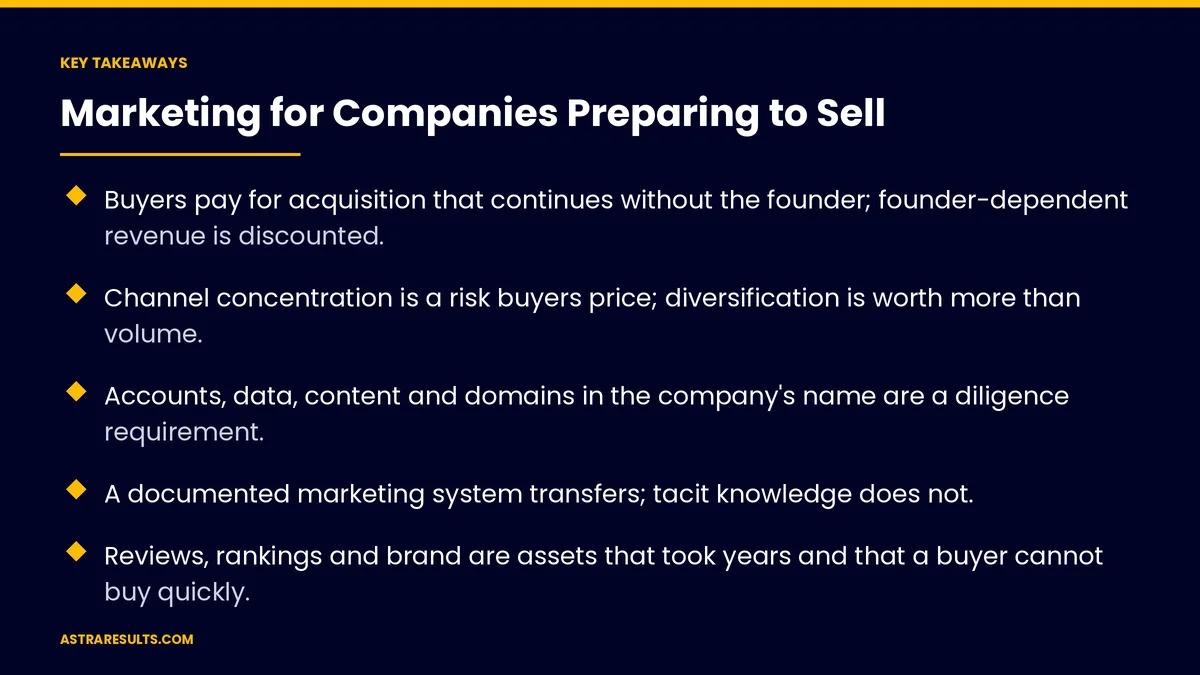
- Buyers pay for acquisition that continues without the founder; founder-dependent revenue is discounted.
- Channel concentration is a risk buyers price; diversification is worth more than volume.
- Accounts, data, content and domains in the company's name are a diligence requirement.
- A documented marketing system transfers; tacit knowledge does not.
- Reviews, rankings and brand are assets that took years and that a buyer cannot buy quickly.
- Start eighteen to twenty-four months out; buyers read trends, not snapshots.
Published: September 17, 2026 | Reading Time: ~12 minutes | Category: Exit Strategy
Marketing can be the asset that answers that question well — a documented, transferable system that produces customers without anyone specific in the room. This piece explains what a buyer looks for, what lowers the multiple, and the work that turns marketing from a line-item expense into something a buyer pays for. Stated simply: a buyer pays for customers that keep arriving after you are gone.
Guidance for owners and operators. Nothing here is legal, tax, M&A or financial advice. Any sale process is subject to law and should be conducted with qualified transaction counsel, accountants and advisors.
In This Playbook
- What a buyer reads in your marketing
- Founder dependence: the multiple killer
- Channel concentration
- Accounts, data and content in the company's name
- Documentation that transfers
- Why do reviews, rankings and brand count as assets?
- What lowers the multiple
- The eighteen-to-twenty-four-month sequence
What a buyer reads in your marketing
The seller sees marketing as a cost line. The buyer sees it as the answer to whether revenue is durable.
- Durability. Will customers keep arriving after the transaction? A machine says yes. A founder's phone says no, detailed in the acquisition machine investors buy.
- Transferability. Can the buyer's team run it? Documented channels, scripts and tools transfer. "Ask Maria, she knows how it works" does not.
- Risk. Where could acquisition break? One channel producing most customers, one person holding the relationships, one agency holding the accounts.
- Efficiency. What does it cost to acquire a customer, and is that cost stable? Rising CAC with no explanation is a finding.
- Upside. Are there channels the company never built that the buyer could? Sometimes the sale story is what marketing has not done yet, and that is fine, as long as what exists is solid.
Founder dependence: the multiple killer
The single largest marketing-related discount in a sale is revenue that depends on the founder.
- How it shows up. The founder is the face of the brand. The founder closes every large deal. The founder's personal network is the referral source. The founder's name is on the reviews.
- Why it costs. The buyer has to assume some of that revenue leaves with the founder, and prices accordingly. Earnouts and transition periods get longer.
- The fix takes time. Move the brand from the founder's name to the company's. Put other people in front of customers and on camera. Build referral systems that run through the company, not the founder's phone. Build inbound channels — search, AI search, reviews — that produce customers who never met the founder, laid out in the four-stage engine.
- The real test. Take the founder out of marketing for ninety days. If lead volume holds, the machine exists. If it collapses, the buyer will find the same thing in diligence.
Channel concentration
A company that gets sixty percent of customers from one source has a risk the buyer will price.
- What concentration looks like. One referral partner. One ad platform. One ranking that could move. One salesperson.
- Why buyers care. An algorithm change, a partner's exit or a departure could remove most of the pipeline. The buyer models that scenario.
- Diversification, correctly understood. Not eight channels. Three or four that each produce a meaningful share, each with its own measured cost per customer, laid out in attribution by channel.
- The organic layer. Search rankings, AI citations and reviews are the channels least dependent on continued spending, and they take years to build. A buyer values them because they cannot be replicated quickly and they keep producing after the deal.
Accounts, data and content in the company's name
The diligence request that surprises sellers most.
- What gets checked. Who owns the domain. Who owns the ad accounts. Who owns the analytics, the business profiles, the social accounts, the email list, the CRM data, the content, the video, the photography.
- The common finding. An agency owns the ad accounts. A former employee registered the domain. The social accounts are on the founder's personal login. The content was never assigned in a contract.
- Why it matters. Each of those is either a transfer problem, a legal question or a hostage situation. Buyers treat them as findings, and findings cost money or time.
- The fix. Everything in the company's name, with agencies and staff as managers who can be removed. Contracts that assign content. Logins in a company-controlled system. This is a term of engagement with any vendor, not a favor, according to the ownership principle.
Documentation that transfers
A system that lives in people's heads is not a system a buyer can pay for.
- What to document. Each channel: what it is, who runs it, what it costs, what it produces, how it is measured. The intake process: scripts, response standards, escalation. The tools: what they do, who administers them, what they cost. The content calendar and the standards it follows. The reporting: what is measured and why.
- The format. A marketing operations manual a competent new hire could run from. Not a strategy deck.
- The test. Hand it to someone outside the company and ask them to explain how a customer is acquired. If they can, it transfers.
- The side benefit. Companies that document their marketing to sell discover it works better in the process, because documenting forces the question of what each part is for.
Why do reviews, rankings and brand count as assets?
Some marketing assets took years and cannot be bought at closing.
- Reviews. Hundreds of recent, answered reviews under the company's name are an asset. Reviews under the founder's name, or concentrated years ago, are weaker.
- Rankings and AI citations. Organic visibility that produces customers without spend. Buyers value it precisely because it took time and reduces dependence on paid acquisition.
- Brand recognition. In the company's name, across every surface, consistent. A buyer inheriting a coherent brand has less to rebuild.
- Content library. Articles, videos and pages that rank, get cited and convert. An asset only if owned and only if it performs.
- The valuation logic. These assets lower future acquisition cost, and lower future acquisition cost is worth money to a buyer.
What lowers the multiple
- Discount-driven revenue in the year before sale, producing customers who do not retain.
- An unexplained spike in marketing spend or leads that looks like window dressing.
- Reporting that does not reconcile with the financials — marketing claims forty customers, the books show twenty-five.
- An agency dependency where nobody inside the company understands the marketing.
- Reputation problems unaddressed: unanswered negative reviews, a stale profile, a dead social account.
- Compliance gaps in consent, recording, data handling or advertising claims that a buyer's counsel will find.
The eighteen-to-twenty-four-month sequence
Buyers read trends. A snapshot is not enough.
Months 1–6: instrument and own
Attribution installed. CAC by channel computed. Cohort tracking started. Every account, domain and dataset moved into the company's name. Content ownership confirmed or contracted.
Months 7–12: de-risk
Founder moved out of the front of the brand. Second and third channels built to meaningful share. Intake standardized so pipeline does not depend on one person. Reviews systematically solicited under the company's name.
Months 13–18: build the assets
Organic and AI search visibility. Content library. Brand consistency across surfaces. Referral systems through the company.
Months 19–24: document and prove
The marketing operations manual. Twelve-month cohorts matured. Forecast versus actual on record. The ninety-day founder-absence test passed.
How Astra prepares a company to sell
Astra Results Marketing works with owners eighteen to twenty-four months before a planned exit to turn marketing into a transferable asset: attribution and cohorts that prove durability, founder dependence reduced with inbound and referral systems that run through the company, channels diversified to meaningful shares, every account and dataset in the company's name, and a marketing operations manual a buyer's team can run from.
Engagements begin with an exit-readiness diagnostic through our business consulting team. Astra does not provide M&A, legal, tax or financial advice.
Related reading
Frequently asked questions
What does a buyer look for in a company's marketing?
Whether customers keep arriving after the founder leaves. They read durability, transferability, risk and efficiency: documented channels with known costs, acquisition that does not depend on one person or one source, accounts and data in the company's name, and stable cost per customer. Founder-dependent revenue is discounted because the buyer is otherwise buying a job, not a business.
Why is founder dependence so costly in a sale?
Because the buyer has to assume some revenue leaves with the founder and prices accordingly, with longer earnouts and transition periods. The fix takes time: move the brand to the company's name, put other people in front of customers, build referral systems through the company, and build inbound channels that produce customers who never met the founder. The real test is removing the founder from marketing for ninety days.
What is channel concentration and why does it matter?
Getting most customers from one source — one partner, one platform, one ranking, one salesperson. A buyer models the scenario where that source disappears. Diversification means three or four channels each producing a meaningful share with its own measured cost, not eight channels. Organic search, AI citations and reviews are valued because they keep producing without spend and cannot be replicated quickly.
What ownership issues surface in diligence?
Who owns the domain, ad accounts, analytics, business profiles, social accounts, email list, CRM data, content and video. Common findings: an agency owns the ad accounts, a former employee registered the domain, social accounts sit on the founder's personal login, content was never assigned in a contract. Each is a transfer problem, a legal question or a hostage situation, and each costs money or time.
What does "documentation that transfers" mean?
A marketing operations manual a competent new hire could run from: each channel with its owner, cost, output and measurement; the intake scripts and standards; the tools and who administers them; the content standards; the reporting. The test is handing it to an outsider and asking them to explain how a customer is acquired. Companies that document to sell find the marketing works better in the process.
How far ahead should the work start?
Eighteen to twenty-four months, because buyers read trends rather than snapshots and twelve-month cohorts need twelve months to mature. The first six months instrument and move everything into the company's name; the next six de-risk founder dependence and concentration; the following six build organic and brand assets; the final six document and prove with matured cohorts and a passed founder-absence test.
READY TO MAKE MARKETING AN ASSET A BUYER PAYS FOR? Astra Results Marketing turns marketing into a transferable system before a sale: durability proven, founder dependence reduced, channels diversified, everything owned, and a manual a buyer's team can run. Astra Results Marketing · 1101 Brickell Ave, Miami, FL 33131 · +1 (786) 321-2866 · [email protected] Find us on Google · Yelp ▸ CALL (786) 321-2866 · ▸ REQUEST YOUR CONSULTATION