Rated 5 star on


How Astra Sequences Fast Wins Before Slow Compounding
Quick answer
Fast work changes what happens to demand that already exists: answering, conversion, search advertising, reviews. Slow work creates new demand and compounds, which takes months. Starting with the slow work spends a quarter producing nothing visible and loses the owner's confidence. The fast work buys the time the slow work needs to start paying.
Two marketing plans can contain identical work and produce opposite outcomes. The difference is the order. A plan that starts with slow compounding work spends four months producing nothing visible, loses the owner's confidence, and gets cancelled a month before it would have started working.
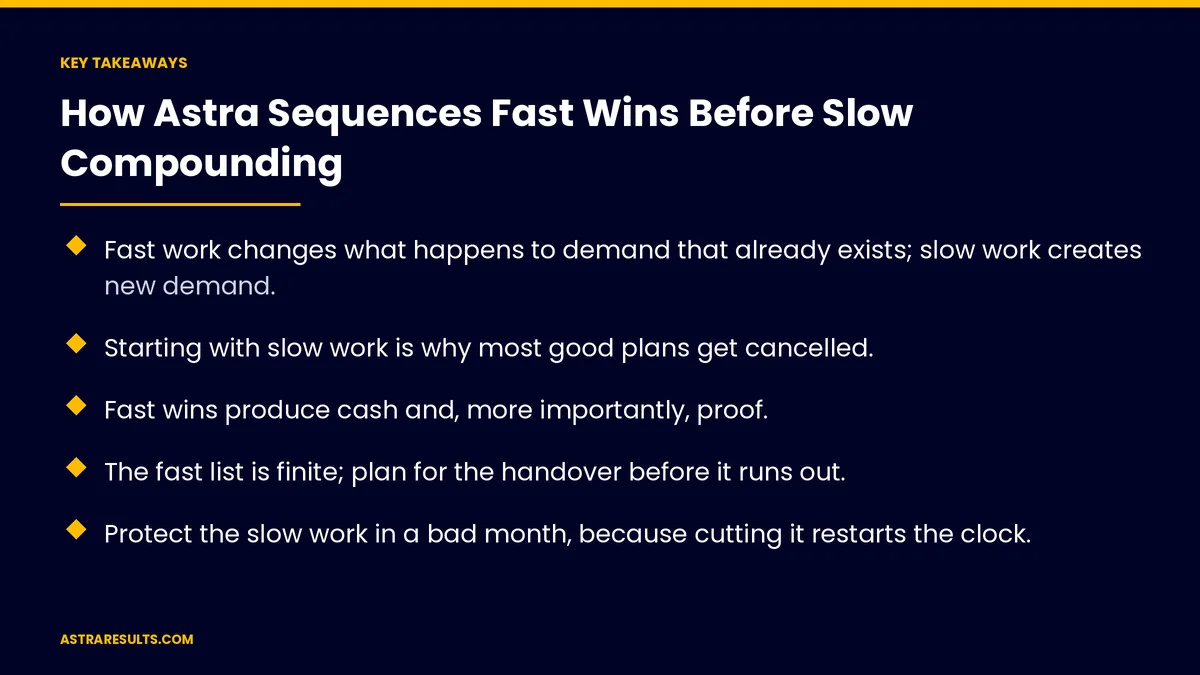
Key Takeaways
- Fast work changes what happens to demand that already exists; slow work creates new demand.
- Starting with slow work is why most good plans get cancelled.
- Fast wins produce cash and, more importantly, proof.
- The fast list is finite; plan for the handover before it runs out.
- Protect the slow work in a bad month, because cutting it restarts the clock.
- Judge each bucket on its own timeline, not on one shared calendar.
Published: September 14, 2026 | Reading Time: ~12 minutes | Category: Sequencing
This is not a scheduling detail. It is the single most common reason good marketing plans fail. This piece covers which work belongs in which bucket, why the order matters more than the contents, what to do when the fast work runs out, and how to protect the slow work when a month goes badly. Put plainly: the fast work buys the time the slow work needs.
Guidance for owners and operators. Nothing here is financial advice. Timelines vary by market, competition and starting position.
In This Playbook
- The two buckets
- Why order beats contents
- What the fast work usually is
- What the slow work usually is
- The handover between buckets
- Protecting slow work in a bad month
- How the review reflects the sequence
- When the sequence should be inverted
- How the first quarter runs
The two buckets
- Fast work. Changes what happens to demand the business already has. Response time, follow-up cadence, negative keywords, landing page fixes, review requests, intake coverage, checkout friction. Results appear in weeks because the demand is already arriving.
- Slow work. Creates demand that does not exist yet, or builds an asset. Organic search, AI citation presence, content, brand awareness, connected TV, referral systems, reputation. Results appear over quarters because the mechanism is accumulation.
- Why the distinction is not about effort. Some fast work is hard and some slow work is easy. The difference is whether the result depends on existing demand or on building something.
- The diagnostic question. If this works, when would we see it? Weeks means fast bucket. Quarters means slow bucket. Anything claimed to be both is neither.
- The link to diagnosis. Which fast work matters depends on where the constraint sits, as set out in finding the binding constraint.
Why order beats contents
- The confidence problem. A business paying for marketing needs evidence it is working before its patience runs out, and patience is shorter than most plans assume.
- What happens with slow work first. Months one to three produce rankings that have not converted, content nobody has found yet, and a brand campaign with no attributable revenue. The owner reasonably asks what they are paying for.
- What happens with fast work first. Month one produces answered leads and recovered quotes. Month two produces booked customers from demand that was already being paid for. The owner sees the mechanism working and extends trust to the part that takes longer.
- The compounding irony. The slow work is the more valuable half. Starting with it is what prevents it from ever paying off.
- The cash dimension. Fast wins fund the slow work directly, which matters for businesses without a large marketing reserve.
What the fast work usually is
- Answering. Speed to lead, after-hours coverage, and a response to every inbound contact. Almost always the largest single available gain, as detailed in where the leaks are.
- Following up. The second, third and fourth contacts on quotes that went out and went quiet.
- Waste removal. Negative keywords, ad schedules matched to when someone answers, and campaigns that produce leads the business cannot serve.
- Landing pages. Sending paid traffic to a page about the thing that was searched rather than a homepage.
- Review requests. Asking every satisfied customer, systematically, which lifts local visibility and conversion at once.
- Reactivation. Contacting past customers who have not bought in a year, which is the cheapest revenue in most businesses.
- The pattern. None of it requires new demand. All of it recovers value already paid for.
What the slow work usually is
- Organic search. Technical health, intent-matched pages, depth, authority. Quarters to matter and years to compound, as covered in honest SEO timelines.
- AI citation presence. Content structure, entity consistency and authority that make a business a source answer engines quote.
- Brand awareness. Connected TV, video, social presence. Builds recognition that makes every other channel convert better and shows up as branded search rather than clicks.
- Referral and reputation systems. Systematized rather than accidental, compounding as the customer base grows.
- Content libraries. Pages that produce customers for years without further spend.
- Data foundations. Connected systems and recorded outcomes, which unlock everything later and produce nothing immediately, as explored in the data foundation.
The handover between buckets
- The fast list is finite. A business can only answer its phone once. After the obvious recoveries, the easy gains are gone.
- When it runs out. Usually two to four months in, when response time is fixed, waste is cut and follow-up is systematic.
- What that means for the plan. The slow work must already be underway by then, or the business hits a flat month with nothing in the pipeline.
- The practical rule. Start the slow work in month two, funded by month one's gains, even though nothing will come of it for a while.
- The signal to watch. When fast-win improvements stop moving the numbers, the business is relying on the slow work, and the question becomes whether it was started early enough.
Protecting slow work in a bad month
- The reflex. Revenue dips and the first cut is the line item with no attributable return this month — which is always the slow work.
- Why it is the wrong cut. Stopping compounding work does not pause it; it restarts it. Rankings decay, content stops accumulating, citation presence fades.
- The better cut. Underperforming fast spend, which stops costing immediately and can be restarted instantly.
- The conversation to have in advance. Agreeing before a bad month which lines are protected, so the decision is not made under pressure.
- The exception. A business in genuine cash difficulty should cut everything that does not produce this month, and should be told that plainly rather than encouraged to keep spending.
How the review reflects the sequence
- Judge each bucket on its own clock. Fast work reviewed monthly on customers produced. Slow work reviewed quarterly on leading indicators — rankings, citations, branded search, review volume — and annually on customers.
- The mistake to avoid. Applying a monthly revenue test to work that takes two quarters, which guarantees cancelling it.
- The leading indicators that matter. For organic, commercial-intent impressions and rankings on terms that convert. For AI, presence in a test set of buyer questions. For brand, branded search volume. For referral, the share of customers arriving by recommendation.
- What to report. Both buckets, separately labeled, with their own timelines stated, as set out in the monthly review.
When the sequence should be inverted
Fairness requires naming the exceptions.
- No demand to fix. A business with excellent conversion and almost no leads has nothing to recover, so the slow work is the only work.
- A new business. No existing demand, no past customers, no quotes to follow up. The fast bucket is nearly empty.
- A structural threat. A competitor's organic position or an algorithm change that will cost the business its main channel demands the slow work start immediately regardless of cash.
- A known seasonal deadline. Work that must be in place before a season starts cannot wait for a sequence.
- The principle behind the exceptions. The sequence exists to protect the slow work by proving the mechanism first. Where there is nothing to prove, the reason disappears.
How the first quarter runs
Days 1–30: fast work only
The constraint identified and addressed — usually answering and following up. Waste removed from paid. Review requests systematized. Everything measured against a recorded baseline.
Days 31–60: fast gains banked, slow work begun
The first fast-win results reported. Technical health, content and entity work started with no expectation of return yet. The protected-lines conversation held before any bad month arrives.
Days 61–90: both running, reviewed separately
Fast work reviewed on customers produced. Slow work reviewed on leading indicators only. The handover point identified, and the plan for when the fast list runs out agreed.
How Astra handles it
Astra Results Marketing puts the work that recovers existing demand first — answering, following up, removing waste — because it produces cash and proof within weeks, and the proof is what buys patience for the work that takes quarters.
The slow work starts in month two rather than after the fast list is exhausted, so the business does not hit a flat month with nothing accumulating. Which lines are protected in a difficult month is agreed in advance rather than under pressure, and each bucket is reviewed on its own clock.
Where a business should cut everything that does not produce this month, that is said plainly. Engagements begin with a diagnostic and sequencing plan through our business consulting team.
Related reading
Frequently asked questions
What is the difference between fast and slow marketing work?
Fast work changes what happens to demand the business already has — response time, follow-up, negative keywords, landing pages, review requests — and shows results in weeks because the demand is already arriving. Slow work creates demand or builds an asset: organic search, AI citation presence, brand, referral systems, data foundations. The diagnostic question is simple: if this works, when would we see it?
Why does the order matter more than the contents?
Because a business needs evidence before its patience runs out, and patience is shorter than most plans assume. Slow work first produces three months of rankings that have not converted and content nobody has found, and the owner reasonably asks what they are paying for. Fast work first produces answered leads and booked customers, and that proof extends trust to the part that takes longer.
When does the fast work run out?
Usually two to four months in, once response time is fixed, waste is cut and follow-up is systematic — a business can only answer its phone once. That is why the slow work should start in month two, funded by the first gains, even though nothing comes of it for a while. Otherwise the business hits a flat month with nothing accumulating in the pipeline.
What should be cut when a month goes badly?
Underperforming fast spend, which stops costing immediately and restarts instantly. Not the slow work: stopping compounding work does not pause it, it restarts it, because rankings decay, content stops accumulating and citation presence fades. Which lines are protected should be agreed before a bad month, so the decision is not made under pressure.
How should each type of work be reviewed?
On its own clock. Fast work monthly, on customers produced. Slow work quarterly on leading indicators — commercial-intent rankings, presence in a test set of buyer questions, branded search volume, referral share — and annually on customers. Applying a monthly revenue test to work that takes two quarters guarantees cancelling it.
When should the sequence be inverted?
When there is no existing demand to recover: a business with excellent conversion and almost no leads, or a new business with no past customers and no quotes outstanding. Also when a structural threat to the main channel demands the slow work start immediately, or when a seasonal deadline cannot wait. The sequence exists to protect slow work by proving the mechanism first; where there is nothing to prove, the reason disappears.
READY FOR A PLAN IN THE ORDER THAT SURVIVES? Astra Results Marketing recovers existing demand first for cash and proof, starts the compounding work in month two, and agrees which lines are protected before a difficult month arrives. Astra Results Marketing · 1101 Brickell Ave, Miami, FL 33131 · +1 (786) 321-2866 · [email protected] Find us on Google · Yelp ▸ CALL (786) 321-2866 · ▸ REQUEST YOUR CONSULTATION