Rated 5 star on


React Native: One Team, Two App Stores
Quick answer
React Native shares most business logic and ordinary screens across iOS and Android, and leaves platform differences in the last stretch of the work. Native modules are the escape hatch, and needing several of them changes the economics enough to reconsider. The framework is a hiring and maintenance decision as much as a technical one.
React Native is the framework most business apps end up on, and the reasons are unglamorous: the talent pool is large, the ecosystem is mature, and a team that already builds web applications can build the mobile app without hiring two new specialists. For a company choosing where to put a limited budget, those practicalities matter more than benchmarks.
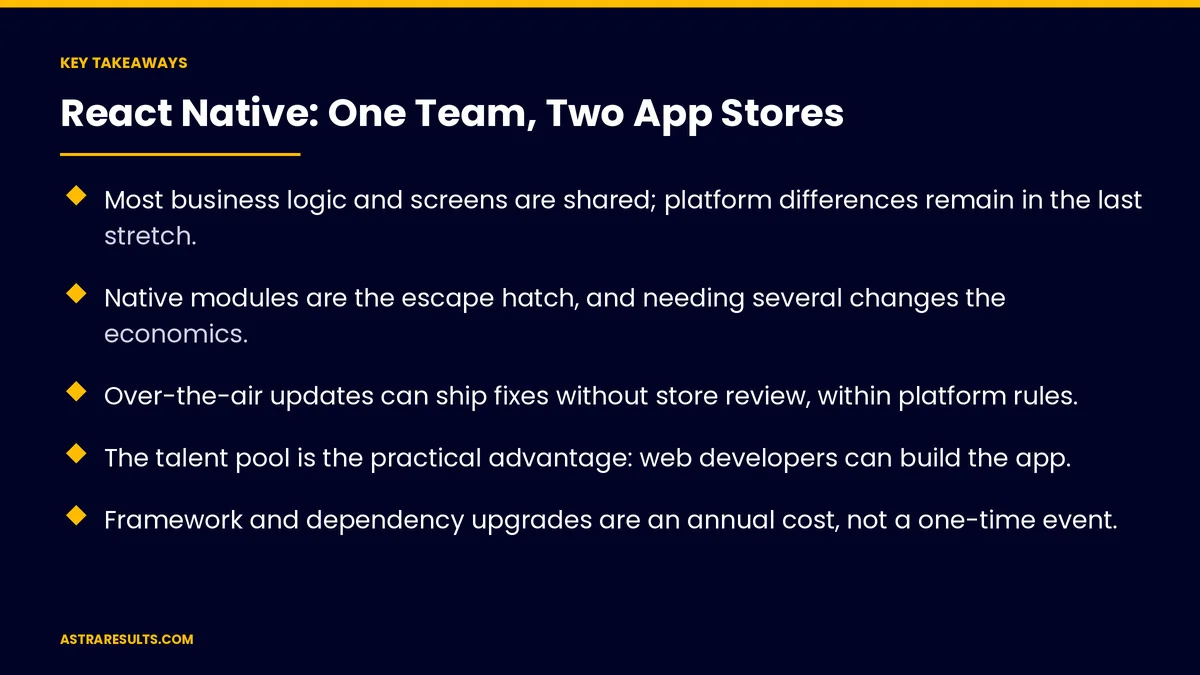
Key Takeaways
- Most business logic and screens are shared; platform differences remain in the last stretch.
- Native modules are the escape hatch, and needing several changes the economics.
- Over-the-air updates can ship fixes without store review, within platform rules.
- The talent pool is the practical advantage: web developers can build the app.
- Framework and dependency upgrades are an annual cost, not a one-time event.
- Choose it for fit and team, not because it is popular.
Published: September 20, 2026 | Reading Time: ~13 minutes | Category: React Native
This guide is what a business owner needs to know before committing: what actually gets reused, when native code is still required and what that costs, how over-the-air updates change release cycles, and the upgrade tax that surprises companies two years in. Reduced to a sentence: the framework is a hiring and maintenance decision as much as a technical one.
Guidance for owners and operators. Nothing here is legal or technical advice. App store policies, including rules on remotely updating app behavior, change and should be verified before relying on them.
In This Playbook
- What React Native is, in plain terms
- What gets reused
- Native modules: the escape hatch and its price
- Over-the-air updates
- The hiring advantage
- The upgrade tax
- When React Native is the wrong choice
- Choosing between frameworks
- A three-month sequence
What React Native is, in plain terms
- The idea. Write the app once in the same language most web developers already use, and the framework renders real native components on each platform rather than a web page in a shell.
- Why that matters. The buttons, lists and navigation are the platform's own, so the app feels native to the user, unlike the wrapped-website approach of a decade ago.
- What is shared. The logic, the data handling, the API calls, the screen structure and most styling.
- What is not. Anything that touches a platform capability the framework does not cover, and the design details each platform expects.
- The maturity point. It has been used in production by large consumer apps for years. The question is no longer whether it works, but whether it fits a specific app, detailed in the cross-platform decision.
What gets reused
- Business logic. Rules, calculations, validation, state. Written once.
- Data and networking. API calls, caching, offline storage, synchronization. Written once.
- Screens and navigation. The structure of the app, shared with platform-appropriate patterns applied.
- Most styling. With deliberate differences where each platform's conventions demand them.
- What is written twice or once-per-platform. Native module bridges, platform-specific permissions handling, store configuration, push notification setup, and the small adjustments that stop the app feeling foreign on either platform.
- The realistic share. A large majority of the codebase shared for a typical business app, less as the app gets closer to hardware.
Native modules: the escape hatch and its price
This is the part that decides whether React Native was the right call.
- What they are. Platform-specific code written in each platform's own language, exposed to the shared codebase. The bridge for anything the framework does not handle natively.
- When they are needed. Uncommon hardware, specialized SDKs, background behavior that fights platform rules, performance-critical processing, and any vendor library that ships native-only.
- What they cost. Each one is effectively two small native projects plus the integration. One or two is normal. Several means the app is fighting the framework, and the savings evaporate.
- The existing ecosystem. Many common needs — camera, maps, payments, notifications, biometrics — already have well-maintained community modules, which is a large part of the framework's practical value.
- The diligence step. Before committing, list every device capability and third-party SDK the app needs and check each against the ecosystem. The surprises found here are the ones that matter.
Over-the-air updates
A genuine advantage worth understanding precisely.
- What it allows. Shipping changes to the app's shared code directly to installed apps, without a store submission or review.
- Why it matters. A bug found on Friday can be fixed Friday, rather than waiting on review. For businesses with field workforces on a critical app, this is the difference between an afternoon and a week.
- What it does not cover. Changes involving native code still require a full store release.
- The rules. Platforms permit this within limits — broadly, fixing and improving an existing app rather than substantially changing what it does. The policies are specific and they change, so they should be verified rather than assumed.
- The discipline. Over-the-air updates make it easy to ship carelessly. The same testing standard should apply, with staged rollout and the ability to roll back.
The hiring advantage
The reason many businesses land here, and a legitimate one.
- The talent pool. Developers who work in the dominant web framework can build React Native apps with modest additional learning. That pool is far larger than the pool of native iOS or Android specialists.
- Cost and availability. Easier to hire, easier to replace, and easier to find an agency, which reduces key-person risk on a long-lived app.
- The web team argument. A company with an existing web application can often share logic, patterns and people between web and mobile.
- The caveat. Someone on the project still needs to understand both platforms. A team with no native experience will eventually hit a native problem and stall.
- The continuity question. Whoever builds it, can another team take it over? That is a contract and documentation question as much as a technical one, detailed in ownership settled before work starts.
The upgrade tax
The cost that surprises companies in year two.
- What it is. The framework releases regularly, dependencies update, platforms require new target versions, and an app that skips upgrades becomes progressively harder to update at all.
- What it looks like in practice. A yearly upgrade effort touching the framework version, the native dependencies and the store requirements. Modest when done annually, painful when deferred three years.
- The dependency risk. Community modules can be abandoned. An app relying on an unmaintained module for something critical faces a rewrite of that piece.
- How to reduce it. Prefer well-maintained modules, minimize the number of dependencies, keep upgrades annual, and budget for them explicitly, according to maintenance from day one.
- The right framing. This is not a React Native flaw; every mobile app has a maintenance cost. It is a line item that gets left out of quotes.
When React Native is the wrong choice
- Hardware-heavy apps. Continuous camera processing, on-device vision, Bluetooth peripherals, rugged scanner integration. Native handles these with less friction.
- Performance-critical interfaces. Real-time graphics, animation-dense experiences, very large data-heavy lists.
- Single-platform apps. An Android-only field app gains nothing from a cross-platform framework and pays its overhead.
- Deep platform integration. Where widgets, watch apps or platform-specific system features are central rather than incidental.
- Teams with strong native skills already. Using what a team is excellent at is better than adopting what is popular.
Choosing between frameworks
- The short answer. For most business apps, either of the leading cross-platform frameworks will work, and the difference matters less than scope, design quality and maintenance discipline.
- What should decide it. The team's existing skills, the availability of modules for the specific capabilities needed, and who will maintain it.
- What should not decide it. Benchmarks unrelated to the app, framework popularity, or a developer's preference unexamined.
- The reversibility point. Switching frameworks later means a rewrite. The decision deserves the hour it takes to check requirements against ecosystems.
A three-month sequence
Days 1–30: verify fit
Every device capability and third-party SDK listed and checked against the ecosystem. Native module needs identified and estimated. The supported OS versions and devices agreed. The maintenance and upgrade budget agreed before the build, not after.
Days 31–60: build the core
The shared logic, data layer and primary screens, with platform navigation conventions respected on each. Real devices from both platforms in testing from the first week. Over-the-air update infrastructure set up with staged rollout.
Days 61–90: harden and submit
Native modules completed and tested. Both store submissions prepared in parallel, with time budgeted for rejection. Crash and performance monitoring by platform. The upgrade cadence and named maintenance owner in place before launch.
How Astra handles it
Astra Results Marketing checks the requirements against the ecosystem before recommending a framework: every device capability and third-party SDK listed, native module needs estimated without optimism, and the recommendation changed to native when the app is hardware-heavy or single-platform.
The maintenance and annual upgrade budget is agreed before the build rather than discovered in year two, over-the-air updates are set up with staged rollout and rollback, and the code is documented so another team could take it over. Engagements begin with a capability and framework assessment through our UI/UX development and design team.
Related reading
Frequently asked questions
What does React Native actually share between platforms?
Business logic, data handling and networking, offline storage and sync, screen structure and most styling — a large majority of a typical business app's codebase. What is written per platform is native module bridges, permissions handling, store configuration, push notification setup, and the design adjustments that stop the app feeling foreign on either platform. The shared share falls as the app gets closer to hardware.
What are native modules and when do they matter?
Platform-specific code exposed to the shared codebase, used for uncommon hardware, specialized SDKs, background behavior that fights platform rules, performance-critical processing and vendor libraries that ship native-only. One or two is normal. Several means the app is fighting the framework and the savings evaporate, which is why every device capability and third-party SDK should be checked against the ecosystem before committing.
What are over-the-air updates?
Shipping changes to the app's shared code directly to installed apps without a store submission, so a bug found on Friday can be fixed Friday rather than waiting on review. Changes involving native code still need a full release. Platforms permit this within limits — broadly fixing and improving rather than substantially changing what the app does — and those policies are specific and change, so they should be verified rather than assumed.
Why do businesses choose React Native?
Largely for hiring. Developers who work in the dominant web framework can build React Native apps with modest additional learning, and that pool is far larger than native iOS or Android specialists — easier to hire, replace and find an agency for, which reduces key-person risk on a long-lived app. The caveat is that someone still needs to understand both platforms, or the team will stall on the first native problem.
What is the upgrade tax?
The annual cost of keeping the framework version, native dependencies and store requirements current. Modest when done yearly, painful when deferred three years, and occasionally serious when a community module the app depends on is abandoned. It is not a React Native flaw — every mobile app carries maintenance — but it is a line item routinely left out of quotes.
When is React Native the wrong choice?
Hardware-heavy apps with continuous camera processing, on-device vision, Bluetooth peripherals or rugged scanners. Performance-critical interfaces with real-time graphics or very large data-heavy lists. Single-platform apps, such as an Android-only field app, which gain nothing and pay the overhead. Deep platform integration where widgets or watch apps are central. And teams already strong in native, where using existing excellence beats adopting what is popular.
READY TO CHECK WHETHER THE FRAMEWORK FITS BEFORE YOU COMMIT? Astra Results Marketing lists every capability and SDK against the ecosystem first, recommends native when the app is hardware-heavy or single-platform, and agrees the upgrade budget before the build. Astra Results Marketing · 1101 Brickell Ave, Miami, FL 33131 · +1 (786) 321-2866 · [email protected] Find us on Google · Yelp ▸ CALL (786) 321-2866 · ▸ REQUEST YOUR CONSULTATION