Rated 5 star on

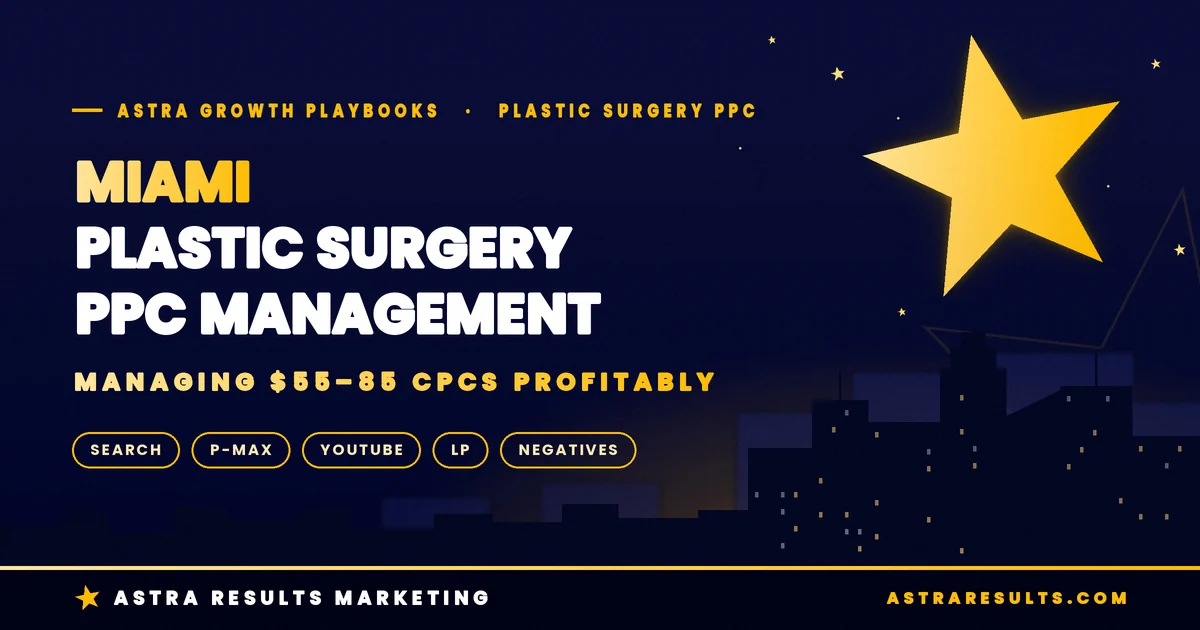
Miami Plastic Surgery PPC: Managing $55-85 CPCs Profitably
Quick answer
At fifty-five to eighty-five dollars per click, the difference between profit and donation is discipline: procedure-level architecture, ruthless negatives, landing pages matching the ad's promise, and reporting that ties keywords to booked cases. The largest hidden loss is negative-keyword neglect, which costs the vertical fifteen to thirty percent of spend most accounts never audit.
Plastic surgery is among the most expensive click auctions in all of paid search, and Miami sits in its top band. In-market prices commonly land between $55 and $85 for high-intent procedure and neighborhood terms, and the priciest phrases climb well beyond that. National aesthetic brands run institutional budgets against those numbers. Cosmetic surgery chains subsidize acquisition with volume. Injector-heavy med spas bid against the same words for lower-priced treatments that convert differently. Against that field, the wrong question is "how do we win the auction." The right one is: "how do we operate the auction so it produces booked consultations and signed cases at prices our economics can sustain."
Key Takeaways
- At $55–85 CPCs, the difference between profit and donation is discipline: procedure-level architecture, ruthless negatives, landing pages that match the ad's promise, and reporting that ties keywords to booked cases.
- The single largest source of hidden loss is negative-keyword neglect — the vertical loses 15–30% of spend to job seekers, students, celebrity news, financing-only intent, and out-of-scope queries most accounts never audit.
- Meta ads restrict before/after imagery and personal-attribute targeting for cosmetic procedures — ads must lead with education, credentials, and offers, while consented results do their converting on-site.
- Optimize to consultations and signed cases in your PMS, not to lead-form completions — the practices that only measure leads over-pay for cheap forms that never book.
- Spanish-language campaigns typically face a thinner auction with commercial-grade intent; they convert only when the ad, landing page, and intake are Spanish end to end.
- Performance Max is powerful for aesthetic accounts only when its audience signals, asset exclusions, and campaign-level negatives are actively managed — never handed to the algorithm unattended.
Published: August 9, 2026 | Reading Time: ~15 minutes | Category: Plastic Surgery · Paid Media
That is the entire craft of Miami plastic surgery PPC — and this Authority guide is its operator's manual. It is the channel-level companion to our Miami plastic surgery playbook, which sets the strategy this account architecture executes. The account you will read your way to has four working parts: procedure-level structure that lets each service line be measured and steered independently, a negative-keyword system disciplined enough to reclaim the 15–30% of spend the category quietly loses to wrong intent, landing pages engineered to hold what the ad promised, and a reporting spine that closes the loop from click to booked case in your practice management system. Everything else is decoration. Marketing guidance for practices only; clinical claims belong to your providers, all copy and imagery pass your compliance review, and platform advertising policies govern what actually runs.
In This Playbook
- The Miami Plastic Surgery Auction: What Makes It Priced This Way
- Procedure-Level Account Architecture
- Negatives: The 15–30% Reclamation
- Landing Pages That Hold the Promise
- Performance Max, Used Deliberately
- Meta Ads, YouTube, and the Restrictions That Shape Creative
- Bidding: What Machine Learning Wants From You
- Attribution and Reporting: Click to Case
- Common Failure Modes to Avoid
- A 90-Day Rebuild Plan
The Miami Plastic Surgery Auction: What Makes It Priced This Way
Three structural facts explain the price and dictate the counterplay.
- Case values fund the bids. A rhinoplasty, breast augmentation, or mommy makeover carries a five-figure revenue value with real gross margin, which anchors what a competitor is rationally willing to pay for a click that might contain one. In economic language, the market clears at the marginal advertiser willing to pay right below the value of the average signed case. If your account cannot convert clicks at competitive rates, you are subsidizing everyone else who can — with your budget.
- The field is stacked. National brands run cross-market budgets. Chains centralize call-center intake and pay for it out of a lifetime-value model that penalizes single-practice pricing. Lead-gen and directory sites resell the same inquiry multiple times, which lets them out-bid any single practice. Meanwhile, unrelated queries — surgical training, celebrity procedures, DIY research, financing shopping — inflate the average CPC of every campaign that fails to exclude them.
- Miami's aesthetic density amplifies both. More than 150 board-certified plastic surgeons practice within a compressed metro alongside cosmetic surgeons, dermatologists, and aesthetic med spas. Every neighborhood, every procedure, and every language runs a real auction between real competitors. With the biggest budgets pointed at the same six or eight procedure terms nearly everyone bids on.
The playbook that follows is not built on out-bidding this field. It is built on operating so cleanly around it that at any given CPC, your ratio of clicks to booked cases is meaningfully better than the account next to yours.
Procedure-Level Account Architecture
A single "plastic surgery" campaign is where budgets die at Miami prices. The account has to isolate each service line so it can be measured, bid, negatived, and creatively steered independently.
The default architecture is one campaign per signature procedure. Rhinoplasty, breast augmentation, mommy makeover, tummy tuck, liposuction (with BBL treated per your compliance and clinical decision), facelift, gynecomastia. Each with its own ad groups by intent tier, its own budget, its own negatives, its own landing page, and its own bid strategy. A separate campaign covers brand terms (yours and, cautiously, plausible competitor comparisons. Many practices choose not to bid on named competitors for professional reasons; check with your ethics counsel and platform policies). Intent-tier ad groups inside each procedure campaign follow the pattern:
- High intent: "rhinoplasty Miami," "rhinoplasty [neighborhood]," "best rhinoplasty surgeon Miami," "rinoplastia en Miami," "consulta rinoplastia Miami." Exact and phrase match, higher bids, mapped to procedure-specific landing pages.
- Research intent: "rhinoplasty recovery time," "rhinoplasty cost Miami," "rhinoplasty before and after." Phrase match, moderate bids, mapped to educational content. With clear CTAs to consult booking, and expected conversion rates far lower than high-intent traffic.
- Comparative intent: "open vs closed rhinoplasty," "ultrasonic rhinoplasty Miami." Phrase match, moderate bids, pointed at comparison content that positions your practice's approach honestly.
Add a Spanish sibling for each ad group with natively written copy pointing to Spanish landing pages. Never mix languages inside one ad group — it wrecks relevance and quality scores in both. And add corridor-level geo-targeting or bid modifiers layered on top: Brickell, Coral Gables, Coconut Grove, Miami Beach. The neighborhood method our ranking strategy prescribes applies to paid as much as maps.
One consolidation temptation to resist: do not merge low-volume procedures into a single ad group to "get enough data." Small campaigns can be paused; blurred campaigns cannot be steered.
Negatives: The 15–30% Reclamation
Negative-keyword discipline is the single most under-invested lever in aesthetic PPC, and at Miami CPCs it routinely reclaims a meaningful share of wasted spend. Build a themed shared negative list, layered onto every campaign, and audit the search-terms report weekly.
- Career and training queries — "plastic surgery jobs," "plastic surgery training," "plastic surgery school," "how to become a plastic surgeon," "esthetician certification," "residency Miami" — waste is invisible until you look.
- Celebrity and news intent — "[celebrity name] plastic surgery," "plastic surgery gone wrong," "before and after celebrity" — these clicks never book.
- Financing-only intent — "free plastic surgery," "cheap BBL," "plastic surgery grants," "financing bad credit". The intent behind these searches is to avoid paying market prices; premium practices should not compete for them regardless of CPC.
- Reconstructive out-of-scope — if your practice does not offer reconstructive work, negative "reconstructive," "breast reconstruction after mastectomy," "revision surgery" where you do not offer revision.
- DIY research — "plastic surgery at home," "DIY," "reddit," "quora," where those platforms are not appropriate for a paid destination.
- Wrong geography — "Miami OK," "Miami University," "Miami Ohio," "Miami of Ohio," "plastic surgery Miami Beach [state that is not Florida]." Yes, some of these actually run against Miami accounts and yes, they cost you money.
- Related but wrong procedure — layer procedure-specific negatives so a rhinoplasty campaign does not answer "breast augmentation" queries and vice versa.
Run the audit weekly. In a typical Miami aesthetic account, the first four weeks of disciplined negatives recover enough spend to fund an entire additional procedure campaign — before any other optimization.
Landing Pages That Hold the Promise
At Miami prices, a click that lands on a homepage or a generic "plastic surgery" page has already been wasted. Every procedure ad must land on a procedure-specific page built to convert this exact traffic.
The elements that actually move conversion rate: a headline that mirrors the ad and the query. If the ad said "rhinoplasty Brickell," the page says "rhinoplasty in Brickell". A surgeon photograph and credentials above the fold (board certification named precisely, hospital privileges, years in practice). Consented before-and-after galleries organized by case type. Honest treatment of process, recovery, and pricing in the format your practice publishes it. Social proof — reviews and specific patient sentiments. Placed at the trust-critical moments. A single primary CTA (consultation booking) available at the top, midpoint, and end of the page. And bilingual mirroring with proper hreflang so the Spanish ad lands on the Spanish page.
Speed matters materially. A page that takes four seconds to load on mobile loses a meaningful share of clicks a Miami practice paid $70 apiece for. Get Core Web Vitals green, compress imagery, and prioritize the elements above the fold.
And keep compliance in the copy: no outcome guarantees, no "best" or comparative superlatives absent verifiable proof, precise credentials, testimonials and results treated per HIPAA and platform advertising policy, and consent-workflow records maintained for every image displayed. Consult your compliance counsel on the specific requirements for your services; pages that clear internal review the first time compound a speed advantage as the account scales.
Performance Max, Used Deliberately
Performance Max is genuinely useful in aesthetic accounts — and dangerous when handled the way Google's onboarding flow suggests. It combines Search, Display, YouTube, Discover, Gmail, and Maps in one automated campaign steered by audience signals and creative assets. The upside is scale and cross-surface reinforcement; the downside is opacity — without active management, P-Max sprays budget across surfaces you never intended to fund.
The management standard: strong audience signals from real converters (existing patients, converted call lists, high-intent site visitors). High-quality creative variety — multiple headlines, descriptions, images (consented, platform-compliant), and video variations. Account-level negative keywords and campaign-level negative themes to keep it out of the waste categories above. Asset group segmentation by procedure so its outputs remain legible; and — critically — regular review of the placements report and search-terms insights, with pruning applied ruthlessly. Treat P-Max as a scaling layer on top of a well-run search account, not a replacement for it. And exclude the search terms your search campaigns are already winning at good CPAs — otherwise P-Max cannibalizes efficient search traffic and reports the results as its own.
Meta Ads, YouTube, and the Restrictions That Shape Creative
Paid social matters for aesthetic acquisition, and Meta specifically shapes what your ads can look like. Meta restricts before/after imagery and body-transformation framing in cosmetic-procedure ads, and restricts targeting on personal attributes. You cannot target ads based on someone being described as a candidate for a specific procedure, and personal-hardship-adjacent framing is limited. Plan around it: ads lead with education, brand, credentials, and consultation offers. Consented result imagery lives on your site and organic feed where it converts most. And creative that clears review the first time is a compounding speed advantage as the account scales. The full social strategy is our Miami med spa Instagram guide; paid Meta is one lever inside it.
- YouTube converts differently but predictably. Aesthetic decisions are visual and personal, and surgeon-led explanations — technique, candidacy honestly stated, recovery expectations — accelerate trust the way no landing page can. Run in-stream and in-feed formats targeted by procedure interest, life events where policy allows, and geographic corridor. YouTube's contribution shows up in view-through and assisted conversions rather than last-click bookings — measure it accordingly or you will kill an asset that is actually working.
Bidding: What Machine Learning Wants From You
Google's bid strategies work well in aesthetic accounts when you feed them the right signal — and terribly when you feed them the wrong one. The rule: bid to the deepest reliable conversion event, and give the algorithm at least the recommended conversion volume per campaign before running smart bidding.
For most Miami plastic surgery accounts, that means Target CPA or Maximize Conversions on booked consultations (not raw leads). With call tracking capturing phone-book conversions, form submissions verified as real intent, and duplicate/spam signals suppressed before the conversion fires. Where the account has enough signed-case data, Target ROAS with case value as the conversion value produces the strongest optimization pressure. But requires disciplined offline conversion imports back into Google Ads.
Two failure modes to avoid: optimizing to lead-form fills alone (the algorithm learns to find cheap form-fillers who never book), and starting smart bidding before you have enough conversion data (the algorithm learns nothing and drains budget while it fails to learn).
Attribution and Reporting: Click to Case
At $55–85 a click, honest reporting is the only defense against expensive self-deception. The reporting spine has four layers: call tracking on every campaign (with recorded, scored calls), form tracking with attribution, offline conversion import from your practice management system so booked consultations and. Where possible — signed cases show up against the keyword and campaign that produced them, and a dashboard that reads cost per booked consultation and cost per signed case by campaign, procedure, language, and corridor. Report weekly at the campaign level, monthly at the strategic level, quarterly at the P&L level. Kill what does not produce cases; scale what does.
Two operational notes. First, ignore lead-form-completion CPA once you have real booked-consult data — it will consistently underestimate paid ROI and get campaigns cut that were actually working. Second, be honest about the halo: paid search often assists organic and direct traffic, and last-click attribution over-credits organic while under-crediting paid. Data-driven attribution in Google Ads is closer to the truth than last-click; check your assumptions there.
Common Failure Modes to Avoid
- One campaign to rule them all. A single "plastic surgery" campaign at Miami prices is where budgets die. Split by procedure, always.
- No weekly negatives audit. The single fastest source of savings in a Miami aesthetic account. Every week, no exceptions.
- Ads to a homepage. A click paid at $70 that lands on a general homepage has been wasted; every procedure ad lands on a procedure page.
- Optimizing to leads instead of cases. The algorithm becomes what you measure. Measure cases.
- English-only in a Spanish-speaking market. Two-thirds of Miami-Dade speaks Spanish at home; running English-only concedes the thinner auction and the county's largest demand pool. Our Spanish-first playbook sets the standard.
- Handing Performance Max the credit card. Manage it or pause it; there is no middle option in aesthetic accounts.
- Ignoring compliance in creative. Restrictions are not obstacles — they shape ads that clear review, run consistently, and compound in performance. Practices that treat compliance as an enemy re-shoot creative every three weeks.
A 90-Day Rebuild Plan
- Days 1–30 — Foundation: account audit, procedure-level restructure, negatives system deployed, tracking rebuilt end to end (calls, forms, offline import from PMS), landing pages assessed and prioritized for rebuild.
- Days 31–60 — Optimization: landing pages rebuilt for the top three procedures, Spanish siblings launched, smart bidding turned on where conversion data supports it, P-Max deployed as a scaling layer with active management, weekly negatives cadence running.
- Days 61–90 — Scale: cost-per-case dashboards reading cleanly, the top-performing procedures scaled, the under-performers investigated or paused, corridor-level bids and geo-targeting tuned to what the case data actually says, and the plan for the next quarter's creative and page work set on evidence.
How Astra Runs Plastic Surgery PPC in Miami
Astra Results Marketing is a Google Premier Partner running plastic surgery accounts to case-level reporting: procedure-level architecture, the negatives discipline, Spanish-parity execution, compliance-aware creative that clears review, Performance Max managed rather than trusted, and dashboards that read in booked consultations and signed cases. The same operating standard behind our PPC management for aesthetic practices. Engagements begin with an account and economics audit through our business consulting team.
Frequently Asked Questions
What is a reasonable cost per booked consultation for Miami plastic surgery?
It varies materially by procedure, positioning, and account maturity — from mid-hundreds for well-run accounts on core procedures to well over a thousand for premium single-procedure targeting during learning phases. The number that matters is your cost per signed case, and disciplined accounts routinely trend that number down as compounding intake, landing-page, and offline-conversion improvements accumulate.
Should we bid on competitor names?
Sometimes — and cautiously. It is legal in most cases but reads professionally poorly to some audiences, and several state bar-style considerations apply for legal-adjacent contexts (aesthetic is not one of those, but consult your compliance counsel on trademark and platform policy). Many premium practices choose not to; if you do, keep the bids modest and route the traffic to a comparison page that positions honestly rather than adversarially.
Are $55–85 CPCs really worth paying?
They can be excellent economics for a procedure worth five figures with disciplined intake — and terrible economics for an undifferentiated account without procedure-level architecture and case-level reporting. Practices that measure clicks or leads-only usually conclude PPC does not work; practices that measure signed cases usually conclude it does. Both are right about their own accounts.
How much budget do we need to make Miami plastic surgery PPC work?
Enough conversion data to let smart bidding learn: as a rule of thumb, you want each active bid strategy to produce at least 30 conversions per month on the deepest event you optimize to. In Miami aesthetics that typically means four- to five-figure monthly paid budgets to test disciplined architecture across the top procedures. With scaling driven by cost per case, not by planned percentages.
Do we need to run Spanish campaigns too?
In Miami-Dade, effectively yes for any account that wants to see its efficiency ceiling. Spanish paid auctions are typically thinner than English, intent is fully commercial, and the chain has to hold end-to-end: Spanish ad → Spanish landing page → Spanish intake. Our bilingual playbook is the standard.
How is Performance Max different from a regular Search campaign?
Search targets keywords with your explicit control; Performance Max blends Search, Display, YouTube, Discover, Gmail, and Maps under one algorithm steered by audience signals and creative variety. It scales well and hides its own placements poorly — which is why aesthetic accounts either manage it actively (signals, exclusions, negatives, weekly reviews) or run it as an expensive experiment. Managed correctly it complements Search; unmanaged it competes with it.
READY TO OPERATE MIAMI'S TOUGHEST PPC AUCTION PROFITABLY? Astra Results Marketing runs plastic surgery PPC to case-level reporting. Procedure architecture, negatives discipline, Spanish-parity execution, compliance-aware creative, and Performance Max managed rather than trusted. Start with an account and economics audit for your practice. ▸ CALL (786) 321-2866 · ▸ REQUEST YOUR CONSULTATION