Rated 5 star on

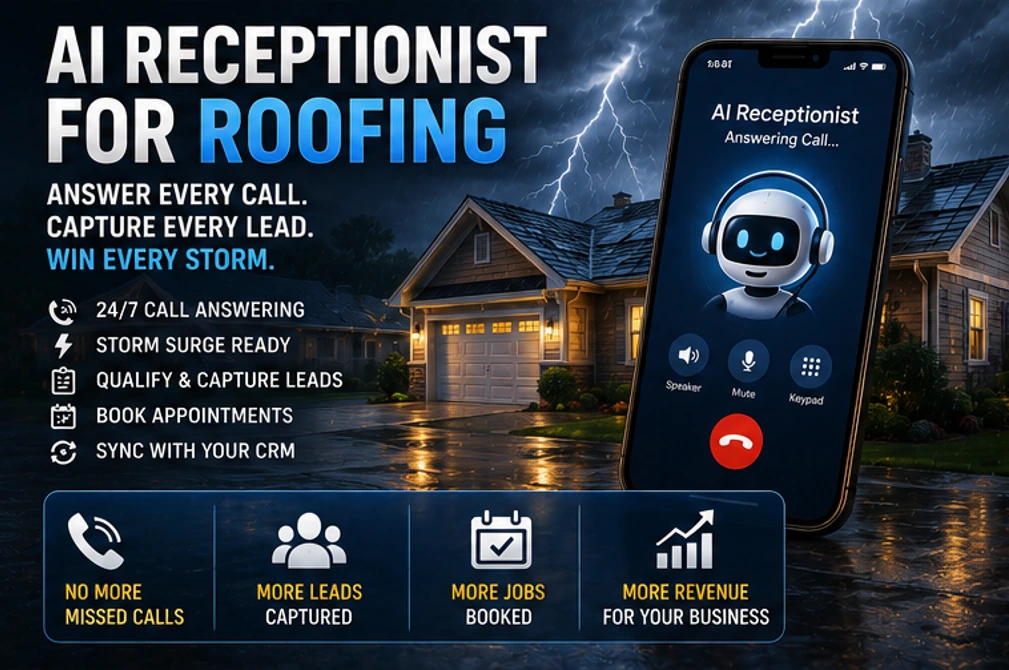
AI Receptionist for Roofing
Quick answer
Most roofing operations underestimate how many calls they miss, and storm windows produce intake surges no realistic staffing level absorbs. An AI receptionist answers every call around the clock, captures after-hours and surge leads, and stops paid placements from generating calls nobody picks up. The craft is the hand-off, not the replacement.
Roofing operations live and die by their ability to handle inbound calls. During steady-state demand, missed calls represent direct lost revenue. During storm windows, when affected homeowners are calling whoever answers first, missed calls compound into substantial competitive disadvantage — LSA leads that triggered charges but never converted, Map Pack inquiries that went elsewhere, paid search clicks that produced calls reaching voicemail, and customer relationships lost to competitors who answered when you didn't. AI receptionist tools have moved over the past two years from novelty experiments to commercial-grade infrastructure capable of handling roofing intake at the operational reliability levels the work requires.
Key Takeaways
- Most roofing operations underestimate how many calls they miss.
- Storm windows produce intake surges that human capacity can't realistically handle without dramatic over-staffing.
- The art of AI receptionist deployment isn't replacing humans entirely; it's optimizing the hand-off so AI handles what AI handles well and humans handle what humans handle well.
Published: July 23, 2026 | Reading Time: ~8 minutes | Category: Roofing Marketing — AI Receptionist
This guide covers AI receptionists for roofing. It shows why intake capacity is the biggest easy win most roofers have, what these tools really do, and where they matter most: storm windows. It covers setup, the hand-off between the AI and a human callback, how to measure it, and the mistakes that waste it. New to AI receptionists or trying to fix a weak one, the framework fits.
What You'll Learn
- Why intake capacity is the single highest-leverage operational improvement for roofing
- What AI receptionist tools actually do in practice for roofing intake
- Storm-window dynamics where AI capability matters most
- Configuration and integration that makes AI receptionist work for roofing
- Hand-off discipline between AI and human callbacks
- Measurement of AI receptionist performance
- Common deployment mistakes that produce disappointing results
- The economics: AI receptionist cost vs lost LSA and Map Pack leads
Why Intake Capacity Is the Highest-Leverage Operational Improvement
Most roofers miss more calls than they think. Measure it honestly and the number often stings. You miss calls when the lines are busy. You miss them at night and on weekends. You miss them in storms, when the surge buries your staff. And you miss them at lunch, in meetings, or mid-task. Every missed call wastes the LSA fee, the map-pack work, and the paid click you already bought — and loses the job behind it.
- LSA economics directly punish missed calls. LSAs charge for the lead regardless of whether you answer; missing the call wastes the per-lead cost and damages LSA ranking (which weighs response rate heavily).
- Map Pack and organic SEO leads bypass investment when calls go unanswered. The marketing investment that produced the call is wasted when intake fails.
- Storm windows compound missed-call costs dramatically. When affected homeowners are calling whoever answers first, missing the call typically loses the customer to whoever does answer.
- After-hours calls are substantial in roofing. Emergency calls, evening household decisions, and customers in different time zones all produce after-hours inquiry volume that human-staffed phone lines miss.
- Weekend and holiday demand exists. Roofing damage doesn't follow business hours; affected homeowners call when they discover problems.
THE ECONOMICS OF CAPTURING MISSED CALLS: Say you get 200 leads a month from LSAs, the map pack, paid search, and organic. You answer 75% in business hours and 10% after. That misses about 50 leads a month — leads your marketing already paid for — purely on intake. At a 30% booking rate and a $5,000 job, that is $75,000 in lost monthly revenue (50 leads × 30% × $5,000). An AI receptionist runs $200 to $800 a month. The math is simple: capture even part of those calls and it pays back many times over, right away.
What does an AI receptionist actually do?
Modern AI receptionists — Goodcall, Slang.ai, EasyVoice, tools from big phone vendors, and roofing-specific ones — answer when your staff can't. They run the intake, gather the details, and route the call. The quality has jumped in two years. Today's tools handle most routine roofing intake about as well as a person.
- Answer calls within first ring or two: AI receptionists answer immediately, eliminating voicemail or busy-signal scenarios.
- Conduct conversational intake: ask about the issue (damage type, location, urgency), gather contact information, qualify the inquiry against your service area and offerings.
- Schedule appointments where appropriate: integration with calendar systems lets AI receptionists book estimates directly for routine inquiries.
- Route emergency situations: identify emergency calls and either direct to immediate human callback or escalate appropriately based on configuration.
- Handle multiple simultaneous calls: AI receptionists handle many concurrent calls, eliminating the surge-window busy-signal problem entirely.
- Operate 24/7: continuous coverage including after-hours, weekends, holidays — the time periods when human staffing isn't economic.
- Transfer to humans when appropriate: complex inquiries, customer requests for human contact, or scenarios requiring judgment route to human callback or transfer.
- Send notifications to staff: completed intake calls trigger notifications to appropriate staff for follow-up.
Storm-Window Dynamics Where AI Matters Most
Storms create call surges no reasonable staffing can absorb. Do the math on storm intake and you see why an AI receptionist becomes core infrastructure.
- Storm-window call volume often runs 5-10x normal demand during the first 24-48 hours after major events. Human staffing for normal demand is overwhelmed; staffing for storm peaks is uneconomic for baseline operations.
- Storm-window calls are disproportionately high-value. The emergency-driven calls during storms convert at higher rates than steady-state calls and produce substantial job values. Missing storm calls costs substantially more than missing steady-state calls.
- Storm-window competition rewards first response. Affected homeowners call whoever answers first; operations that can't handle surge volume lose to operations that can — regardless of operations' overall quality or capability.
- AI receptionist handles surge volume that human staff can't. Concurrent call handling scales linearly with AI capacity; there's no busy signal or hold-time problem.
- Configuration for storm-specific scenarios captures the substantial intake the storm produces — damage type details, photo documentation requests, immediate-response prioritization, insurance claim status — at scale that human surge staffing couldn't match.
PRO TIP: Most roofers set up an AI receptionist for after-hours and miss the storm case, where it helps most. Before the season, test how it handles storm calls — damage descriptions, urgency, scheduling during a surge — and wire up crew dispatch and human callback for that volume. Roofers who set this up early switch it on the moment a storm hits. Those who didn't scramble to configure mid-event and lose real capacity in the critical first four to six hours.
Configuration and Integration
- Service area definition: configure AI receptionist with your actual service areas so geographic mismatches get appropriately routed (typically declined politely with referral information) rather than booked into work you can't service.
- Service offerings configured: AI receptionist knows what services you offer, what you don't, and how to handle off-target inquiries.
- Pricing guidance for common questions: AI receptionists can provide pricing ranges for common services where you've configured the guidance, reducing the friction of customer questions you might prefer humans handle.
- Calendar integration for direct booking: integration with scheduling systems lets AI receptionists book routine estimates directly, eliminating callback latency for qualified inquiries.
- CRM integration: completed intake automatically populates your CRM with the lead information, enabling immediate follow-up without manual data transfer.
- Notification routing: completed calls trigger notifications to appropriate staff (project managers, sales, dispatch) based on call type and configuration.
- Hand-off triggers: defined scenarios that escalate to human callback rather than AI completion — complex damage situations, customer-requested human contact, urgency situations requiring immediate human attention.
- After-hours messaging: AI receptionist can handle most after-hours inquiries directly while logging urgent items for immediate human callback the next business morning.
- Multi-language support where appropriate: AI receptionist tools increasingly handle multiple languages, enabling bilingual intake without bilingual human staffing.
When should the AI hand a call to a human?
The goal is not to replace people. It is to split the work so the AI does what it does well and people do what they do well.
- AI handles: routine intake conversations, scheduling for clearly-qualified inquiries, basic FAQ responses, after-hours coverage, surge-window overflow, geographic and service-offering qualification, basic information gathering.
- Humans handle: complex damage situations requiring judgment, scope conversations involving substantial work, escalations from AI when scenarios exceed configured handling, sales conversations for substantial projects, situations where customer explicitly requests human contact.
- Hand-off triggers configured deliberately: AI receptionist should escalate cleanly when scenarios exceed its handling rather than struggling through and producing poor experiences.
- Human callback systems supporting the AI: when AI captures inquiry that needs human follow-up, the callback should happen promptly. Operations with AI intake and slow callback discipline produce worse outcomes than operations with no AI but fast human response.
- Customer transparency: customers should know they're interacting with AI when they are; transparent configuration produces better customer experiences than attempts to disguise AI as human.
Measurement of AI Receptionist Performance
- Call answer rate: percentage of incoming calls handled (by AI or human) rather than missed. Should approach 100% with AI receptionist deployed.
- Calls handled by AI vs transferred to human: reveals where AI is providing capacity and where the hand-off is occurring.
- Conversion rate from AI-handled calls: percentage of AI-handled inquiries that convert to booked work. Should approach human-handled conversion rates with good configuration.
- Customer satisfaction with AI interactions: feedback mechanisms that surface where AI experience is working and where it's failing.
- Storm-window performance: lead volume captured, conversion rates, and customer experience during surge periods specifically.
- Cost per call: AI receptionist cost divided by calls handled, comparing against human-staffed cost per call.
- Time-to-callback for human-escalated calls: when AI receptionist captures inquiries requiring human follow-up, how quickly the callback happens. Long callback latency degrades the AI receptionist value substantially.
Common Deployment Mistakes
- Treating AI receptionist as full human replacement rather than capacity supplement. Operations that try to eliminate human intake entirely often produce poor customer experiences in scenarios AI doesn't handle well.
- Configuring AI receptionist generically rather than for roofing-specific scenarios. Roofing intake has distinct patterns (damage types, insurance considerations, urgency triage) that benefit from roofing-specific configuration.
- Failing to test before launch. AI receptionist behavior in edge cases needs to be tested before going live; production discovery of configuration gaps produces customer experience problems at scale.
- No human callback discipline. AI receptionist capturing inquiries that require human follow-up needs the operational discipline of fast callback. Without it, the AI capture produces worse outcomes than not having AI at all.
- Hiding AI from customers. Attempts to disguise AI as human typically backfire when customers recognize the pattern. Transparency about AI use produces better experiences.
- Underconfigured for storm scenarios. Operations that deployed AI receptionist for steady-state intake without explicit storm-scenario configuration find the storm-window value substantially diluted.
- Set-and-forget deployment. AI receptionist performance benefits from ongoing review of call recordings and outcomes, configuration adjustments based on what's working and what isn't, and continuous improvement that produces better performance over time.
The Bottom Line
AI receptionists have grown from novelties into real infrastructure. They handle routine roofing intake nearly as well as staff, and they cover surges and around-the-clock hours that staffing can't. For most roofers, intake is the biggest easy win. Missed calls are direct lost revenue from marketing you already paid for, storms multiply the loss, and the economics pay back many times over when set up right.
The version that works splits the load: the AI handles routine intake at scale, and people handle the tricky calls that need judgment. Setup matters a lot — roofing scenarios, your service area and offerings, calendar and CRM links, hand-off rules, storm prep, and steady measurement. Roofers who set it up with care capture calls they used to lose, lift LSA rankings through steady response rates, own storm-window intake, and give callers the experience that turns inquiries into jobs. For any roofer tired of wasting marketing on missed calls, an AI receptionist is no longer optional.
Key Takeaways
- Intake capacity is the single highest-leverage operational improvement for most roofing operations. Missed calls waste paid marketing investment (LSAs, Map Pack effort, paid search), with storm windows compounding the cost dramatically
- Economics of capturing missed calls: typical operation missing 50+ monthly leads through intake gaps represents $75K+ monthly lost revenue at typical conversion and job values. AI receptionist at $200-800/month produces multiples of ROI when properly deployed
- What AI receptionists do: answer immediately, conduct conversational intake, schedule routine appointments, route emergency situations, handle concurrent calls during surges, operate 24/7, transfer to humans when appropriate, send notifications to staff
- Storm-window dynamics where AI matters most: 5-10x normal call volume during first 24-48 hours, disproportionately high-value calls, first-response wins, concurrent call handling solves busy-signal problem, configuration for storm scenarios captures surge demand
- Configuration considerations: service area definition, service offerings, pricing guidance, calendar integration, CRM integration, notification routing, hand-off triggers, after-hours messaging, multi-language support where appropriate
- Hand-off discipline: AI handles routine intake, scheduling, FAQ, after-hours, surge overflow, qualification, basic information gathering. Humans handle complex damage, scope conversations, escalations, sales for substantial projects, customer-requested human contact
- Measurement: call answer rate, AI vs human handling split, conversion rate from AI calls, customer satisfaction, storm-window performance, cost per call, time-to-callback for escalated calls
- Common deployment mistakes: treating AI as full replacement, generic configuration, no testing before launch, no human callback discipline, hiding AI from customers, underconfigured for storms, set-and-forget deployment
- AI receptionist is foundational operational capability for roofing operations, not optional — produces immediate ROI through missed-call capture, improves LSA performance through response-rate consistency, dominates storm-window intake when surges happen
READY TO BUILD A LEAD PIPELINE THAT'S YOURS? Astra Results Marketing sets up AI receptionists for roofers. Tuned to your service area and offerings, linked to your calendar and CRM, with a clear hand-off to human callback, storm prep that catches the surge, and steady measurement that keeps the value coming. Stop letting missed calls waste your marketing. Build the intake that captures the leads you already paid for. Astra Results Marketing · astraresults.com · (+1) 786-321-2866