Rated 5 star on

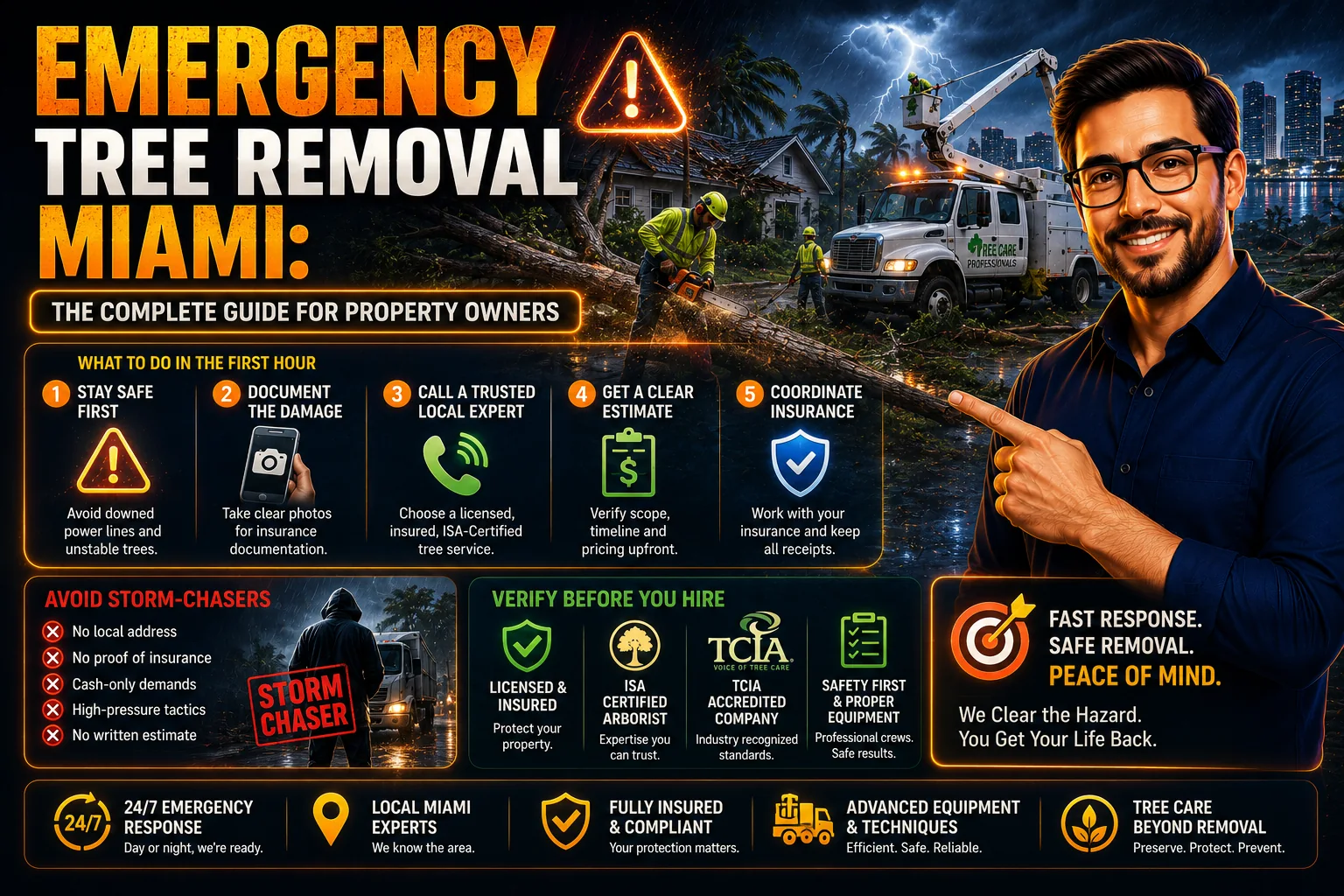
Emergency Tree Removal Miami: The Complete Guide for Property Owners
Quick answer
When a tree falls on a Miami home, the decisions made in the first hour determine how the whole situation resolves. Secure the area, document the damage, and verify credentials before anyone touches the tree. Miami's permitting, canopy protections, and storm-chaser problem make generic emergency guidance actively unhelpful here.
When a tree falls on your Miami home, crashes through a fence, blocks your driveway, or threatens a structure after a storm, the decisions you make in the first hour determine how the situation resolves. Who you call, what information you have ready, how the work gets coordinated with insurance, and what the response actually looks like all matter enormously. Miami's specific dynamics — the year-round storm exposure, the dense urban environments where emergency access is complicated, the mix of property types from Brickell high-rises to Coconut Grove single-family homes, the substantial property values that elevate the stakes, and the bilingual reality of the market. Shape how emergency tree removal actually works here in ways that generic emergency-removal guides miss.
Key Takeaways
- When a tree falls on your Miami home, crashes through a fence, blocks your driveway, or threatens a structure after a storm, the decisions you make in the first hour determine how the situation resolves.
- Generic emergency-removal guidance misses what makes Miami different.
- The credentialing that distinguishes professional Miami tree-service operations from storm-chasers and uncredentialed operators is concrete and verifiable.
- Professional response begins with the call or message you make.
- Not all storms produce the same kind of tree damage.
Published: July 15, 2026 | Reading Time: ~14 minutes | Category: Tree Service — Emergency Tree Removal Miami
Miami sees more emergency tree work than most US markets, and far more during hurricane season and severe storms. The mix of big tree canopy in older neighborhoods, hurricane and tropical-storm risk through the warm months, and dense development produces emergencies often. And the response looks very different from routine tree work. Property owners who know what to expect, what to do first, and how to pick a credentialed provider before they need one handle these situations far better than owners learning the process live during their own emergency.
This is the full Miami emergency tree removal reference. For homeowners preparing for the next storm, owners dealing with an active mess, property managers and HOA boards over many Miami properties, and anyone who wants to understand what professional emergency response really involves. It covers what makes Miami different, what to do the moment an emergency hits, how to spot a credentialed provider, how the response actually unfolds, insurance and documentation, the common mistakes owners make under stress, and what sets a professional Miami crew apart from the storm-chasers that flood the market after events. ArborCentric Solutions handles emergency tree removal across Miami-Dade and beyond, and this framework reflects how they actually work.
What You'll Learn
- Miami-specific dynamics that shape emergency tree removal here
- What to do immediately when an emergency tree situation occurs
- How to identify credentialed Miami emergency providers (and why the credentialing matters)
- How professional emergency response actually unfolds — assessment through completion
- Insurance and documentation considerations specific to Miami emergency tree work
- Common mistakes property owners make under stress and how to avoid them
- What distinguishes professional Miami response from the storm-chaser operators that flood the market
- How ArborCentric Solutions handles emergency response across Miami-Dade
What makes emergency tree work different in Miami?
Generic emergency guidance misses what makes Miami different. A few factors shape how the work really plays out here in ways that matter for owners making decisions.
When is Miami actually at risk from storms?
Miami's official hurricane season runs June 1 through November 30, but the real risk window is wider. Tropical storms can form outside the season, severe thunderstorms damage trees all year, and the mix of mature trees and frequent bad weather means emergencies happen regularly, not just during named storms. Owners who treat emergency tree work as a hurricane-season-only concern miss its year-round nature.
How does urban density complicate emergency response?
Miami's density — narrow streets in older areas, packed development in Coral Gables and Coconut Grove, parking limits in Brickell and Downtown, gated communities with access rules. Shapes how the response unfolds. Crews can't always reach a property fast even when they're close by. Equipment positioning, crane access, debris staging, and traffic all get more complex than in the suburbs. Crews that know Miami's access challenges handle the work better than ones parachuting in from elsewhere.
Why do Miami property values raise the stakes?
Miami's high property values mean tree damage to homes, cars, and landscaping carries big financial exposure. A tree on a Coral Gables home or through a Pinecrest pool cage is major damage on its own; a removal that adds damage through sloppy technique makes it worse. Owners deciding during an emergency are protecting big assets, so the crew's credentials and skill matter more than in lower-value markets.
Why does emergency response need to be bilingual?
Miami's bilingual reality touches every part of the response. Owners may speak English, Spanish, or switch between them. Intake needs both languages to serve the whole market; crews often communicate in Spanish on Miami sites; and bilingual capability is a competitive must here. Crews without it lose a big share of the market they could serve.
Property Type Diversity
Emergency work spans very different property types. Single-family homes in the older neighborhoods, condos in Brickell and Downtown, big estates in the western communities, commercial sites across the metro, and the large rental market. Each type has its own response pattern, decision-makers, insurance context, and operational quirks.
THE STORM-CHASER PROBLEM: After big storms, Miami sees a rush of out-of-state crews and reactive local operators chasing the brief surge. The pattern is well known: out-of-area crews with unclear credentials, inflated prices that exploit distress, work done fast but often below standard, and crews that vanish after the surge with no accountability. Owners under stress, calling whoever answers first, sometimes hire these operators and pay more for less. The way to avoid it is to pick a credentialed Miami crew before you need one. The shops that serve Miami year-round, hold real credentials and insurance, and keep a reputation through ongoing local work are far more reliable than the operators that appear after events.
What to Do Immediately When an Emergency Occurs
Safety First
- Stay clear of the affected area until you can assess from a safe distance. Compromised trees can shift, drop additional limbs, or destabilize further — proximity is dangerous.
- If utilities are involved (power lines, gas lines), stay well away and contact the utility company immediately. Do not approach downed power lines under any circumstances; treat all downed lines as live.
- If anyone is injured, prioritize medical response over property concerns. Tree-removal decisions can wait; injury response cannot.
- If the situation is structurally unstable (tree on the house with potential for further collapse, tree threatening a structure with people inside), contact emergency services.
Initial Documentation
- Take photographs of the situation before any work begins — multiple angles, the affected structures, surrounding area, and any visible damage. These photos matter for insurance claims and any subsequent legal or financial considerations.
- Note the time and date of the incident, the weather conditions if storm-related, and any witnesses to the event.
- If the incident affected utilities, vehicles, or structures, document each affected element separately.
Insurance Contact
- Contact your insurance company as soon as practical to report the incident. Most policies require prompt notification, and starting the claims process early facilitates the subsequent work.
- Ask your insurance representative about emergency mitigation work — most policies cover or reimburse emergency work necessary to prevent further damage.
- Get clear guidance on what your insurance will and won't cover before authorizing substantial work.
- Document all communications with your insurance company in writing where possible.
Contractor Selection
- If you have an established relationship with a credentialed Miami tree-service operation, contact them first. The pre-existing relationship means faster response, established trust, and known capability.
- If you don't have an established provider, verify the credentialing of any operation you contact before authorizing work — ISA-Certified Arborist status, insurance verification, license verification, and references.
- Avoid operations that appear at your property unsolicited offering immediate service at quoted prices — this is the classic storm-chaser pattern.
- Get written estimates before authorizing substantial work where time allows; emergency mitigation may proceed without full written estimates but should be documented thoroughly.
How do you tell a credentialed crew from a storm-chaser?
The credentials that separate a professional Miami tree shop from storm-chasers and uncredentialed operators are concrete and checkable. Owners can verify them before authorizing any work.
- ISA-Certified Arborist status — verifiable through the International Society of Arboriculture's database. The credential indicates demonstrated professional competence in arboriculture.
- TCIA Accreditation (for companies) — the Tree Care Industry Association accredits companies meeting business and safety standards, with relatively few operations holding the credential. A meaningful differentiator when present.
- Florida contractor license verification — depending on the specific work, Florida may require licensing that can be verified through the state's licensing portal.
- General liability and workers' compensation insurance — verifiable through certificates of insurance the operation can produce on request. Adequate coverage is essential; inadequate insurance exposes you to liability for incidents on your property.
- Local business establishment — operations established in Miami with verifiable local address, history, and community presence. Storm-chasers can't produce this verification.
- Reviews and references — substantial review history on Google and other platforms, with verifiable customer references. Storm-chasers and uncredentialed operations lack this trail.
PRO TIP: The single most valuable emergency-prep move a Miami owner can make is to pick a credentialed local tree shop before they need one. A few minutes in calm times to check credentials, save the contact, and maybe introduce yourself or book a routine assessment sets up the relationship that becomes priceless during a real emergency. When a tree hits your house in a storm, you have no time to research providers or check credentials. And the ones that appear during the stress often aren't the ones to hire. Choose your provider before you need them.
How Professional Emergency Response Actually Unfolds
What happens on the first emergency call?
A professional response starts with your call or message. A good intake covers what happened, where, what's at risk now, who's involved (utilities, vehicles, people), the access, and the urgency. It doesn't just take an address; it gathers what the crew needs to respond right and quote right.
On-Site Assessment
Before any work starts, a certified arborist or experienced supervisor sizes up the situation: the tree's structure and condition, what's already failed and what could fail next, the surroundings (structures, vehicles, utilities, access), the safest effective approach, and the crew and gear needed. That assessment shapes both the work and the quote. Shops that skip a real assessment and quote off a phone call often hit surprises mid-job that spark disputes.
Approach Selection and Planning
Depending on the situation, the approach varies. Sectional dismantling for trees on structures that need careful piece-by-piece removal, crane work for big trees or tight access, conventional felling where there's room, technical rigging in cramped conditions. The right method depends on the specifics, and credentialed crews pick based on the assessment rather than forcing one approach on every job.
Execution
Professional execution takes trained crews, the right gear, set safety rules, and the technical work emergency removal requires. Communication runs throughout — with the owner on progress and any changes, with utilities if involved, with neighbors when the work affects them. Good execution leaves the site safer and cleaner than before, with no extra damage from the removal itself.
What documentation should emergency work produce?
Big emergency jobs involve documentation throughout — photos before, during, and after, written records of the work and decisions, and the paperwork that supports insurance claims. Professional shops provide this as part of the job; uncredentialed ones often don't, leaving the owner without the records they need for insurance and more.
Insurance Considerations Specific to Miami
- Hurricane-season tree damage is generally covered by homeowner insurance, though specific policies vary. Verify coverage details with your specific policy before you need to make claims.
- Emergency mitigation work — work necessary to prevent further damage — is generally covered or reimbursable, though documentation requirements vary by insurer.
- Damage to specific structures (the home, fences, pools, outbuildings) may be covered under different policy sections with different limits and deductibles.
- Vehicle damage from trees is typically covered under comprehensive auto insurance rather than homeowner insurance — separate claims process.
- Tree replacement is not typically covered by homeowner insurance unless specifically endorsed. The removal of fallen trees is generally covered to the extent necessary to address property damage, but replanting is generally out-of-pocket.
- Insurance companies sometimes have preferred contractor networks; using out-of-network providers may affect coverage details depending on policy.
- Documentation matters substantially — photos before any work, written estimates and invoices, and detailed records of the work performed all support claims processes.
Common Mistakes Property Owners Make Under Stress
- Authorizing work without verifying credentials in the rush to address the emergency. Even substantial emergency work generally allows the few minutes needed to verify credentialing and insurance.
- Accepting prices from unsolicited operations that appear at the property after storms. These prices are often substantially inflated, and the work quality often substandard.
- Failing to document the situation before work begins. Photos and records support both insurance claims and any subsequent disputes.
- Not contacting insurance early in the process. Insurance involvement smooths the work substantially; delaying contact can create coverage and reimbursement complications.
- Approaching the affected area or moving debris before professional assessment. Compromised trees can shift dangerously; well-intentioned cleanup can compound damage or create injury risk.
- Approving substantial additional work without written documentation during the response. Scope expansions during emergency work should be documented as they occur.
- Choosing the lowest price exclusively rather than considering credentialing and capability. Emergency tree work done badly can produce damage substantially exceeding the price savings.
Do different hurricane categories damage trees differently?
Not all storms cause the same tree damage. Knowing the difference helps owners anticipate what they may face and decide on pre-season prep.
Tropical Storms and Category 1 Hurricanes
Winds in the lower range mostly damage compromised trees — those with structural issues, decay, root problems, or too-dense canopy. Healthy, sound trees generally ride these out well. Owners with maintained trees see local damage (broken branches, some canopy loss, an occasional uprooting of a weak tree); owners with neglected trees see far more. At these wind levels, tree condition makes a dramatic difference.
Category 2 Hurricanes
At higher winds, even healthy trees take real damage. Branch loss spreads across the canopy, larger trees partly uproot, and the damage shifts from mostly-weak-tree damage to broad canopy damage. Trees given proper structural pruning and thinning fare far better than trees that weren't.
Category 3 and Higher Hurricanes
Major hurricanes cause damage at levels where prep matters less, because even well-kept trees take heavy hits. Whole-tree failures become common, homes take widespread structural damage from fallen trees, and demand exceeds what any tree-service market can handle right after. Response then runs by priority (life safety first, then structural-damage emergencies, then everything else). Owners in hit areas should expect the timeline to run weeks, not days.
Pre-Season Preparation Matters Most Below Category 3
What this means for owners: pre-season prep. Proper structural pruning, selective thinning to cut wind resistance, removing weak trees before storms — helps most against the tropical-storm-through-Category-2 range that hits Miami most often. It's real protection against the common scenarios, even if a Category 3-plus overwhelms it. Maintained trees survive minor storms intact and major storms with less damage than neglected ones.
Bilingual Capability and Why It Matters in Miami Emergencies
Miami's bilingual reality shapes the response in concrete ways monolingual shops underestimate. Owners in an emergency may speak mainly Spanish — especially first-generation residents and certain neighborhoods. Intake that doesn't work in both languages loses a big share of the market. Crews often communicate in Spanish on the job, and crews without it can't work well in many Miami settings. Documentation may need to be in both languages for owners and insurance.
Shops serious about Miami emergency response build bilingual capability throughout. Intake that handles calls in either language without delay, crews with fluent Spanish speakers, documentation templates in both languages, and the cultural familiarity that makes it work in practice, not just on paper. It matters most in the moments that matter most. Emergencies where an owner needs to convey complex information under stress, where cultural familiarity smooths the interaction, and where the bilingual shop simply serves better than the monolingual one.
What Distinguishes Professional Miami Response
- Year-round Miami presence with verifiable local establishment — not parachuting in for storm windows.
- ISA-Certified Arborist staff with credentialing visible and verifiable.
- Substantial review history from Miami customers across years of operation.
- Bilingual capability serving the metro's actual language reality.
- Equipment and crew capacity to handle the specific Miami access challenges and the substantial work emergency situations involve.
- Insurance and credentialing documentation produced on request without delay.
- Documentation discipline producing the records property owners need for insurance and other purposes.
- Substantive on-site assessment before work and quote rather than phone-call estimates.
- Established relationships with adjacent service providers (utility coordination, insurance adjusters, debris-removal services) supporting the broader response.
How ArborCentric Handles Emergency Response Across Miami-Dade
ArborCentric Solutions handles emergency tree removal across Miami-Dade with the response setup professional Miami work requires. The pieces — ISA-Certified Arborists on staff with verifiable credentials, an established Miami operation with real local history and presence, bilingual capability for the whole metro, intake that pairs human staff with AI receptionist overflow so no emergency call goes unanswered, crews and gear that handle Miami's access and complexity, documentation that supports insurance claims and owner records, year-round operation that doesn't dilute skill through storm-chasing or out-of-area work, and the review and reputation history Miami owners can check first. Together set the professional standard that separates credentialed crews from reactive ones.
The result for Miami owners: when an emergency hits, ArborCentric responds fast with credentialed crews, does the work to standard, documents it properly, coordinates with insurance and other services as needed, and leaves the property safer than before. The capability matters most when it matters most. During storms, after events, and in the moments when a professional response is the difference between a handled emergency and a bigger problem. Owners who pick ArborCentric (or another comparable credentialed Miami shop) before they need it handle these situations far better than owners learning the process during their own emergency.
The Bottom Line
Emergency tree removal in Miami involves dynamics generic guidance doesn't cover. The year-round storm risk, dense city, high property values, bilingual market, and property-type mix all shape how the work really goes here. A professional response from a credentialed Miami shop differs sharply from the storm-chaser pattern that floods the market after events. And owners who know the difference, pick a credentialed local provider ahead of time, document situations well, and coordinate with insurance handle emergencies far better than owners learning under stress.
ArborCentric Solutions provides this professional response across Miami-Dade, with the credentials, capability, year-round operation, bilingual support, and integrated setup professional Miami work requires. Whether you're prepping for hurricane season, dealing with damage now, or just thinking about who you'd call, this framework applies. Pick your provider before you need them. Check their credentials while you have time. Save their contact where you can reach it under stress. A few minutes of prep pays back a lot when emergencies hit — and in Miami they hit often enough to make the prep worth it.
Key Takeaways
- Miami's emergency tree removal dynamics differ from generic markets: year-round storm exposure (not just June-November), dense urban environments complicating response, substantial property values elevating stakes, bilingual market reality, and property type diversity from condos to estates
- The storm-chaser problem is real — out-of-area operations and reactive operators flood Miami after major storms with uncertain credentialing, inflated pricing, and substandard work. Identify a credentialed Miami provider before you need them
- Immediate response steps: safety first (stay clear, avoid utilities, prioritize injury response), document the situation with photos, contact insurance early, verify contractor credentialing before authorizing substantial work
- Verifiable credentials: ISA-Certified Arborist (ISA database), TCIA Accreditation (relatively few hold it), Florida contractor licenses, insurance certificates, local Miami establishment, substantial review history
- Professional response unfolds through initial intake and triage, on-site assessment by credentialed arborist, approach selection appropriate to the specific situation, trained execution with appropriate equipment and safety protocols, and substantive documentation throughout
- Insurance considerations: hurricane-season tree damage generally covered, emergency mitigation generally reimbursable, different policy sections for different damage types, vehicle damage through comprehensive auto, tree replacement typically out-of-pocket, documentation supports claims
- Common mistakes property owners make under stress: authorizing work without verifying credentials, accepting unsolicited storm-chaser prices, failing to document before work, delaying insurance contact, approaching affected areas before assessment, approving scope expansions without documentation
- Professional Miami response distinguishes through year-round local presence, ISA-Certified staff, substantial Miami review history, bilingual capability, equipment for Miami's access challenges, insurance and documentation discipline, substantive on-site assessment, established adjacent-service relationships
- ArborCentric Solutions provides emergency tree removal across Miami-Dade with credentialed crews, bilingual support, AI-receptionist-backed intake ensuring no emergency call is missed, year-round operation, and substantive review history Miami property owners can verify. The professional response standard property owners can identify before they need it
READY TO BUILD A LEAD PIPELINE THAT'S YOURS? ArborCentric Solutions provides 24/7 emergency tree removal across Miami-Dade with ISA-Certified Arborists, bilingual support, full insurance and credential records, and the response setup Miami emergencies require. Save our information before you need it. When emergencies hit — storms, fallen trees, hazards — call the credentialed local shop that serves Miami year-round, not the storm-chasers that flood the market after events. Astra Results Marketing partners with ArborCentric to provide the marketing that professional Miami tree shops need to reach the customers who need them. And we work with other credentialed tree shops across Miami and South Florida who want similar professional positioning. Astra Results Marketing · astraresults.com · (+1) 786-321-2866