Rated 5 star on

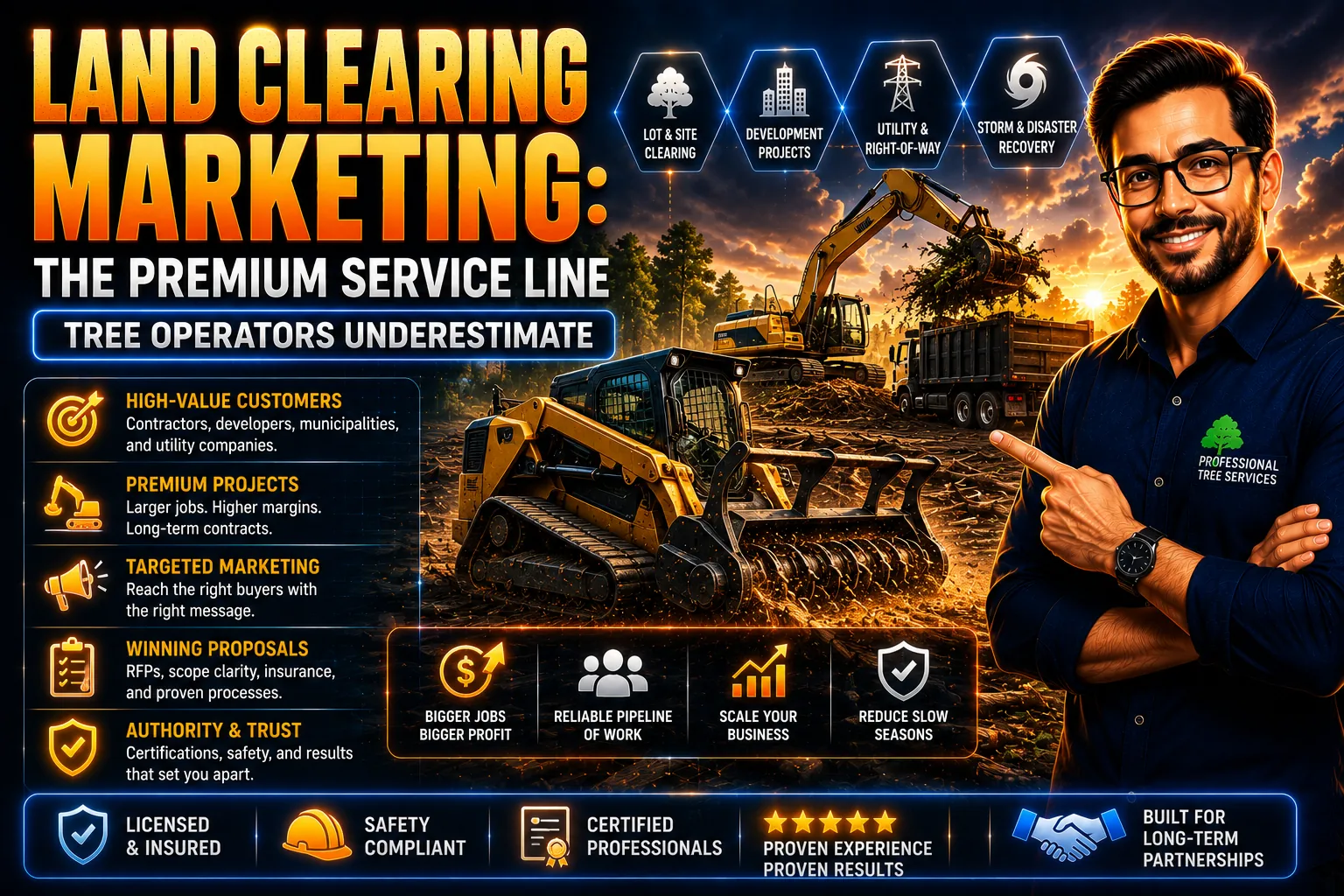
Land Clearing Marketing
Quick answer
Land clearing is different work at a different scale from residential tree removal, with different equipment and regulatory requirements. New construction needs cleared lots, which makes developers and homebuilders the most consistent customer base. These buyers research vendors heavily before issuing proposals, reviewing project portfolios and references against the specific project's requirements.
Land clearing sits at the intersection of tree service, site preparation, and construction support. A service line where job values often run from the mid-five-figures into six figures, where the customer profile is dramatically different from residential tree care, and where the marketing infrastructure most tree-service operators have built doesn't reach the customers who actually buy this work. The operators who recognize land clearing as a distinct service line with its own marketing requirements, customer base, and unit economics build a premium revenue stream alongside their core tree service business. The operators who treat it as 'tree removal at larger scale' miss the opportunity entirely. Either failing to compete for the work or pricing it like residential tree removal and watching their margins evaporate against the operational complexity it actually involves.
Key Takeaways
- Land clearing involves different work than residential tree removal at a different scale with different requirements.
- New construction requires cleared lots, and developers and homebuilders represent the most consistent land-clearing customer base.
- PRO TIP: Land-clearing customers research vendors heavily before issuing RFPs or selecting providers — they review websites, evaluate project portfolios, check references, and assess apparent capability against the project requirements.
- Operators competent in the regulatory landscape both protect themselves and customers from costly compliance failures, and communicate this competence as a differentiator.
- Catastrophic storms — hurricanes, severe tropical systems, major weather events — produce land-clearing demand that dwarfs typical residential storm tree work.
Published: July 14, 2026 | Reading Time: ~16 minutes | Category: Tree Service — Land Clearing
Land clearing is genuinely different work. Clearing a home lot for a build, prepping a commercial site, clearing farmland for crops, opening a utility corridor, clearing catastrophic storm debris. Each needs different gear, different rules, different customers, and a different sale. The gear alone (mulchers, excavators with shears, big dump trucks, sometimes brush cutters and forestry mowers) costs far more than home tree work needs. And the customers — developers, builders, commercial owners, utilities, government agencies — buy very differently from a homeowner scrolling search results.
This guide covers land-clearing marketing as a premium line for tree shops: why it's a distinct service with its own approach, the customers who buy it, the gear and skill that gate real work, the channels and content that reach these buyers, the sales and proposal habits that win, the permits and rules competent providers know, how it fits the core tree operation, and how shops positioned for it earn premium revenue that scales them past home tree care. ArborCentric Solutions does land clearing across South Florida as part of their operation, and the positioning they built for it shapes the framework here.
What You'll Learn
- Why land clearing is a distinct service line requiring its own marketing approach
- The customer segments that buy land clearing work — developers, builders, commercial owners, agricultural operations, utilities, government
- Equipment and capability investment that gates entry to meaningful work
- Marketing channels and content that reach land-clearing customers
- Sales and proposal disciplines that win the work
- Regulatory and permitting considerations competent providers understand
- Integration with the core tree-service operation and how the two reinforce each other
- Pricing structures and unit economics that distinguish land clearing from residential tree work
Why Land Clearing Is a Distinct Service Line
Land clearing is different work at a different scale with different requirements. The differences are foundational, not small.
Different Work
Home tree removal takes out specific trees and leaves the rest — the dead oak, the leaning maple, the diseased palm, with the property kept intact. Land clearing removes all or nearly all the vegetation from an area to ready it for new use. It's not just trees but the underbrush, stumps, roots, sometimes old structures, leaving a cleared site ready for the next phase. The methods (mulching, mass removal, grubbing) differ from selective tree work.
Different Equipment
Home tree removal needs a crew, chainsaws, climbing gear, and a chipper. Land clearing at real scale needs much more: forestry mulchers that chew through volume, excavators with tree shears or grapples, big dump trucks for debris, sometimes brush cutters and chippers sized for commercial work. The gear runs well into six figures, and the economics only work at a volume that justifies the capital.
Different Customers
Home tree customers are homeowners. Land-clearing customers are developers, builders, commercial owners, farms, utilities, and government agencies. They buy through different processes (RFPs, written proposals, multi-person approvals), judge you on different things (scale and gear, not just credentials and reviews), and work in a different context (project-driven, often time-sensitive, big budgets but big accountability).
How do land clearing margins and risks differ?
Home tree removal has known economics — the work fits the crew and gear, you can size it up by eye before quoting, and the risks are manageable. Land clearing has more variable scope (what's under that brush?), more complexity (equipment positioning, debris handling, rules), and bigger risks (equipment damage, scope creep, environmental issues). Price for the variability, because shops that price land clearing like scaled-up home work lose money on it.
THE CAPABILITY GAP MOST TREE OPERATORS DON'T CROSS: Most tree shops stop at home-and-light-commercial scale because the investment for real land clearing. Gear, crew specialization, permit know-how, proposals for project buyers — is big. Shops that cross the gap reach a line with far higher per-project values, repeat work with developers and builders, and revenue home lead-by-lead work can't match. The investment is real, but the shops that make it earn premium revenue and scale others can't. The gap is also why land clearing stays a premium line: only a small subset of tree shops can compete for it, so the competition is far lighter than for home tree removal.
Customer Segments Worth Targeting
Why are developers the most consistent customer?
New builds need cleared lots, and developers and homebuilders are the steadiest land-clearing customers. The work is project-based but the relationships can be ongoing — a builder running several projects a year becomes a repeat client once the relationship is set. Reaching them takes direct outreach (LinkedIn, builder associations, construction events), capability statements and project portfolios, and the proposal skill to answer specs well.
What does commercial site development need?
Commercial site work — retail, office, industrial, mixed-use — needs big clearing as part of site prep. The projects are larger than home builds but less frequent, with several decision-makers (owners, developers, civil engineers, general contractors). Reaching them takes industry presence, civil-engineer relationships, and the ability to work the more complex project structures.
Agricultural Operations
Farm clearing — readying acreage for crops, pasture, or other use — is a steady market where farming is active. The work removes trees and brush at scale, often across large acreage, with different gear and approach than home or commercial. Farm customers are often direct landowners or farm operations, reached through farm networks and direct outreach to specific properties.
Utility Companies
Utility corridor clearing — power lines, pipelines, infrastructure right-of-way — runs under contract with utilities or their contractors. The work is steady (corridors need ongoing upkeep), large, and gated by qualification (utility-specific credentials, sometimes special gear, often an ISA Utility Specialist on staff). Shops that qualify and build utility relationships reach a stable contract market.
Government Agencies
Federal, state, county, and city agencies contract clearing for parks, public lands, infrastructure, and disaster response. The buying runs through formal RFPs and government rules (prevailing wage, bonding, specific insurance, sometimes set-asides for certain businesses). Shops that chase this plan the qualification investment over several years.
How large is post-storm land clearing demand?
Catastrophic storms create clearing demand at huge scale — hauling fallen trees and debris across whole areas, often under government contracts or insurance claims. Shops set up for storm recovery (gear, crew capacity, and the contracts or relationships that route the work) capture big revenue during these events.
Equipment and Capability Investment
- Forestry mulchers — equipment that processes vegetation in place, reducing trees and brush to mulch for site preparation. Major capability multiplier for residential-lot and small-commercial clearing.
- Excavators with tree shears or grapples — for larger trees and substantial debris handling on commercial and agricultural work.
- Large dump trucks and roll-offs — debris removal at the volume land clearing produces, beyond what residential tree work typically generates.
- Chippers sized for commercial volume — moving beyond residential-scale chippers to equipment that processes volume efficiently.
- Loaders and skidsteers — for material handling and site work supporting the clearing operation.
- Crew specialization and training — operators trained on the specific equipment, with experience in land-clearing work distinct from residential tree work.
- Regulatory and permitting knowledge — understanding of local permitting requirements, environmental considerations, erosion control, and the compliance work clearing projects often require.
- Insurance and bonding at commercial-project levels — substantially higher coverage requirements than residential tree service.
Where do land-clearing customers actually look?
- Direct outreach to builders, developers, and commercial property professionals — LinkedIn presence, builder association membership and events, civil-engineer relationships, direct contact based on identified projects.
- Capability statements and project portfolios — formal documents and digital presence demonstrating actual completed work, equipment and crew capacity, references from comparable projects.
- Dedicated website section for land clearing — separate from residential tree-service positioning, with content addressing the distinct customer needs, equipment capability, project examples, and contact paths for project inquiries.
- Industry publication presence — trade publications in construction, agriculture, and utility sectors where target customers consume content.
- Strategic partnerships with adjacent service providers — civil engineers, surveying firms, environmental consultants, general contractors who route land-clearing work to qualified vendors as part of their project workflows.
- RFP and bid response capability — for government and large commercial work that procures through formal processes.
- SEO targeting commercial and project-driven searches — 'land clearing contractor,' 'commercial site clearing,' 'lot clearing for construction,' with the substantive content that decision-makers research before issuing RFPs or making vendor decisions.
PRO TIP: Land-clearing customers research vendors hard before they issue an RFP or pick a provider. They read sites, review project portfolios, check references, and weigh your apparent ability against the job. A weak online presence (no land-clearing positioning, no project examples, no capability statement) drops you before any sales talk begins. A real online presence — a website section, a project portfolio, a capability statement, content on the buyer's concerns — earns you a spot on the shortlist that actually wins work. Generic tree-service positioning doesn't say "we clear land"; specific land-clearing positioning does.
Sales and Proposal Disciplines
- Substantive proposals matched to the specific project. Not generic templates, but proposals demonstrating understanding of the site, the scope, the relevant considerations (regulatory, environmental, logistical), the approach and methodology, the equipment and crew assigned, the timeline, the pricing, and the risk allocation.
- Site visits before quoting — land-clearing projects involve site-specific factors (access, terrain, vegetation density, debris volume, regulatory considerations) that can't be quoted from satellite images. Substantive site visits inform accurate pricing and demonstrate professionalism.
- Pricing structures appropriate to the work — typically per-acre, per-cubic-yard, or project-based depending on scope and customer preferences. Hourly pricing is rarely appropriate for land clearing because it puts schedule risk on the customer in ways they don't accept.
- Contract clarity on scope, change orders, and risk allocation. Land clearing scope discoveries (additional debris, regulatory requirements emerging, weather delays) need contract structures that handle them professionally rather than creating disputes.
- References and project portfolios — written case studies and reference contacts from comparable projects, vetted and willing to speak to your work.
- Professional follow-up and communication — project-based customers value clear communication during proposal evaluation and through project execution.
Which permits does land clearing require?
- Local clearing permits — most jurisdictions require permits for substantial vegetation removal, with specific approval processes, environmental review, and compliance requirements.
- Environmental considerations — protected species, wetlands, mature-tree preservation requirements, and other environmental factors that affect what can be cleared and how.
- Erosion and sediment control — clearing typically triggers stormwater compliance requirements, with site-specific erosion control measures required during and after the work.
- Hauling and disposal compliance — debris disposal regulations vary by jurisdiction and material type, with compliance affecting both operations and pricing.
- Utility location and protection — clearing near utilities requires advance location and protection of buried infrastructure, with significant consequences for utility strikes.
- Worker safety compliance — OSHA requirements for the specific equipment and work involved, beyond typical tree-service safety requirements.
Shops that know the rules protect themselves and their customers from costly compliance failures — and can sell that know-how as an edge. Customers choosing between providers value the one who clearly understands the rules over the one who treats them as someone else's problem.
Integration With Core Tree-Service Operation
- Shared credentialing — ISA Certification, TCIA Accreditation, and insurance investments support both residential tree service and land clearing.
- Equipment cross-utilization — chippers, dump trucks, and some equipment supports both lines, improving overall equipment ROI.
- Crew flexibility — trained crew members can shift between residential tree work and land-clearing projects depending on demand, smoothing capacity utilization.
- Storm-response integration — operators positioned for both lines can offer comprehensive storm-response services from individual emergency removals through catastrophic clearing, capturing more of the storm-event opportunity.
- Marketing efficiency — credentialing, brand presence, and operational reputation support both service lines without separate brand investment.
- Revenue diversification — the two lines balance differently against seasonal and economic cycles, smoothing total revenue volatility.
Storm and Disaster Recovery as Land Clearing Opportunity
Catastrophic storms — hurricanes, severe tropical systems, major weather events — create clearing demand that dwarfs normal home storm work. Whole neighborhoods, public infrastructure, commercial sites, and government lands may need clearing. The work routes through different channels than home storm response: government emergency contracts, insurance-claim work for commercial and large homes, FEMA-related contracts in big disasters, and partnerships with disaster-recovery contractors.
- Pre-event qualification matters more than reactive scrambling. Operations that have established relationships with municipal emergency management, FEMA contractor lists, insurance-adjuster networks, and disaster-recovery prime contractors capture work that operations without those relationships can't access.
- Equipment and crew capacity to scale during events. The operations capturing substantial storm-recovery work have either the standing capacity or the established subcontractor and partnership relationships that scale quickly when events happen.
- Compliance and documentation for federal and insurance work. The work involves specific documentation, prevailing-wage compliance in federal contexts, and the back-office capability to handle the administrative requirements of large-scale recovery contracts.
- Operating discipline under demanding conditions. Disaster-recovery work happens under stressful conditions with substantial accountability — operations that perform consistently in these conditions build the reputation that produces future contract awards.
For tree shops in storm-prone markets, land-clearing set up for disaster recovery is the highest-margin chance the shop will see. Big contract values, faster payment on emergency work, and relationships built during recovery that produce more work in later events.
What does a winning land-clearing proposal contain?
Land-clearing customers — commercial developers, government agencies, utilities, large farms — buy through formal proposals. The shops that win build a repeatable proposal process instead of improvising each time.
- Master capability statement maintained and updated quarterly. The document that consolidates credentials, equipment, project portfolio, references, insurance, and approach into a comprehensive presentation distributed to prospective customers and used in formal proposals.
- Project portfolio with documented case studies — written project summaries with scope, approach, results, photos, and references for completed work. The portfolio demonstrates actual capability rather than asserting it.
- Proposal templates with substantive structure. Executive summary, company profile, project approach, personnel qualifications, equipment, references, insurance, pricing, and timeline templates that adapt to specific opportunities without starting from blank pages every time.
- Reference systems for customer contacts — vetted reference contacts who'll respond positively to prospective-customer inquiries, refreshed as new project completions add to the reference base.
- Cost-estimation systems calibrated to the work. Historical job data informing accurate pricing on new projects, accounting for the variables (terrain, vegetation density, debris volume, regulatory factors) that affect actual project economics.
- Project-management documentation — the systems demonstrating how you'd manage the project from award through completion, addressing the customer's concerns about execution risk.
Case Examples of Successful Land-Clearing Wins
Real case studies of finished work are among the strongest marketing assets a land-clearing shop has. Format matters: each should cover the project (location, scope, customer type, timeline), the approach (assessment, method, gear used, crew), the execution (work done, challenges met, rules handled), the outcome (completion, customer satisfaction, the relationship after), and photos (before and after, work in progress, the finished site).
- Residential lot clearing case studies — straightforward but valuable for builder and developer audiences evaluating capability against their own projects.
- Commercial site preparation case studies — substantive projects with multi-stakeholder coordination (general contractor, civil engineer, owner), regulatory navigation, and project-management complexity.
- Agricultural clearing case studies — large-acreage projects demonstrating equipment capacity and project-management for substantial scope.
- Utility corridor case studies — for operators pursuing utility work, the case studies demonstrate the specialized capability and regulatory understanding the market requires.
- Storm and disaster recovery case studies — substantive documentation of catastrophic-event work demonstrating the operational discipline these projects require.
Each case study should be substantial — 500 to 1,000 words with photos. And featured both online (dedicated pages, downloadable PDFs) and in proposals (cited in proposals, added to the capability statement's supporting docs). Shops with real case-study libraries close more land-clearing work than shops relying on generic credentials and verbal claims.
How long does it take to build clearing capacity?
Land-clearing ability isn't built overnight. The path from a home tree shop to real land-clearing capability usually takes 2 to 5 years of deliberate investment, and the shops that make it follow recognizable steps.
Phase 1 — Establishing Basic Capability
First, buy the starter gear (a first forestry mulcher, a bigger chipper, more dump-truck capacity), train the crew on it, learn the permits and rules, and put up a first marketing presence for land clearing as a line. Early jobs target home lot clearing and small commercial work the new ability can finish well. Revenue here is modest — you're building the ability, not the returns yet.
Phase 2 — Building Project Pipeline
Next, expand the gear (an excavator with a shear, more mulcher capacity, special debris equipment), build proposal skill for project buyers, grow direct outreach and industry relationships that feed steady projects, and start stacking case studies from finished work. The shop begins competing for real commercial projects and building developer relationships that repeat.
Phase 3 — Operational Scale
Then, run multiple crews on concurrent projects, field a real equipment fleet for major commercial and farm work, handle heavy concurrent volume with proposal and project management, hold relationships with developers, builders, commercial owners, and (where pursued) utilities and government, and run the back-office systems that support big project revenue. The land-clearing side now earns revenue and scale home tree work alone couldn't.
Phase 4 — Strategic Position
Shops at this stage compete for the biggest clearing projects in their markets, hold relationships with major regional developers and builders that repeat, have storm-recovery contracts ready for big events, and stand as the credentialed, capable, professional option commercial and government customers actually want. The economics and scale here far outrun the shop's home-service roots.
Pricing Structures
- Per-acre pricing — common for substantial acreage projects, with rates varying by vegetation density, terrain, and access. Useful for agricultural and large-lot clearing where acreage is the natural measurement unit.
- Per-cubic-yard or per-load pricing — common for debris-heavy projects where the unit of work is volume removed. Useful for projects with significant existing debris or substantial brush.
- Project-based fixed pricing — single price for the defined scope, with clear scope definition and change-order procedures. Common for residential lot clearing and well-defined commercial projects.
- Time and materials — less common for land clearing because customers typically prefer fixed pricing for project budgeting, but appropriate for projects with substantial scope uncertainty handled openly.
- Combination structures — fixed base price for defined scope plus per-unit pricing for variable elements (additional acreage, debris beyond projected volume) — handling scope uncertainty without creating budget risk for either party.
ArborCentric Outcome
ArborCentric Solutions does land clearing across South Florida as part of their operation, with the investments (gear, crew specialization, permit know-how, proposal skill) that let them compete for it. The marketing — dedicated land-clearing positioning separate from home messaging, project portfolios of finished work, capability statements sent to target developers and commercial customers, direct outreach and industry presence in South Florida construction circles, RFP-response skill for commercial and government work, and SEO aimed at project-driven searches. Feeds a steady flow of project chances beside the home tree operation.
The result: land clearing adds a big share of ArborCentric's total revenue, at per-project values home work can't match, with builder and developer relationships that repeat, storm-recovery ability that catches big-event work, and the credentialed, capable positioning that wins larger commercial and government jobs. Running home tree service and land clearing together produces efficiencies, better equipment payback, and revenue mix that single-line rivals can't match. For tree shops set up to make the investment, land clearing is the premium line that scales the operation past what home work alone supports.
The Bottom Line
Land clearing is a distinct line from home tree service — different work, gear, customers, sales, margins, and risks. Most tree shops never make the investment to compete for real land-clearing work, so they never reach the premium revenue and scale it can produce. The shops that do. Gear that enables the work, crew specialization and training, permit and rules know-how, proposal skill for project buyers, dedicated positioning, and the outreach and partnerships that reach the buyers. Earn big revenue from work that scales them past home tree care alone.
ArborCentric Solutions made those investments and runs land clearing as a deliberate line across South Florida. The result is the kind of diversified, larger-scale operation pure-home tree service can't match. For tree shops sized and set up to invest. And willing to do the marketing, sales, and operational work — land clearing is one of the best growth moves available in the broader tree-service market. The chance is real and the work is concrete; the question is whether your shop is set up to take it.
Key Takeaways
- Land clearing is a distinct service line from residential tree service. Different work (mass vegetation removal vs selective tree removal), different equipment (forestry mulchers, excavators with shears, large debris handling), different customers (developers, commercial, agricultural, utility, government), different sales processes (RFPs, proposals, multi-stakeholder), different margins and risks
- Customer segments: developers and builders (most consistent), commercial property developers, agricultural operations, utility companies (recurring contract market with qualification requirements), government agencies (formal procurement, multi-year qualification investment), post-storm and disaster recovery (catastrophic-event opportunities)
- Equipment and capability investment is substantial. Forestry mulchers, excavators with shears or grapples, large dump trucks, commercial chippers, loaders, crew specialization, regulatory expertise, insurance and bonding at commercial levels. But operators that make the investment access a market less crowded than residential
- Marketing channels: direct outreach to builders/developers via LinkedIn and industry events, capability statements and project portfolios, dedicated website section, industry publications, strategic partnerships with civil engineers and adjacent providers, RFP-response capability, SEO targeting commercial/project-driven searches
- Strong digital presence is required because customers research vendors before issuing RFPs — generic tree-service positioning doesn't communicate land-clearing capability; substantive land-clearing-specific content does
- Sales disciplines: substantive proposals matched to specific projects, site visits before quoting (not satellite-image estimates), pricing structures appropriate to the work (per-acre, per-cubic-yard, project-based), contract clarity on scope and change orders, references from comparable projects
- Regulatory landscape — local permits, environmental considerations, erosion and sediment control, hauling and disposal compliance, utility location and protection, worker safety — competent operators understand it and communicate the competence as differentiator
- Integration with core tree-service operation produces shared credentialing benefit, equipment cross-utilization, crew flexibility, storm-response integration, marketing efficiency, and revenue diversification
- ArborCentric Solutions runs land clearing as a deliberate service line across South Florida. Capability investment, marketing positioning, proposal capability, and the integrated operation producing substantial revenue alongside residential tree service that single-line operators can't replicate
READY TO BUILD A LEAD PIPELINE THAT'S YOURS? Astra Results Marketing builds land-clearing marketing for tree shops set up for the work. Dedicated online positioning separate from home messaging, capability statements and project portfolios, direct outreach to developers and commercial customers, RFP-response support, SEO aimed at project-driven searches, and integration with the broader tree operation. We built this with ArborCentric Solutions, and land clearing now adds real revenue to their South Florida operation. Stop leaving the premium line on the table because your positioning doesn't say you can do the work. Astra Results Marketing · astraresults.com · (+1) 786-321-2866