Rated 5 star on

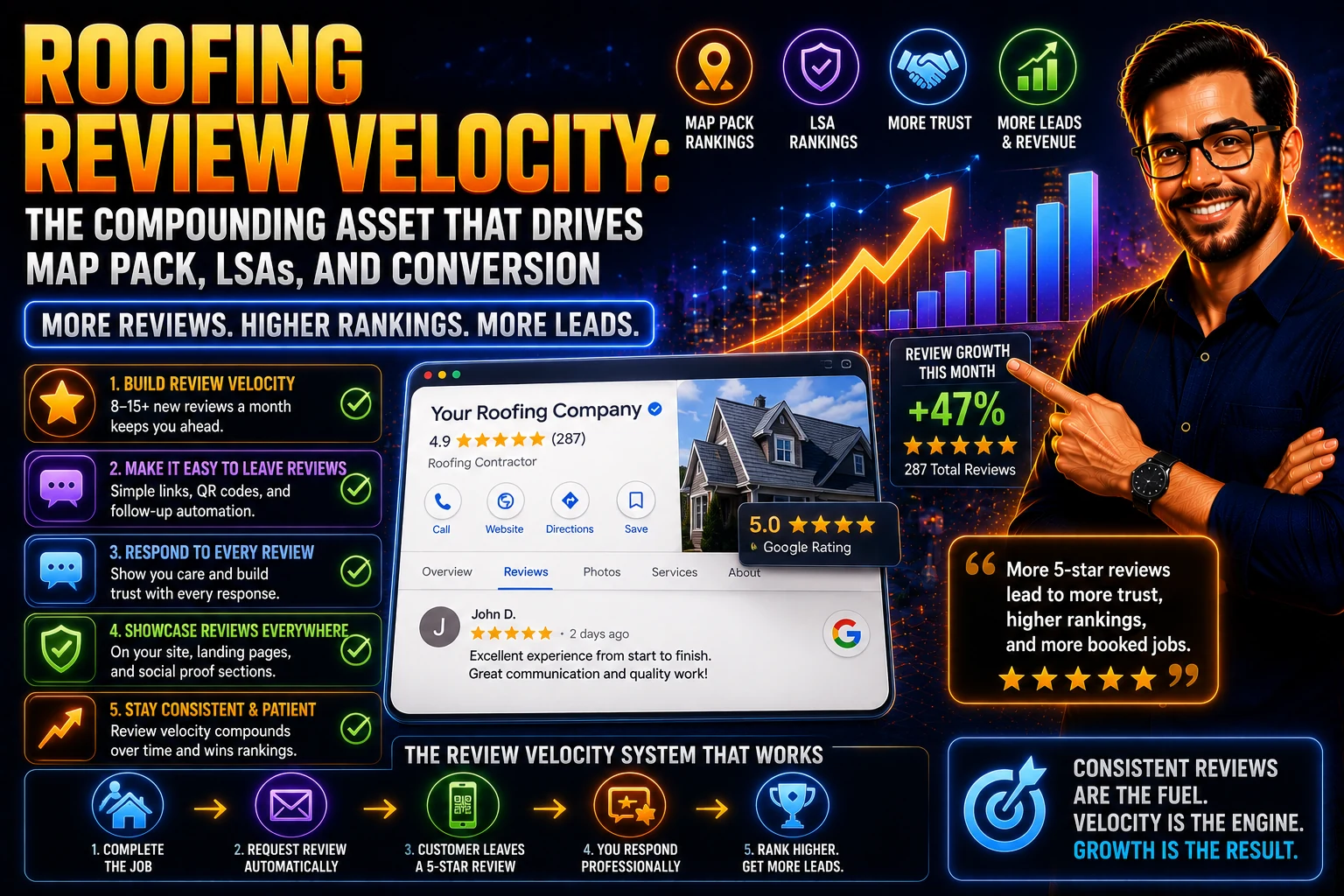
Roofing Review Velocity
Quick answer
Velocity beats accumulation. Once an operation holds a baseline of fifty to a hundred reviews, the rate of new ones matters more for ranking than the total. Sustained velocity comes from a systematic request process rather than hoping customers remember, and different customers respond to different channels, so ask across several.
Reviews are simultaneously a Map Pack ranking factor, an LSA ranking factor, a trust signal customers genuinely evaluate before substantial roofing investments, an AI-search citation factor, and a referral generator that produces ongoing leads from satisfied customers. For roofing operations specifically, where job values are substantial and customer trust matters enormously, sustained review velocity is among the highest-leverage marketing investments available. And one of the most consistently underbuilt by operations that treat review generation as an afterthought rather than as systematic operational discipline.
Key Takeaways
- VELOCITY BEATS ACCUMULATION: Once an operation has a baseline of reviews (typically 50-100+), sustained velocity matters more for ranking than continued accumulation.
- Sustained review velocity comes from systematic process rather than from hoping customers leave reviews.
- Different customers respond to different channels.
- Responding to every review — positive, negative, or constructive — signals active operation and engagement that affects both perception and search-ranking signals.
- Generic five-star reviews ('great service, would recommend') reinforce ratings but don't sell prospective customers as effectively as specific story-driven reviews mentioning the scope of work, the situation, the response, and the outcome.
Published: July 20, 2026 | Reading Time: ~8 minutes | Category: Roofing Marketing — Review Velocity
This guide covers review pace for roofers: why reviews matter more here than in many trades, the system that produces a steady stream, the channels that lift response rates, the reply discipline that signals you're engaged, the specifics that sell future customers, the difference between steady pace and bursts, managing reviews across platforms, handling critical and negative reviews well, the schema that surfaces review stars in search, and the metrics that tell a real program from stray activity.
What You'll Learn
- Why reviews matter more for roofing than for many other home-services categories
- Systematic generation process that produces sustained velocity
- Multi-channel requesting that maximizes response rates
- Response discipline on every review (positive and constructive)
- Specificity in reviews that converts future prospects
- Sustained velocity vs burst patterns and what each signals
- Review management across Google, Facebook, BBB, and industry platforms
- Constructive and negative review handling that protects reputation
- Schema markup that surfaces review signals in search results
- Measurement of review program performance
Why do reviews matter more in roofing?
- Substantial dollar decisions: roof replacement involves substantial homeowner investment, and customers researching providers rely heavily on review signals to evaluate which operations they can trust with the investment.
- Trust-sensitivity at peak: the combination of substantial cost, contractor-relationship risk, and limited customer ability to independently evaluate workmanship makes trust signals disproportionately important. Reviews are the most accessible trust signal customers actually evaluate.
- Storm-chaser distinction: established operations with substantial review histories distinguish themselves from storm-chasers (who can't accumulate years of reviews) precisely through the accumulated review base. Reviews are evidence storm-chasers can't fabricate.
- Map Pack ranking primary factor: for roofing local search, Map Pack ranking is the primary battleground, and review signals are the single most important factor in Map Pack ranking. Operations with sustained review velocity rank consistently; operations without it don't.
- LSA ranking primary factor: similarly, LSA ranking weighs reviews heavily. The same review-generation work strengthens both channels.
- AI-search citation factor: AI search systems increasingly factor reviews into business evaluations. Operations with substantial positive review histories surface more often in AI-generated answers than operations without.
- Referral compounding: customers who leave positive reviews refer friends and neighbors at higher rates than customers who don't engage with the review process. The review request itself produces referral effects beyond the review.
VELOCITY BEATS ACCUMULATION: Once you have a baseline of reviews (say 50 to 100), a steady pace matters more for rank than piling on more. Algorithms favor recent activity — 10 new reviews this month signals an active roofer, while 500 old reviews with nothing recent signals a stall. Roofers who chase total counts miss this; roofers who hold a steady monthly pace outrank those with bigger totals but slower recent activity. The goal isn't "get more reviews ever." It's "get new reviews every month, every month."
How do you generate reviews systematically?
A steady pace comes from a system, not from hoping customers post. Roofers who earn 8 to 15 new reviews a month built the systems that produce the asks; roofers stuck at 1 or 2 haven't.
- Review request integrated into every job completion: the request happens automatically as part of the standard job-completion workflow rather than depending on whether the project manager remembers to ask.
- Timing at peak satisfaction: the request reaches the customer at the moment of highest positive feeling, typically immediately after job completion when the customer is most likely to act on the request.
- Multiple touchpoints: initial request, follow-up if no response within a defined window, second follow-up if still no response. Many customers who would leave reviews don't act on the first request but respond to follow-ups.
- Direct links eliminating friction: the request includes a direct link to the Google review form (and other platforms targeted), eliminating the navigation friction that kills review completion.
- Clear ask: the request explicitly asks for the review, with context about why it matters to the operation. Vague messages produce vague responses.
- Sales process integration: the review request is mentioned during the sale ('we'll ask for a Google review when the work is complete') so the request later doesn't surprise the customer.
Multi-Channel Requesting
Different customers answer on different channels. Ask across several and you reach more of the pool than asking on just one.
- Email: the most common channel, particularly for older homeowners and customers who prefer email communication. Branded, professional emails with clear direct links.
- Text/SMS: increasingly the highest-response channel, particularly for younger demographics and customers with established mobile communication preferences. Short messages with direct review links.
- In-person at job completion: crew lead or project manager mentions the request when work concludes, supported by the digital follow-up. The in-person ask increases response rates on the subsequent email or text.
- Follow-up phone call for substantial customers: customers from substantial jobs (full replacements, large commercial work) sometimes warrant follow-up phone outreach that's both customer-service touch and review request opportunity.
- Email signature and invoice inclusion: review request links in standard email signatures and on invoices produce passive review generation across all customer touchpoints.
Should you respond to every single review?
Reply to every review — good, bad, or mixed. It signals you're engaged, which helps both perception and rankings. Roofers who reply look professional; roofers who ignore reviews look absent.
Positive Reviews
Reply with real, personal appreciation. Name a detail from the review ("thank you for noting our crew's care during the storm cleanup"), thank the customer by name, and promise the same for the next job. A generic "thanks for the review" reads as a bot; a specific reply reads as a real person.
Constructive Reviews
Critical reviews — three or four stars with specific feedback — deserve a professional reply that owns it. Address the points raised, admit what could have been better, note any fixes, and thank them for the feedback. Handled well, critical reviews often sell future customers better than a wall of five stars, because they read as real instead of cherry-picked.
Negative Reviews
Negative reviews — one or two stars — need careful, professional replies. Stay measured, not defensive. Acknowledge the concern, note any attempt to fix it, and offer to talk offline. Don't argue in public, attack the customer, or pile on defensive detail. The reply is for the prospects reading it, not just the reviewer. Handling a complaint well often keeps more future customers than the review loses.
PRO TIP: The best way to answer a bad review isn't to win the argument. It's to show future customers you handle problems well. Prospects read reviews to see how you deal with trouble, not just how you celebrate wins. A calm, professional reply that owns the concern often converts the reader better than having no negative reviews at all. Handled right, a negative review becomes an asset; handled defensively, it turns one complaint into wider reputation damage.
What makes a review actually persuade the next prospect?
Generic five-star reviews ("great service, would recommend") hold up your rating but don't sell like specific, story-driven ones that name the job, the situation, the response, and the result.
- Encourage specific reviews through the request copy: 'please tell us how the project went and what stood out to you' produces more specific reviews than 'please leave us a review.'
- Highlight specific reviews on the website: example reviews showing the kind of detail that helps future customers reinforces the model. Customers asked to write reviews often follow examples they've seen.
- Story-driven storm reviews particularly powerful: customers who experienced storm damage and were helped through the response often leave specific story-driven reviews that mention the situation, the timing of the response, and the outcome. These reviews convert future storm-affected customers more effectively than generic reviews.
- Reviews mentioning credentialing: customers mentioning the operation's licensing, insurance, manufacturer certifications, or specific credentials in their reviews reinforce the trust positioning for future searchers.
- Visual content: reviews that include customer-submitted photos of completed work add visual evidence that text-only reviews don't provide.
Is steady review flow better than a burst?
Both algorithms and people read steady pace and bursts differently. A steady stream (5 to 15 new reviews a month, ongoing) signals an active roofer and holds rank. A burst (50 in one month, then silence) reads as fake or stalled depending on context.
- Target sustained monthly velocity rather than concentrated bursts. The systematic generation process produces consistent monthly numbers; the unsystematic process produces irregular spikes.
- Algorithm penalties for review-acquisition gaming: Google and other platforms have detection systems for fake reviews, paid reviews, and other manipulation. Sustained organic velocity is safe; concentrated bursts that look artificial can trigger algorithmic suppression.
- Customer perception of recency: prospective customers note review dates. Reviews from years ago carry less weight than recent reviews; sustained recent activity signals active operation.
- Velocity through seasonal demand patterns: maintain velocity through quieter periods as well as peak demand. Operations that generate reviews only during storm windows produce visible patterns that signal seasonal-only operation.
Review Management Across Platforms
- Google reviews: the dominant platform for local search ranking and consumer evaluation. Primary focus.
- Facebook reviews/recommendations: secondary platform with substantial visibility for social-network-active customers.
- Better Business Bureau: still consulted by some homeowners for substantial-investment decisions like roofing.
- Industry platforms (Angi, HomeAdvisor, Networx): platform-specific reviews supporting performance on those platforms.
- Yelp where relevant: less central than Google for roofing in most markets but consulted by some customers.
- NextDoor: neighborhood-specific platform where local recommendations carry weight.
Different platforms reach different audiences and shape different searches. Focus review generation on Google first while keeping a baseline presence elsewhere, and you get the best combined return.
Schema Markup for Reviews
- Review schema on the website displaying customer reviews with the source platform identified. Schema-marked reviews can surface in search results enhancing CTR.
- AggregateRating schema showing overall rating across reviews. Surfaces star ratings in search results for the operation.
- LocalBusiness schema with aggregateRating included reinforces the trust signal across multiple touchpoints.
- Avoid review schema for fabricated or selectively-displayed reviews: schema must accurately represent actual reviews. Misrepresentation triggers algorithmic penalties and trust issues.
Measuring Review Velocity: Monthly Pace and Rating Held
- New reviews per month by platform: tracking monthly velocity by platform reveals where the generation systems are working and where attention is needed.
- Average rating maintained: tracking average rating alongside velocity ensures the volume isn't coming at quality cost.
- Response rate to reviews: percentage of reviews receiving operation responses, with target approaching 100%.
- Review-to-job ratio: new reviews per month divided by completed jobs per month. Reveals what percentage of customers actually leave reviews and where systematic improvement is possible.
- Source attribution: reviews requested through which channels (email, text, in-person) producing actual reviews. Reveals which channels work best for your customer base.
- Map Pack and LSA ranking trends: the downstream effect that review velocity actually drives. Sustained velocity should produce improving or sustained ranking; declining ranking with sustained velocity indicates other competitive or technical issues.
The Bottom Line
Review pace is one of the highest-leverage investments a roofer can make — it drives map-pack rank, LSA rank, AI-search citations, customer trust, and referrals through one system. Roofers earning 8 to 15 new reviews a month built the process; roofers with sporadic reviews didn't. The work isn't glamorous (request workflows, several touchpoints, reply discipline, measurement) but the returns compound for years and strengthen every other channel.
For most roofers, building a review system is one of the highest-return moves available. The cost is discipline, not ongoing spend; once built, it runs on little. And the downstream effects — map-pack rank, LSA performance, trust at the moment of choice, more referrals — lift every other channel. Stop treating reviews as something customers post on their own. Build the system that produces the pace roofing rewards.
Key Takeaways
- Reviews matter more for roofing than for many home-services categories. Substantial dollar decisions, trust-sensitivity at peak, storm-chaser distinction, Map Pack primary ranking factor, LSA primary ranking factor, AI-search citation factor, referral compounding
- Velocity beats accumulation: once an operation has 50-100+ baseline reviews, sustained monthly velocity matters more than continued accumulation. 10 reviews this month outranks 500 accumulated reviews with no recent activity
- Systematic generation process: review request integrated into every job completion, timing at peak satisfaction, multiple touchpoints with follow-up, direct links eliminating friction, clear ask, sales-process integration
- Multi-channel requesting: email (older homeowners), text/SMS (highest response in many demographics), in-person at job completion, follow-up phone for substantial jobs, email signature and invoice inclusion
- Response discipline on every review: personalized appreciation on positive reviews, professional acknowledgment on constructive reviews, measured professional handling on negative reviews — for future prospects reading more than the original reviewer
- Specificity converts: encourage specific reviews through request copy, highlight specific reviews on website, story-driven storm reviews particularly powerful, reviews mentioning credentialing reinforce trust positioning, visual content adds visual evidence
- Sustained velocity vs burst patterns: target consistent 5-15+ monthly indefinitely rather than concentrated bursts that look artificial. Maintain through seasonal patterns
- Cross-platform: Google primary focus, Facebook secondary, BBB still consulted, industry platforms (Angi, HomeAdvisor, Networx), Yelp where relevant, NextDoor neighborhood-specific
- Schema markup: Review schema with source identification, AggregateRating schema, LocalBusiness with aggregateRating — only for accurate representation of actual reviews
- Measurement: new reviews per month by platform, average rating maintained, response rate, review-to-job ratio, source attribution, downstream Map Pack and LSA ranking trends
READY TO BUILD A LEAD PIPELINE THAT'S YOURS? Astra Results Marketing builds review systems for roofers. Post-job request workflows, several request channels, reply discipline, copy that draws out specifics, pace tracking, and the joined-up approach that produces 8 to 15 new reviews a month, driving map-pack rank, LSA performance, trust, and referrals. Stop hoping customers post reviews. Build the system that produces the pace roofing rewards. Astra Results Marketing · astraresults.com · (+1) 786-321-2866