Rated 5 star on

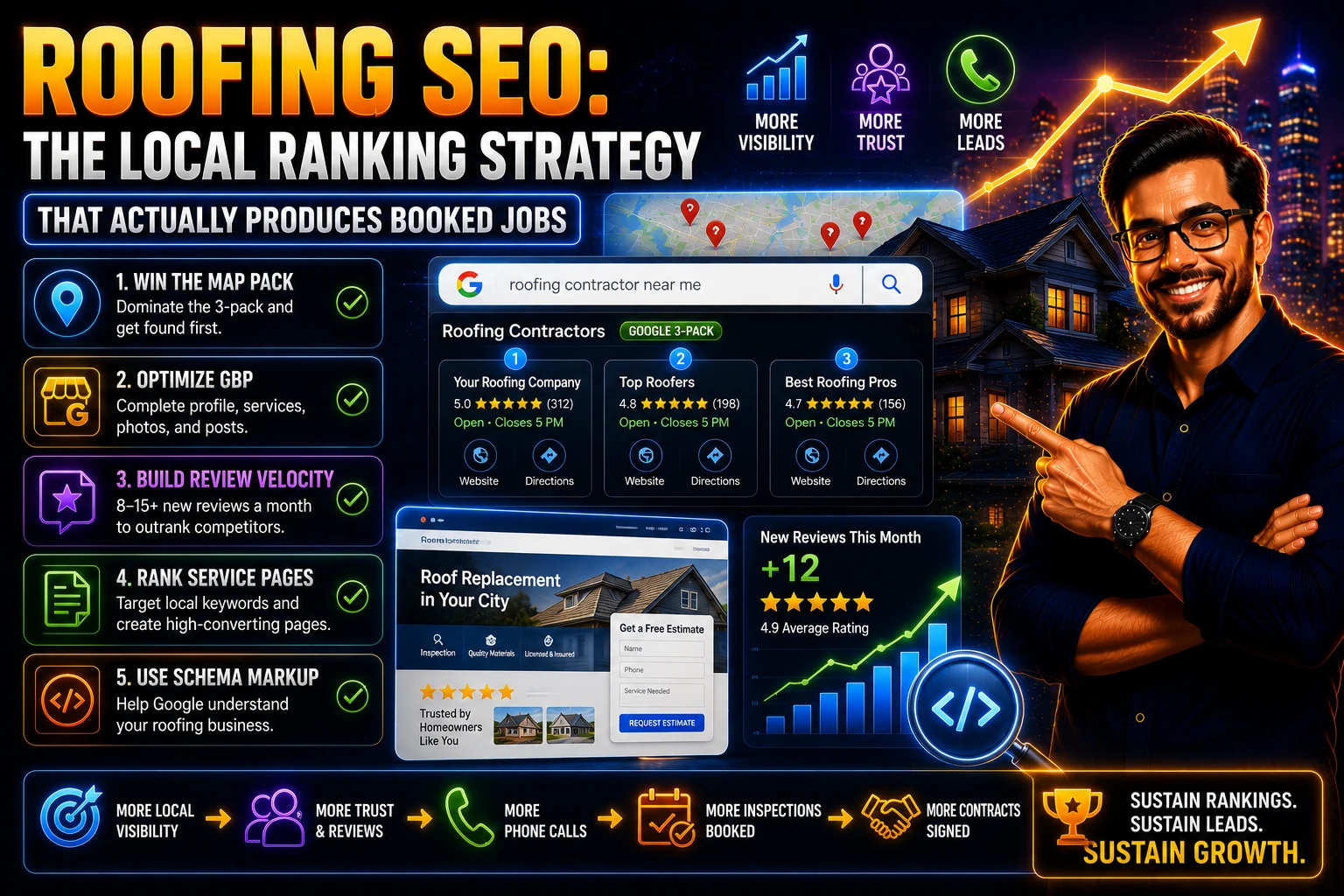
Roofing SEO: The Local Ranking Strategy That Actually Produces Booked Jobs
Quick answer
Most roofing SEO advice is generic local-services SEO with the word roofing swapped in. Roofing demand is storm-driven, high-value, and overwhelmingly local, which reshapes strategy: the Google Business Profile is the foundation, service-area pages need real substance, and review velocity is the asset that compounds. Long-tail queries book more jobs than head terms.
Most roofing SEO advice is generic local-services SEO with 'roofing' swapped in. The advice misses what makes roofing distinct as a search category: the storm-driven demand spikes that compress emergency work into hours, the trust-sensitivity of homeowners making decisions about substantial roof investments, the storm-chaser competition that floods the market after weather events, the insurance-restoration dynamics that route work through different channels than typical home services, and the head-term competition for high-volume terms that small operators can't realistically win against entrenched leaders. Generic SEO playbooks produce mediocre rankings for roofing operators; roofing-specific SEO strategy produces the Map Pack dominance and long-tail traffic that actually generate booked jobs.
Key Takeaways
- Most roofing SEO advice is generic local-services SEO with 'roofing' swapped in.
- Several characteristics of roofing demand shape SEO strategy in ways that don't match generic home-services advice.
- Google Business Profile is the foundation of Map Pack ranking.
- Service-area pages — dedicated pages for each city, neighborhood, or geographic area you serve — are essential for capturing location-modified searches.
- Reviews are simultaneously a Map Pack ranking factor, a trust signal customers genuinely evaluate, an AI-search citation factor, and a compounding asset that strengthens future marketing.
Published: July 17, 2026 | Reading Time: ~9 minutes | Category: Roofing Marketing — SEO
This guide covers roofing SEO for owners who want more leads from local search. It covers what makes roofing different, why the map pack is the main fight and what wins it, the Google Business Profile work that anchors local rankings, the service-area pages that catch geographic searches, the schema that helps regular and AI search, the review pace that compounds over years, the storm content that catches weather demand, the long-tail terms worth chasing, and the metrics that tell real SEO from busywork. Reroofer, storm restorer, or commercial contractor, the framework fits.
What You'll Learn
- Why roofing is distinct as a search category and what that means for strategy
- Map Pack dominance as the primary battleground
- Google Business Profile optimization specific to roofing
- Service-area pages that capture geographic searches without thin content penalties
- Schema markup for roofing services that supports traditional and AI search
- Review velocity as the compounding ranking asset
- Storm-content strategy that captures weather-driven demand spikes
- The long-tail keyword landscape and the head-term reality check
- Measurement that distinguishes working SEO from activity
What makes roofing distinct as a search category?
A few things about roofing demand shape SEO in ways generic home-services advice misses.
- Storm-driven demand compression. Severe weather produces substantial spikes in roofing demand within hours, and the operations that rank in Map Pack and organic results before the storm capture disproportionate work. SEO is the always-on infrastructure that wins storm windows; reactive ranking improvement during storms is too late.
- Trust-sensitivity at substantial dollar levels. Roof replacement involves substantial homeowner investment, and the trust signals that move buying decisions matter more than for low-stakes services. Reviews, credentialing, established local presence, and substantive web presence affect conversion as much as they affect ranking.
- Storm-chaser competition. After major storms, out-of-state operations and reactive local operators flood affected markets, often with weak digital presence but aggressive in-market sales. Established operations with strong SEO retain their position through these waves; operations relying on paid acquisition without SEO foundations get displaced when storm-chasers bid up paid channels.
- Head-term competition is structurally difficult. Generic high-volume terms ('roofing contractor [city],' 'roof replacement') have entrenched leaders with substantial domain authority and long review histories. Small operators that target these terms primarily often struggle to rank; the strategy that works targets the long-tail layer and Map Pack rather than competing for head-term organic positions.
- Insurance-restoration channels operate alongside typical SEO. A meaningful portion of substantial roofing work routes through insurance restoration, which involves adjuster relationships and channels that pure SEO doesn't reach. SEO captures the homeowner-initiated portion; the operation should also be positioned for the insurance-routed work.
MAP PACK IS THE BATTLEGROUND: For roofing, map-pack rank matters more than organic rank for the searches that book jobs. The map pack sits above the organic results, fills the mobile screen, and takes most clicks on local roofing searches. Strong content helps the map pack through authority and reviews, but put the main effort into the map-pack rank itself. A roofer with a weak map pack and strong content loses to one with a strong map pack and decent content. Anchor the work on the map pack and use content to back it up.
How should a roofer optimize the Business Profile?
Your Google Business Profile is the base of map-pack rank. Full optimization is a must for any roofer serious about local search.
- Primary category set to Roofing Contractor, with secondary categories covering relevant work (Commercial Real Estate Agency where applicable for commercial work, Construction Company, etc.). Category selection affects which searches you show up for.
- Complete business information: accurate name, address, phone, hours, service areas with geographic boundaries reflecting where you actually work, and website URL.
- Service list comprehensively populated: roof replacement, roof repair, storm damage repair, insurance restoration, gutter installation, commercial roofing, and the specific services your operation provides. Each service with substantive description.
- Substantial photo library: completed jobs (before/after where customer permission allows), team photos, equipment, and the work-in-progress documentation that builds credibility.
- GBP Posts published regularly: weekly or biweekly posts covering offers, completed projects, seasonal reminders, and storm-response capability. GBP Posts are an underused ranking signal.
- Q&A section populated proactively: ask and answer the common questions your customers actually ask, before customers ask them publicly. This populates the section with quality answers and prevents random or inaccurate community-submitted answers from appearing.
- Products and services properly listed where applicable, with descriptions and pricing guidance where appropriate.
- Review responses on every review: professional engagement with both positive and constructive reviews signals active operation and improves perception.
What makes a service-area page actually rank?
Service-area pages — one page for each city or neighborhood you serve — catch searches with a place name in them. The common mistake is thin doorway pages that don't rank and can even draw a penalty. What works is real pages with genuine content.
- Substantive content for each service area: 800-1500 words minimum, covering services in that specific area, common roofing concerns for that geography (storm patterns, prevalent material types, building stock characteristics), references to local projects where customer permission allows, and clear contact information.
- Genuine local relevance: mention specific neighborhoods, communities, or geographic features. Reference local building stock characteristics, climate considerations, or other features that distinguish this area's roofing needs.
- Internal linking architecture: service-area pages should link to your main service pages and vice versa, with related service-area pages cross-linking where relevant. The internal linking structure supports both ranking and user navigation.
- Schema markup: Service schema marking up the specific service offered, LocalBusiness schema with the service area information, and Review schema where applicable.
- Avoid duplicate content: each service-area page should have genuinely unique content. Thin copies of a template with only city names changed get filtered or penalized.
Schema Markup for Roofing
- LocalBusiness schema marking up the business overall, with service areas, hours, contact information, and credentialing details.
- Service schema for each major service category: roof replacement, roof repair, storm damage restoration, commercial roofing, etc. Each marked with detailed description and applicable details.
- FAQPage schema on service pages with substantive FAQ content. AI search systems particularly favor FAQPage-marked content for direct-answer extraction, making this schema especially valuable for AEO/GEO foundations.
- Review and AggregateRating schema where reviews are featured. The schema surfaces ratings in search results, improving CTR.
- BreadcrumbList schema on internal pages, supporting both navigation clarity and search-result presentation.
- Organization schema with social profiles, contact information, and business credentials cross-referenced.
Review Velocity as the Compounding Ranking Asset
Reviews do four jobs at once: they rank the map pack, they earn customer trust, they feed AI-search citations, and they build on themselves. For roofing, the pace of new reviews matters more than the pile you've stacked up past a baseline. Recent reviews carry more weight than old ones, and a steady stream marks an active roofer.
- Systematic post-job review requests: ask every completed customer at the moment of highest satisfaction, typically immediately after job completion. The customer's positive feeling is highest then and they're most likely to act on the request.
- Multi-channel requesting: email and text both, with clear direct links to the Google review form. Friction kills review completion; eliminate it.
- Encourage specificity: review request copy that prompts customers to mention specific aspects of the work (scope, timing, communication, outcome) produces story-driven reviews that convert future searchers far more effectively than generic 'great service' reviews.
- Sustained velocity: target a steady stream of new reviews each month rather than concentrated bursts. The algorithm responds to sustained activity better than to spikes.
- Response discipline: respond to every review, positive and constructive. Constructive reviews handled professionally signal accountability; ignored reviews signal disengagement.
PRO TIP: The single biggest SEO win for most roofers is steady review generation. A roofer earning 8 to 15 new Google reviews a month, month after month, outranks one with more total reviews but a slower recent pace. The work is operational, not technical — ask for a review at every job, make it one tap with a direct link, and follow up with those who don't answer. The effect compounds: better rank brings more leads, more leads bring more jobs, more jobs bring more reviews, more reviews hold the rank. The hard part is starting and keeping it up.
Storm-Content Strategy
Storm demand needs content that is ready before the storm. Content built during a storm is too late to rank for the searches the storm creates.
- Storm-damage assessment content: substantive pages explaining what to look for after storms, how to identify damage that requires professional inspection, what to document for insurance, and when to call professionally. Captures research-phase searches before homeowners commit to providers.
- Insurance-restoration process content: pages explaining how the insurance restoration process works, what homeowners should expect, the role of public adjusters, and the documentation that supports claims. Substantial content for this search intent.
- Storm-preparation content: pages addressing roof condition assessment before storm season, identification of vulnerable roofing conditions, and the preparation work that reduces storm-damage risk.
- Region-specific storm content: pages addressing the specific storm patterns and damage types common in your geography (hurricanes for coastal areas, hail for plains states, severe wind for various regions, ice damage for northern markets).
- Emergency-response service content: dedicated emergency roof repair and tarping pages that capture urgent-need searches with high conversion intent.
Should you chase head terms or long-tail queries?
Head terms like "roofing contractor," "roof replacement," and "roofer" are hard organic targets for most roofers. Entrenched rivals with big authority, long review histories, and years of SEO own them in most markets. A new or growing roofer should aim for the map pack on these terms, which strong profile and review work can win, not organic position one, which is often out of reach.
The long-tail is where organic SEO pays off for most roofers. Long-tail patterns worth targeting include:
- Service-specific long-tails: 'metal roof installation [city],' 'tile roof repair [neighborhood],' 'flat roof commercial [area].'
- Material-specific searches: 'cost of metal roof,' 'asphalt vs metal roofing,' 'tile roof maintenance,' 'TPO commercial roofing.'
- Decision-research searches: 'how long does a roof last,' 'when to replace vs repair,' 'roof inspection cost,' 'how to choose roofing contractor.'
- Emergency and damage searches: 'emergency roof tarp,' 'roof leak repair,' 'hail damage roof inspection.'
- Insurance and process searches: 'roof insurance claim process,' 'roofing public adjuster,' 'how to document storm damage.'
- Local hyper-specific: 'roofers in [specific neighborhood],' 'roof companies near [landmark],' '[zip code] roofers.'
Roofers who build real content for the long tail pull in traffic from many small searches that add up. Each long-tail term is usually less contested than a head term, and steady long-tail content compounds rankings across many searches over time.
Measurement That Distinguishes Working SEO from Activity
- Map Pack ranking by service area: track competitive position in each market you serve. Declining ranking indicates competitive issues; sustained or improving ranking confirms the foundation is working.
- Organic leads by month: total qualified leads attributed to organic search (Map Pack, organic results, GBP direct contact). Should grow over time as SEO investment compounds.
- Cost-per-booked-job from SEO: SEO investment (agency or in-house cost) divided by booked jobs attributed to organic channels. Compares against other acquisition channels to evaluate channel mix.
- Review velocity: new reviews per month tracked consistently. Should sustain at meaningful levels; declining velocity is an early warning signal.
- Branded search volume: searches for your business name. Growth in branded search indicates brand awareness expanding from your broader marketing presence.
- Service-area page performance: traffic and conversion by service-area page. Reveals which markets your geographic content is reaching and which need attention.
The Bottom Line
Roofing SEO is local-search work tuned to a vertical with its own quirks. Storm-driven demand, high-dollar trust decisions, storm chasers who flood the market after events, head terms that are structurally hard, and insurance-restoration work running alongside homeowner searches. The strategy that books jobs centers on winning the map pack, backed by a full Business Profile, real service-area pages, schema across the site, a steady review pace, storm content ready in advance, and long-tail content. Not doomed fights for head-term position one.
Roofers who do this steadily build durable organic lead flow that compounds for years and survives the storm-chaser waves that displace weaker rivals. The work is concrete: a thorough, maintained profile, real service-area pages per market, schema across the site, review systems that keep the pace up, long-tail content, and metrics that tell real SEO from activity. Roofers who build this beat those who lean on paid ads alone — and once built, it produces leads for years on little ongoing spend.
Key Takeaways
- Roofing SEO is distinct from generic local-services SEO — storm-driven demand compression, trust-sensitivity at substantial dollar levels, storm-chaser competition, structurally difficult head-term competition, and insurance-restoration channels all shape strategy
- Map Pack is the primary battleground for roofing local search. Operations concentrate foundational work there, using organic content to reinforce Map Pack ranking rather than competing for impossible organic head-term positions
- Google Business Profile foundation: complete information, primary and secondary categories, comprehensive service list, substantial photo library, regular GBP Posts, populated Q&A, products and services listed, review responses on every review
- Service-area pages need substantive content (800-1500+ words), genuine local relevance, internal linking architecture, and schema markup — thin doorway pages get filtered or penalized
- Schema markup for roofing: LocalBusiness, Service for each category, FAQPage on service pages (especially valuable for AI search), Review and AggregateRating, BreadcrumbList, Organization
- Review velocity is the highest-leverage SEO improvement for most roofing operations — systematic post-job requests, multi-channel requesting, encouraging specificity, sustained 8-15+ monthly velocity, response discipline on every review
- Storm-content strategy must be built before storms hit: damage assessment, insurance-restoration process, storm preparation, region-specific patterns, emergency-response service content
- Long-tail layer produces durable returns where head terms are too competitive: service-specific, material-specific, decision-research, emergency/damage, insurance/process, and hyper-local searches that aggregate to substantial traffic
- Measurement: Map Pack ranking by service area, organic leads by month, cost-per-booked-job from SEO, review velocity, branded search volume, service-area page performance
READY TO BUILD A LEAD PIPELINE THAT'S YOURS? Astra Results Marketing builds roofing SEO that wins the map pack and long-tail organic leads — Business Profile optimization, real service-area pages, full schema, review systems that keep the pace up, storm content built ahead of time, and the joined-up approach that compounds rankings over years. Stop leaning on paid ads or fighting impossible head-term battles. Build the SEO base that produces compounding organic leads. Astra Results Marketing · astraresults.com · (+1) 786-321-2866