 Rated 5 star on

AI SEO Partners: How to Tell Good From Plausible
Quick answer
A good AI SEO partner sells a clear method and honest reporting, not guaranteed citations. Nobody can guarantee that AI assistants will cite a business, so treat guarantees as a red flag. Real work means strong technical SEO, expert content, consistent business information and earned mentions. Ask for lead reports and keep accounts in your name.
Every agency now sells AI SEO. The pitches sound similar: get cited by ChatGPT, appear in Google's AI answers, win the future of search. Some partners do careful, useful work. Others repackage old tactics with new labels, or promise results nobody can guarantee. From the outside, the plausible and the good can look the same.
Key Takeaways
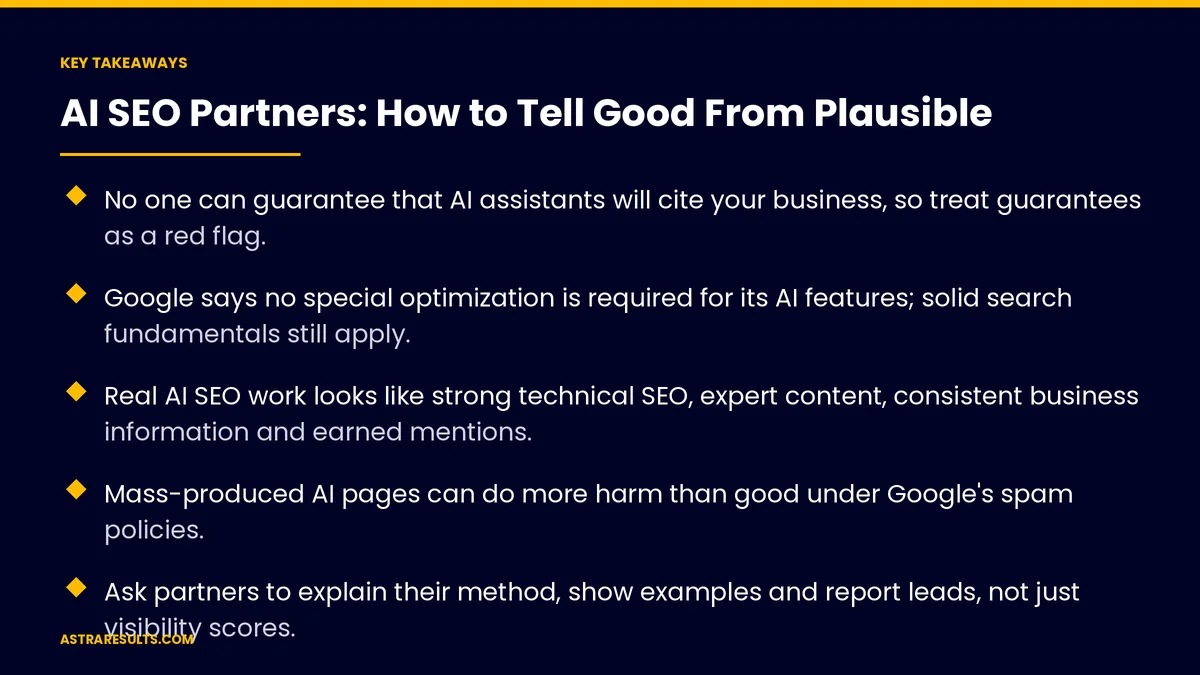
- No one can guarantee that AI assistants will cite your business, so treat guarantees as a red flag.
- Google says no special optimization is required for its AI features; solid search fundamentals still apply.
- Real AI SEO work looks like strong technical SEO, expert content, consistent business information and earned mentions.
- Mass-produced AI pages can do more harm than good under Google's spam policies.
- Ask partners to explain their method, show examples and report leads, not just visibility scores.
- Keep accounts in your name, avoid long lock-ins and define deliverables in writing.
Published: October 18, 2026 | Reading Time: ~10 minutes | Category: AI SEO
This guide helps you tell them apart: the red flags in AI visibility pitches, what solid AI SEO work looks like, the questions to ask, how results should be reported and what to put in the contract. Put plainly: good partners explain their method and measure business results; plausible ones sell secrets and scores.
In This Playbook
- Why this market is confusing
- Red flags in a pitch
- What solid AI SEO work looks like
- Questions to ask a partner
- How results should be reported
- What to put in the contract
- Budget and expectations
- What to measure in a partnership
- The first three months
Why this market is confusing
It's new. AI answers in search and AI assistants have changed quickly, and best practices are still forming.
Results are hard to see. Search Console mixes AI feature traffic into normal results, so it isn't reported separately, as covered in AI Overviews vs classic rankings.
New labels, old work. Many "AI SEO" services are good SEO under a new name. That's fine if it's done well and priced fairly.
Fear sells. "Your business is invisible to AI" is an easy pitch to make and hard to check.
Red flags in a pitch
Guaranteed citations or rankings. No one controls what AI assistants or search engines show.
Secret methods. "Proprietary AI hacks" that can't be explained usually can't be trusted.
A single trick. Anyone selling one file, tag or setting as the key to AI visibility. Google says no special optimization is required for its AI features.
Claimed special access. Partnerships with AI companies that supposedly guarantee placement.
Mass-produced pages. Hundreds of thin AI-written pages can count as scaled content abuse under Google's spam policies, and hurt your whole site.
Scores without method. An "AI visibility score" with no explanation of how it's measured.
Long lock-in contracts. Twelve months or more before you've seen any work.
What solid AI SEO work looks like
Technical foundations. Pages that can be found, crawled and indexed, load fast and are eligible for snippets.
Content that answers questions fully. Clear, accurate pages that cover a topic and its follow-up questions, written or reviewed by people with real expertise, as covered in content for YMYL practices.
Consistent business information. Your name, address, services and facts matching across your site, profiles and directories.
Earned mentions. Reviews, press, partnerships and citations from respected sources.
Multiple formats. Text, video and images that each help, like the watch pages in video SEO.
Local and national both handled. The right approach for how your customers search, as weighed in national vs local SEO.
Questions to ask a partner
"What will you do in the first 90 days?" Look for specific tasks, not vague promises.
"How do you decide what content to create?" Look for customer questions and search data, not volume targets.
"Who writes and reviews content?" Look for real expertise and editing, not unchecked AI drafts.
"How do you measure AI visibility?" Look for a clear method, such as tracking key questions by hand, plus business results.
"Can we see examples?" Real work for real clients, with permission.
"What happens if it doesn't work?" Look for a clear plan to adjust, and a contract you can leave.
How results should be reported
Business outcomes first. Leads, calls, bookings and sales from organic search.
Search visibility. Rankings and organic traffic for important topics.
AI answer checks. For your key questions, what AI answers say and which sources they cite, checked regularly.
Work done. Pages published, fixes made and mentions earned, so you can see effort as well as results.
Clear methods. How each number was measured, with the same method every month.
Connected to revenue. Leads traced to customers, using attribution across every channel.
What to put in the contract
Defined deliverables. What will be done each month.
Reporting. What will be reported, how often and how it's measured.
Ownership. Your website, analytics and profiles stay in your name, and content they create belongs to you.
Reasonable terms. A trial period or short commitment before longer terms.
No guarantees of placement. A partner promising them in writing is a warning sign.
Budget and expectations
Realistic timelines. Search results usually take months, not weeks.
Fair pricing. Compare what's delivered, not the label on the service.
Balance channels. AI search is one surface alongside paid search and classic SEO, as covered in budgeting across three surfaces.
What to measure in a partnership
Leads from organic search. Month over month, against a baseline.
Visibility for key topics. Rankings and AI answer mentions for questions that matter.
Delivery against plan. Agreed work completed on time.
Content quality. Accuracy and usefulness of what's published.
Cost per lead. Partner fees and costs divided by organic leads.
The first three months
Days 1–30: choose carefully
Ask candidate partners the questions above. Check examples and references. Agree deliverables, reporting and ownership in writing, with a short initial term.
Days 31–60: watch the work
Expect a technical audit, fixes, a content plan built on customer questions and the first pages published. Confirm accounts stay in your name.
Days 61–90: judge on evidence
Review leads, visibility for key topics, AI answer checks and work delivered against the plan. Decide whether to continue, adjust or change partners.
Where Astra comes in
Astra Results Marketing does AI SEO the way we'd want a partner to do it for us. We explain our method, start with technical foundations, build expert content around real customer questions, keep your business information consistent and earn mentions from respected sources.
We guarantee no placements, keep every account in your name and report leads alongside visibility and AI answer checks. Engagements begin with a search and AI visibility review through our AI SEO team.
Related reading
Frequently asked questions
Can an agency guarantee we'll be cited by ChatGPT or Google's AI?
No. Nobody controls what AI assistants or search engines show. Treat guaranteed citations or rankings as a red flag.
Is AI SEO different from regular SEO?
Largely, it builds on the same foundations. Google says no special optimization is required for its AI features. Strong technical SEO, expert content that answers questions fully, consistent business information and earned mentions still matter most.
Are AI-generated pages a good way to get visibility?
Mass-produced, thin pages can count as scaled content abuse under Google's spam policies and hurt your site. AI can help draft content, but people with expertise should review and improve it.
What should an AI SEO partner report?
Leads and sales from organic search, visibility for key topics, regular checks of AI answers for your important questions, and the work completed, with clear methods for each number.
What contract terms should we look for?
Defined deliverables, clear reporting, your ownership of accounts and content, a short initial term and no written guarantees of placement.
How long does AI SEO take to show results?
Usually months rather than weeks. Expect technical fixes and content in the first few months, with visibility and leads building over time.
Ready for an AI SEO partner who explains the work and measures the results? Astra Results Marketing builds AI search visibility on solid technical foundations, expert content and consistent business information, guarantees no placements and reports the leads your search presence brings. ▸ CALL (786) 321-2866 · ▸ REQUEST YOUR CONSULTATION





