 Rated 5 star on

Where Ads Appear Inside a Conversation
Quick answer
ChatGPT ads appear below the end of an answer, in a separate box labeled as sponsored. OpenAI says ads do not change the answer itself. Ads reach logged-in adults on the Free and Go plans. They are not shown to users under 18 or in sensitive health conversations. Good ads answer the conversation's question.
An ad inside an AI conversation sounds like it could appear anywhere, even woven into the answer. In ChatGPT, it can't. Ads sit in their own labeled space after the answer, and they're kept away from whole categories of conversation. Knowing where ads appear, and where they don't, shows whether this channel fits you.
Key Takeaways
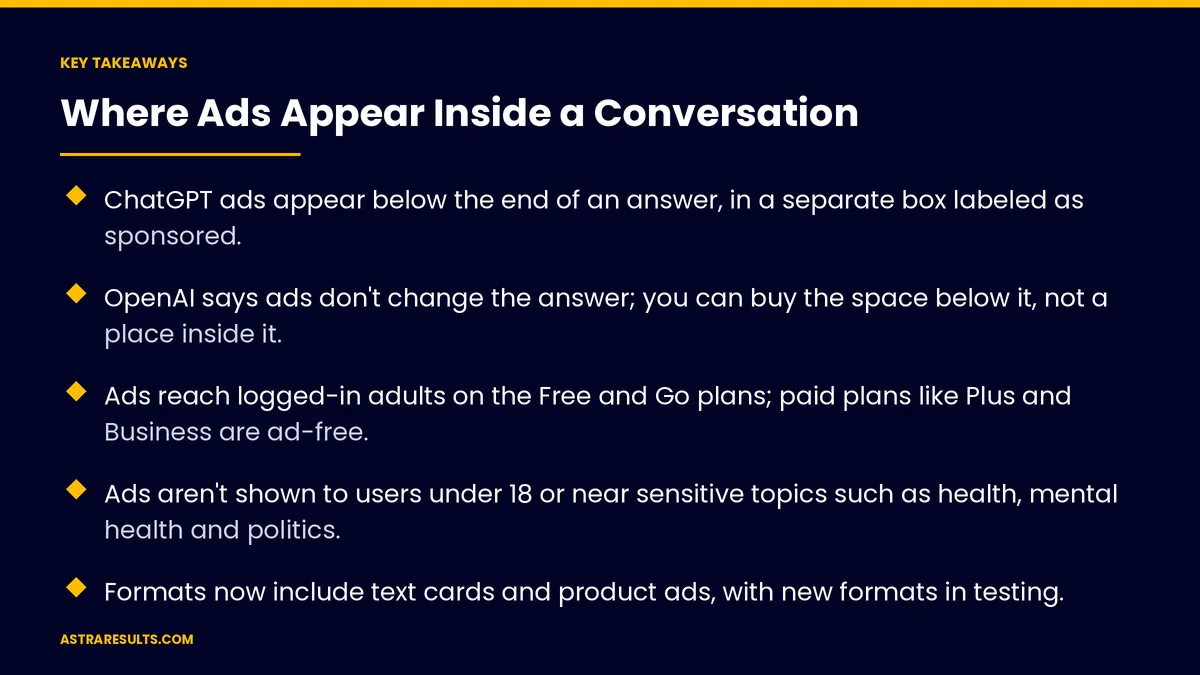
- ChatGPT ads appear below the end of an answer, in a separate box labeled as sponsored.
- OpenAI says ads don't change the answer; you can buy the space below it, not a place inside it.
- Ads reach logged-in adults on the Free and Go plans; paid plans like Plus and Business are ad-free.
- Ads aren't shown to users under 18 or in sensitive conversations such as personal health or mental health, and political ads aren't allowed.
- Formats now include text cards and product ads, with new formats in testing.
- Creative should answer the question the conversation was about, and the landing page should continue it.
Published: October 27, 2026 | Reading Time: ~9 minutes | Category: ChatGPT Ads
This guide covers where ChatGPT ads show up, who sees them, where they're never shown, the formats available today, and what that means for your creative and landing pages. Put plainly: your ad appears after the answer, next to a conversation about your topic, so it has to continue that conversation, not interrupt it.
ChatGPT's ad products change month by month. Check OpenAI's current advertiser guidance before planning a campaign.
In This Playbook
- Where ads sit
- Who sees ads
- Where ads never appear
- Formats today
- Writing ads for a conversation
- The landing page
- Brand safety and privacy
- Is it right for your business?
- Numbers that show fit
- The first three months
Where ads sit
Below the answer. After ChatGPT finishes responding, a sponsored card can appear under the reply.
Clearly labeled. Marked as sponsored and visually separated from the answer.
Matched to the conversation. Ads are chosen based on what the conversation is about.
Not inside the answer. OpenAI calls this answer independence: ads don't influence what ChatGPT says. Earning a place in the answer itself is an organic search question, covered in AI SEO partners.
How the channel works overall is covered in advertising inside ChatGPT.
Who sees ads
Free and Go plan users. Logged-in adults on these plans may see ads.
Not paid plans above Go. Plus, Pro, Business, Enterprise and Education accounts are ad-free.
Growing by country. Ads started in the US in February 2026 and have expanded to more countries since.
Not everyone, every time. Ads appear only when there's a relevant sponsored product or service for the conversation.
Where ads never appear
Users under 18. Whether stated or predicted, these accounts don't see ads.
Sensitive conversations. OpenAI keeps ads out of sensitive conversations such as personal health or mental health, and political ads aren't allowed. Since April 2026, general medical, legal and financial questions can show ads from approved advertisers.
Temporary and logged-out chats. No ads in these sessions.
What this means for some industries. Health and finance are restricted categories. Since July 2026, OpenAI may approve certain US health advertisers case by case, such as dental, vision, urgent care and medical testing, but ads still stay out of sensitive personal health conversations.
Formats today
Text cards. A sponsored card with your name, icon, headline, short copy and sometimes an image.
Product ads. Ads built from a product catalog, showing items relevant to the conversation. Good product data matters, as covered in generative AI product copy.
New formats in testing. OpenAI has tested sponsored agents and announced an image-based format beside image generation, starting in the US in October 2026.
Expect change. Formats, placements and targeting options are still evolving.
Writing ads for a conversation
Answer the question. Someone asking about weekend trips to the Keys wants options and prices, not a slogan.
Be specific. A concrete offer, price or detail that fits the topic.
Match the tone. Helpful and plain, like the answer above it.
One clear next step. Book, compare, get a quote or see availability.
Test several versions. Different headlines and offers, kept or dropped based on results.
The landing page
Continue the conversation. The page should pick up exactly where the ad left off.
Show what the ad promised. The offer, price or product, at the top.
Fast and simple on phones. Most people will tap through on mobile. The principles are in landing pages.
Track it properly. Conversions measured with the pixel and Conversions API, as covered in measuring ChatGPT Ads.
Brand safety and privacy
Conversations stay private. OpenAI says advertisers don't see users' chats.
Topic exclusions protect brands too. Your ad won't appear next to sensitive conversations.
More controls are coming. OpenAI has announced brand-suitability pilots with third-party verification partners.
Review placements. Use the reports available to check where and how your ads appear.
Is it right for your business?
Good fit. Travel, retail, local services, software and other businesses whose customers ask ChatGPT for recommendations and comparisons.
Limited fit. Health, finance and other restricted categories, which need OpenAI's approval and stay out of sensitive conversations.
Compare with search. People in ChatGPT are often still exploring. Search ads catch people ready to act, as covered in the Google Ads playbook.
Numbers that show fit
Click-through rate. How often people tap the ad after reading the answer.
Conversions. Leads, bookings and sales from ad clicks.
Cost per customer. Compared with search and social.
Ad relevance. Which conversation topics bring the best results.
Placement reports. Where ads appear and how often.
The first three months
Days 1–30: check the fit
Confirm your category isn't excluded and that ads run in your markets. List the questions your customers ask ChatGPT. Plan ads and landing pages that answer those questions.
Days 31–60: launch a focused test
Run a small campaign on the strongest topics, with several ad versions and matched landing pages. Set up conversion tracking before launch.
Days 61–90: learn and decide
Compare click-through, conversions and cost per customer with your other channels. Keep the topics and versions that work, and decide whether to scale.
How Astra runs conversational ads
Astra Results Marketing plans ChatGPT ads around the conversations your customers have. We check whether your category fits, write ads that answer the question being asked, build landing pages that continue the conversation and set up tracking before launch.
We test focused campaigns, compare results with search and social, and scale only what brings customers. Engagements begin with a fit and opportunity review through our ChatGPT ads team.
Related reading
Frequently asked questions
Where do ads appear in ChatGPT?
Below the end of an answer, in a separate box labeled as sponsored, matched to what the conversation is about. Ads don't appear inside the answer text.
Can advertisers influence ChatGPT's answers?
OpenAI says no. Its answer independence principle means ads appear separately below the answer and don't change what ChatGPT says.
Who sees ChatGPT ads?
Logged-in adults on the Free and Go plans in supported countries. Plus, Pro, Business, Enterprise and Education accounts don't see ads.
Where are ChatGPT ads never shown?
To users under 18, in sensitive conversations such as personal health or mental health, and in Temporary Chats or logged-out sessions. Political ads aren't allowed.
Can medical practices advertise in ChatGPT?
Some can. Since July 2026, OpenAI may approve certain US health advertisers, such as dental, vision, urgent care and medical testing, after manual review. Ads still stay out of sensitive personal health conversations, so check OpenAI's current policies for your category.
What makes a good ChatGPT ad?
One that answers the question the conversation was about, with a specific offer, a helpful tone, one clear next step and a landing page that continues the conversation.
Ready to show up when customers ask ChatGPT about what you sell? Astra Results Marketing checks whether your category fits, writes ads that answer the question being asked, builds matching landing pages and measures results against your other channels before scaling. ▸ CALL (786) 321-2866 · ▸ REQUEST YOUR CONSULTATION





