 Rated 5 star on

Auto Dealer GenAI: Vehicle Descriptions and Follow-Ups
Quick answer
Generative AI helps dealerships write accurate vehicle descriptions and faster lead follow-ups when it works only from verified data. VIN decode, equipment lists and inspection notes feed the descriptions. Follow-ups answer the customer's question from live inventory. People approve anything about price, financing, condition or history. Texts need consent and an easy opt-out.
A dealership with hundreds of vehicles has hundreds of listings to write, and most end up as bare feature lists. Meanwhile, internet leads wait hours for a reply. Generative AI can help with both: descriptions that read well and replies that go out in minutes. The catch is accuracy, because one wrong feature can cost a sale and trust.
Key Takeaways
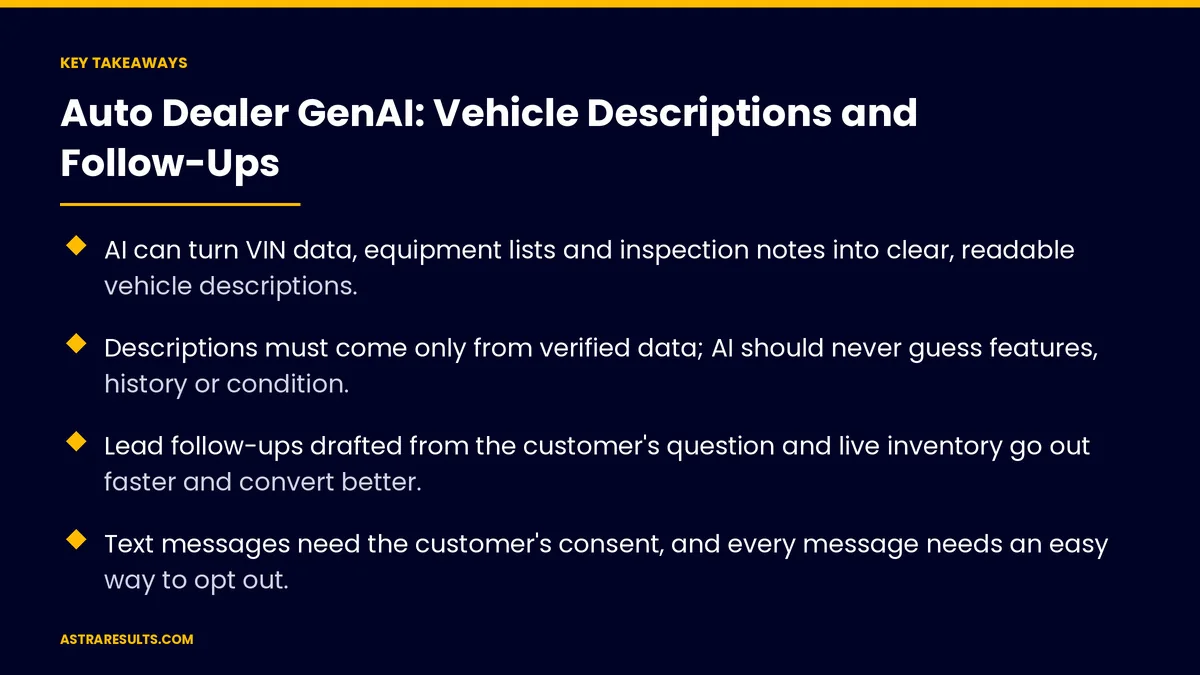
- AI can turn VIN data, equipment lists and inspection notes into clear, readable vehicle descriptions.
- Descriptions must come only from verified data; AI should never guess features, history or condition.
- Lead follow-ups drafted from the customer's question and live inventory go out faster and convert better.
- Text messages need the customer's consent, and every message needs an easy way to opt out.
- People approve anything about price, fees, financing, condition or vehicle history.
- Measure listing engagement, response time, appointments set and shows, not just how many words AI wrote.
Published: October 2, 2026 | Reading Time: ~9 minutes | Category: Generative AI Services
This guide covers how dealers use generative AI to write vehicle descriptions from real data, draft lead follow-ups that match the inquiry, and keep people in charge of every claim about price, condition and financing. Put plainly: let AI write from the facts you have, and never let it invent the ones you don't.
Vehicle advertising, pricing and financing claims are regulated by federal and state rules. Have your compliance team or counsel review templates before you use them.
In This Playbook
- Where generative AI helps a dealership
- Descriptions written from real data
- Accuracy rules for listings
- Lead follow-ups that match the question
- Consent and messaging rules
- Guardrails for the AI
- Rolling it out
- What should a dealership measure with generative AI?
- The first three months
Where generative AI helps a dealership
Vehicle descriptions. Readable listings for every unit, written in minutes instead of skipped.
Lead replies. First responses and follow-ups drafted from what the customer asked.
Service-to-sales notes. Messages to service customers whose vehicles are worth trading in, reviewed before sending.
Spanish versions. Listings and replies in Spanish for Miami buyers, checked by a native speaker.
What stays with people. Prices, fees, financing terms, trade-in values and anything about a vehicle's history. The broader picture is covered in generative AI at work.
Descriptions written from real data
Start with the facts. VIN decode, factory equipment, packages, options, mileage, color and inspection notes.
Write for buyers. Turn codes and feature lists into plain sentences about what the vehicle offers: safety features, technology, comfort and towing.
Keep a consistent voice. The same tone and structure across every listing, as with AI product copy at scale.
Highlight what matters for the model. Fuel economy for commuters, cargo space for families, towing for trucks.
Clean data first. Descriptions are only as good as the inventory feed, the same lesson as catalog data for online brands.
Accuracy rules for listings
No invented features. If a feature isn't in the data, it isn't in the description.
Used vehicles need care. Condition, accident history and service records come from inspections and reports, never from AI guesses.
Packages are tricky. Trim levels and option packages vary by year. Check them against the build data.
Prices and fees stay out of AI text. Show pricing from your pricing system, reviewed under your compliance rules.
People approve. A sales or inventory manager reviews descriptions before they go live, at least until the process proves reliable.
Lead follow-ups that match the question
Answer what they asked. If a customer asks about a specific truck's towing capacity, the reply answers that, from that vehicle's data.
Check live inventory. Never offer a vehicle that has sold. Suggest close matches when it has.
Reply in minutes. Speed matters more than polish in a first reply, as covered in speed to lead.
Hand off to a person. Questions about price, trade-in value, financing or availability holds go to a salesperson quickly.
Follow up with substance. After a test drive, send the details discussed, not a generic "checking in." Call summaries help here, as covered in meeting notes to action items.
Consent and messaging rules
Texts need consent. Marketing texts generally require the customer's prior written consent, and every message needs an easy opt-out, as covered in outbound compliance.
Email needs an unsubscribe. And an accurate sender and subject line.
Respect opt-outs fast. Stop messages promptly when a customer asks.
Florida has its own rules. State telemarketing rules add limits on calling and texting times and frequency.
Guardrails for the AI
Limited access. The AI reads inventory and lead data, but can't change prices or send financing offers on its own, following the limits in agent security.
Approved templates. Messages follow templates your compliance team has reviewed.
Logs. Every generated description and message is saved with who approved it.
Business accounts. Use business AI accounts with clear data terms, as covered in OpenAI in business.
Understand, then write. The system first reads the request and the vehicle data, then drafts, the pattern in GenAI + NLP.
Rolling it out
Start with descriptions. They're lower risk and easy to check.
Then first replies. Drafted by AI, sent by a person at first.
Then follow-ups. Once reply quality is proven, let approved templates send routine follow-ups.
Train the team. Show salespeople how to review and edit quickly.
What should a dealership measure with generative AI?
Listing engagement. Time on vehicle pages and contact rate per listing.
Response time. Minutes from lead to first reply.
Appointments set and shows. From internet leads, before and after.
Accuracy issues. Errors caught in review or reported by customers.
Hours saved. Time no longer spent writing listings and routine replies.
The first three months
Days 1–30: data and rules
Connect the inventory feed, VIN decode and inspection notes. Write accuracy rules and approved message templates with your compliance team. Record baseline response times, appointments and listing engagement.
Days 31–60: descriptions live
Generate descriptions for new inventory, reviewed by a manager before publishing. Add Spanish versions checked by a native speaker. Track errors caught in review.
Days 61–90: replies and follow-ups
Start AI-drafted first replies sent by salespeople, then approved follow-up templates. Measure response time, appointments set, shows and hours saved against the baseline.
How Astra builds dealer AI
Astra Results Marketing builds generative AI for dealerships that writes from real data. We connect inventory, VIN and inspection data to produce accurate descriptions, and draft lead replies that answer the customer's actual question from live inventory.
People approve anything about price, fees, financing or vehicle history, messaging follows consent rules, and every output is logged. Engagements begin with an inventory and lead-flow review through our generative AI services team.
Related reading
Frequently asked questions
Can AI write accurate vehicle descriptions?
Yes, when it writes only from verified data such as VIN decode, factory equipment, options and inspection notes. It should never guess features, history or condition, and a manager should review descriptions before they go live.
Should AI mention prices or financing in listings?
No. Prices, fees and financing terms should come from your pricing system and be reviewed under your compliance rules. Keep them out of AI-written text.
How does AI help with internet leads?
It drafts replies that answer the customer's actual question from live inventory, within minutes. Questions about price, trade-ins or financing go to a salesperson quickly.
Do we need consent to text leads?
Marketing texts generally require prior written consent, and every message needs an easy way to opt out. Florida adds its own limits on timing and frequency. Check your process with counsel.
What about used vehicle history and condition?
Those come from inspections, vehicle history reports and service records, never from AI guesses. A person should confirm anything stated about a used vehicle's condition or history.
Where should a dealership start?
With vehicle descriptions, which are low risk and easy to check. Then move to AI-drafted first replies sent by people, and finally to approved follow-up templates once quality is proven.
Ready for listings that sell and replies that arrive in minutes? Astra Results Marketing builds dealer AI that writes accurate descriptions from real vehicle data and drafts fast, relevant lead replies, with people approving every claim about price, condition and financing. ▸ CALL (786) 321-2866 · ▸ REQUEST YOUR CONSULTATION





