 Rated 5 star on

E-Commerce Ads Plus Generative AI Product Copy
Quick answer
Generative AI can write strong product copy for a large catalog, but only from your own product data. Shopping ads run on the product feed, so better titles and descriptions mean better ads. Invented details cause returns and disapprovals. People should review high-value products, sensitive categories and claims. Test new copy against the old.
A store with two thousand products can't hand-write two thousand good titles and descriptions. So most use the manufacturer's copy. That hurts twice: shopping ads run on weak data, and product pages look like everyone else's. Generative AI can write strong copy for a whole catalog, but only if it's set up to stick to the facts.
Key Takeaways
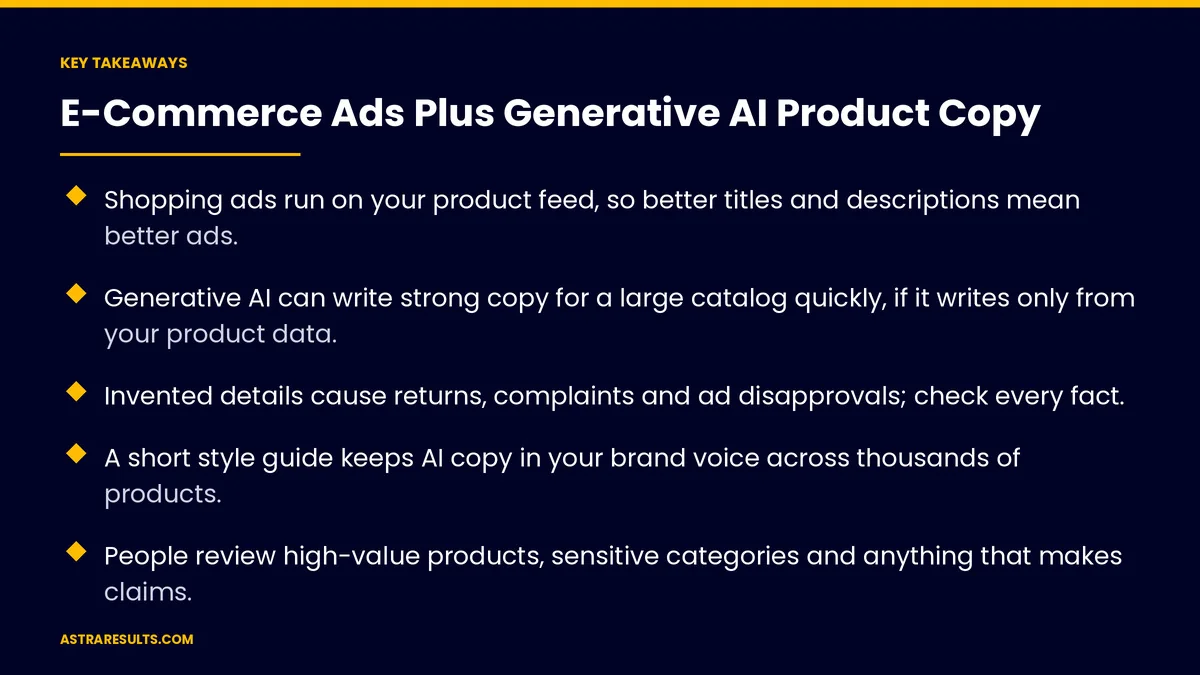
- Shopping ads run on your product feed, so better titles and descriptions mean better ads.
- Generative AI can write strong copy for a large catalog quickly, if it writes only from your product data.
- Invented details cause returns, complaints and ad disapprovals; check every fact.
- A short style guide keeps AI copy in your brand voice across thousands of products.
- People review high-value products, sensitive categories and anything that makes claims.
- Test new copy against the old, and keep what improves clicks, sales and returns.
Published: October 4, 2026 | Reading Time: ~10 minutes | Category: E-Commerce Marketing
This guide covers how stores use generative AI for product titles, descriptions and ad copy: why product data drives ads, writing from facts only, keeping your voice, what people must check, and testing. Put plainly: let AI write from your product data, never beyond it, and let the numbers decide what stays.
In This Playbook
- Why product copy drives your ads
- Write from facts only
- Titles that work
- Descriptions that sell
- Keep your brand voice
- What people must check
- Ad copy from the same facts
- Test what works
- What to measure
- The first three months
Why product copy drives your ads
Shopping ads use your feed. Product ads on search and social pull titles, descriptions, prices and images from your product feed. Weak data means weak ads.
Titles do most of the work. A clear title with brand, product type, size, color and key feature matches more searches and earns more clicks.
Descriptions help matching and buying. They help ad platforms understand the product and help shoppers decide.
Manufacturer copy is everywhere. The same text on dozens of sites does little to stand out.
Better copy helps the whole store. The growth side is covered in growing an online store.
Write from facts only
Start with clean product data. Brand, size, color, materials, dimensions, compatibility, care instructions and price. AI can only be as accurate as this data.
Give the model the facts for each product. Not a vague prompt, but the specific attributes for that item.
Forbid invented details. The model should never add features, materials, certifications or results that aren't in the data.
Flag missing data. If a key attribute is missing, the copy should leave it out and the product should be flagged for someone to fill in.
The pattern is "understand, then generate." Read the data, then write, then check, as covered in GenAI + NLP.
Titles that work
Lead with what shoppers search. Brand, product type and the attribute that matters most, such as size or model.
Add key details. Color, material, quantity or compatibility, in a consistent order for each category.
Keep it readable. No keyword stuffing, all-caps or promotional phrases.
One pattern per category. Shoes, furniture and electronics each need their own title formula.
Descriptions that sell
Answer the shopper's questions. What is it, who is it for, what's included, how big is it, how do I care for it?
Benefits from features. Turn "water-resistant fabric" into what it means for the customer, without overstating it.
Scannable. Short paragraphs and bullet points for key specs.
Unique to your store. Written in your voice, not copied from the manufacturer.
Keep your brand voice
Write a short style guide. Tone, words you use, words you avoid, length by category and how you describe sizes and fit.
Show examples. Ten to twenty descriptions you're proud of teach the model your voice better than rules alone.
Check consistency. Sample copy across categories to make sure it sounds like one brand. The approach is covered in replies in your voice.
What people must check
High-value products. Your best sellers and most expensive items deserve a human read.
Sensitive categories. Health, beauty, supplements, children's products and anything with safety rules. Claims here can carry legal risk.
Any claim. "Best," "clinically proven," "eco-friendly" or "lasts ten years" must be supported, or removed.
Sizes and compatibility. Wrong sizing or compatibility leads directly to returns.
A sample of everything else. Review a regular sample of routine products to catch problems early.
Ad copy from the same facts
Headlines and descriptions for campaigns. Generated from the same product facts and style guide.
Many options, people choose. AI drafts several versions; people pick the ones that fit the brand and the offer.
Match the landing page. The ad's promise should match the product page, as covered in landing pages.
Spanish versions. For Spanish-speaking shoppers, write copy for that audience rather than translating word for word, following what changes when Spanish is a channel.
Test what works
Start with a category. Rewrite one category and compare it with a similar one left as it was.
Measure clicks and sales. Click-through rate on shopping ads, conversion rate on product pages, and revenue.
Watch returns. "Not as described" returns should fall, not rise. If they rise, the copy is overselling.
Keep the winners. Roll out what improves results to other categories.
Track it properly. Attribute sales back to ads and pages with attribution across every channel.
What to measure
Feed quality. Products with complete titles, descriptions and key attributes.
Ad performance. Click-through and conversion rates on shopping ads, before and after.
Product page conversion. By category.
Return rate for "not as described." The clearest signal of accuracy.
Disapproved products. Items rejected by ad platforms, which should fall as data improves.
Time to publish. How quickly new products get complete, accurate copy.
The first three months
Days 1–30: data and voice
Audit product data for missing or messy attributes, and fix the most important gaps. Write a style guide with examples. Choose one category to start, and set title and description patterns for it.
Days 31–60: generate and review
Generate titles, descriptions and ad copy for the first category from product data only. Review high-value items, sensitive products and any claims. Update the feed and product pages.
Days 61–90: test and expand
Compare clicks, sales and returns with a similar unchanged category. Keep what works, fix what doesn't, and roll the approach out to the next categories.
How Astra helps stores
Astra Results Marketing uses generative AI to improve product copy across your whole catalog without inventing facts. We clean your product data, write a style guide in your voice, and generate titles, descriptions and ad copy only from each product's real attributes.
People review high-value and sensitive products and every claim. We test new copy against the old and keep what improves clicks, sales and returns. Engagements begin with a feed and catalog review through our e-commerce marketing team.
Related reading
Frequently asked questions
Can generative AI write product descriptions for a whole store?
Yes, if it writes only from accurate product data, follows a style guide, and people review high-value products, sensitive categories and claims. Without those, it can invent details that cause returns and complaints.
Why do product titles matter for ads?
Shopping ads pull titles from your product feed. Clear titles with brand, product type and key attributes match more searches and earn more clicks than vague or keyword-stuffed ones.
How do we stop AI from inventing features?
Give the model each product's actual attributes, tell it never to add details beyond them, flag products with missing data instead of guessing, and check facts before publishing.
Which products need human review?
Best sellers, expensive items, health, beauty, supplements, children's products and anything with safety rules, plus any copy that makes a claim. Review a regular sample of everything else.
Should we rewrite manufacturer descriptions?
Usually, yes. The same manufacturer text appears on many sites. Copy written in your voice, from accurate data, helps your products stand out on your site and in ads.
How do we know the new copy works?
Test one category against a similar unchanged one, and compare click-through rates, conversion rates, revenue and "not as described" returns. Keep what improves results.
Ready for product copy that sells without overselling? Astra Results Marketing cleans your product data, writes a style guide in your voice, and generates titles, descriptions and ad copy from real attributes only, reviewed by people and tested against your current copy. ▸ CALL (786) 321-2866 · ▸ REQUEST YOUR CONSULTATION





