Rated 5 star on

Generative AI at Work: Beyond the Chatbot
Quick answer
The business value of generative AI comes from connecting a model to the company's own documents and data, not from a chat window. Retrieval is the pattern that matters: the system answers from your sources and cites them, so an answer can be checked. Confidentiality and review are design decisions, settled before anything is deployed.
Most businesses have met generative AI as a chat window. Someone rewrites an email with it and the company concludes it has adopted AI. Meanwhile the useful version sits untouched: a system that has read every document the company owns and can answer from them, draft from them, and find the paragraph nobody could locate.
Key Takeaways
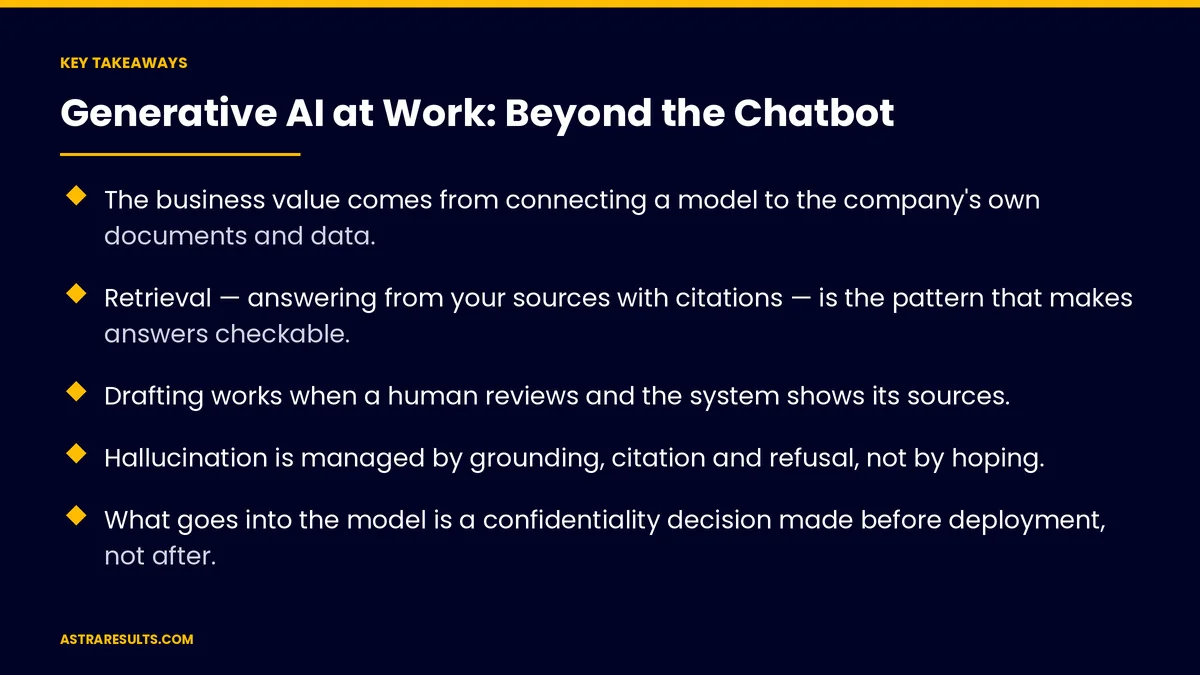
- The business value comes from connecting a model to the company's own documents and data.
- Retrieval — answering from your sources with citations — is the pattern that makes answers checkable.
- Drafting works when a human reviews and the system shows its sources.
- Hallucination is managed by grounding, citation and refusal, not by hoping.
- What goes into the model is a confidentiality decision made before deployment, not after.
- Measure time saved and quality held, with a human spot-check that never stops.
Published: September 13, 2026 | Reading Time: ~13 minutes | Category: Generative AI
This guide covers generative AI as business infrastructure rather than as a chat box. What it does with a company's own knowledge, how drafting works when review is built in, why hallucination is an engineering problem with engineering answers, and what it costs. If you remember one thing: the value is not the model; it is the model connected to your documents.
Guidance for owners and operators. Nothing here is legal or technical advice. Feeding company, customer or employee information into AI systems raises confidentiality, privacy, contractual and sector obligations that vary by jurisdiction and must be reviewed with counsel.
In This Playbook
- The difference from other kinds of AI
- Which pattern matters most, and why is it retrieval?
- Job one: knowledge, answered
- Job two: drafting with review built in
- Job three: search that understands questions
- Hallucination, handled
- Confidentiality: decide before deploying
- What it costs
- The limits, as they stand today
- What the first quarter looks like
The difference from other kinds of AI
- It produces language. Answers, drafts, summaries, translations, explanations — in the company's tone, at whatever length is asked.
- It handles the unstructured. A question asked in plain words. A document in any format. A request that does not match a template.
- It reasons across sources. Given ten documents, it can answer a question that requires pieces of four of them.
- What it is not. A database, which returns exactly what was stored. A calculator, which is always right. A source of truth about the world. It is a very capable writer with an imperfect memory, and the business's job is to give it the right documents and check its work.
- Where it sits alongside the rest. Machine learning predicts, NLP structures text, and generative AI produces language from sources, discussed in what ML does.
Which pattern matters most, and why is it retrieval?
Almost every useful business deployment uses the same shape.
- How it works. The company's documents are indexed. A question arrives. The system finds the passages most relevant to it, gives those passages to the model, and asks it to answer using them. The answer cites which documents it used.
- Why this is the pattern. The model answers from the company's actual documents rather than from what it absorbed in training. The answer is checkable, because the sources are named. And updating knowledge means updating documents, not retraining anything.
- What it needs. Documents that exist, are current, and are permitted to be used. The most common blocker is not technical: it is that the authoritative version of a policy lives in three files and nobody knows which is right.
- The immediate side benefit. Deploying this forces a business to identify its authoritative documents, which most have never done.
Job one: knowledge, answered
- The problem it solves. New staff asking questions that are answered in a document they cannot find. Experienced staff interrupted constantly. The same policy explained forty times a year.
- What it looks like. An internal system that answers "what is our warranty on this product line," "what does the contract with this vendor say about notice," or "how do we handle this exception" — with the source document and the passage attached.
- Who it helps most. Businesses with long documents that matter: contracts, policies, technical manuals, compliance procedures, product specifications.
- The trust rule. Every answer shows its sources. A system that answers without citations trains people to believe it, which is exactly wrong.
- The maintenance. Someone owns the document set: what is authoritative, what is retired, what is missing.
Job two: drafting with review built in
- What it drafts well. First versions. Proposals from a scope, quotes from notes, responses to common enquiries, product descriptions from specifications, summaries for clients, job descriptions, meeting follow-ups.
- Why first versions are the right target. The blank page costs the most time; the judgment about what to keep costs the least. The system produces the draft; the person does the judgment.
- The review requirement. Anything that leaves the company is read by a person. Not because the draft is usually wrong, but because "usually" is not a standard a business can publish against.
- Grounding the draft. A proposal drafted from the company's actual scope templates, pricing rules and past proposals is useful. One drafted from the model's general knowledge of proposals is generic, and reads it.
- The tone problem. Generic AI writing has a recognizable texture. Training on the company's own approved material, and editing, is what removes it, as covered in content the engines trust.
Job three: search that understands questions
- The failure it replaces. Company search that requires the exact filename. Shared drives where finding something means asking the person who saved it.
- What changes. A question in plain words returns the relevant passage, from any document, in any format, with the source.
- The permissions question. Search must respect who is allowed to see what. A system that surfaces the salary file to everyone because it was in the drive is a serious failure, and it is a configuration decision made before launch.
- Across languages. A question in Spanish finds the answer in an English document and answers in Spanish, which matters in any bilingual operation, set out in Spanish as a channel.
Hallucination, handled
The known weakness, with known mitigations. It is an engineering problem, not a reason to avoid the technology.
- What it is. The model producing fluent, confident text that is not true, because producing plausible language is what it does.
- Grounding. Answer only from retrieved documents. The single largest reduction in error.
- Citation. Every claim traceable to a source the reader can open. Errors become visible instead of invisible.
- Refusal. The system is built to say it does not know when the documents do not contain the answer. A system that always answers is a system that sometimes invents.
- Human review where it counts. Anything customer-facing, contractual, regulated or financial.
- Spot-checking that never stops. A sample of outputs reviewed weekly, then monthly, forever. Quality drifts as documents and models change.
Confidentiality: decide before deploying
The question most companies answer after they have already pasted something sensitive into a chat window.
- What to decide. Which categories of information may be processed by which systems. Customer data, employee data, financial records, contracts, anything under a confidentiality obligation to a third party.
- Where processing happens. Whether data leaves the company's environment, which vendors receive it, what their terms say about retention and training on customer data, and whether those terms are contractually binding.
- Third-party obligations. Many customer and vendor contracts restrict disclosure to subprocessors. Feeding that data into an AI service can breach an agreement the business signed years ago.
- The shadow-AI problem. Staff using personal AI accounts with company documents because no approved option exists. The fix is providing an approved option, not a prohibition nobody follows.
- Counsel first. The categories and the vendor terms are reviewed before deployment, according to rules before launch.
What it costs
- Usage. Priced by volume of text processed. For most internal knowledge and drafting deployments, this is modest — comparable to a software subscription rather than a capital project.
- Document preparation. Identifying, cleaning and permissioning the document set. Usually the largest first cost, and usually worth it independently.
- Integration. Connecting to where documents live and where staff work.
- Governance. The owner's time on document maintenance, spot-checks and access review.
- The comparison. Against the hours currently spent searching, drafting first versions and answering repeat questions. That baseline is measurable before anything is built.
The limits, as they stand today
- Anything requiring guaranteed accuracy without review. Calculations, legal conclusions, medical or financial advice.
- Decisions with regulatory weight where a licensed professional must decide and record the basis.
- Work where the output is the product and generic texture is disqualifying, unless heavily edited.
- Companies with no document discipline. If the authoritative version of anything is unknown, the system will confidently cite the wrong file. Fix the documents first.
- Real-time factual claims about the world, unless connected to a live, trusted source.
What the first quarter looks like
Days 1–30: documents and permissions
The authoritative document set identified and cleaned. Confidentiality categories decided and vendor terms reviewed with counsel. Access rules mapped. The baseline measured: hours spent searching, drafting and answering repeat questions.
Days 31–60: knowledge first
Retrieval deployed over the approved document set for one team. Citations on every answer. Refusal behavior tested. Weekly spot-checks. The document owner named.
Days 61–90: drafting and search
Drafting added for two or three high-volume document types, grounded in approved templates, with review mandatory. Search opened to the wider team with permissions enforced. Time saved measured against the baseline, with quality spot-checked.
How Astra handles it
Astra Results Marketing starts with the document set, not the model: what is authoritative, what is permitted, and who may see what. Confidentiality categories and vendor terms go to counsel before deployment. Every deployment answers from the company's own sources with citations, is built to refuse rather than invent, and requires human review wherever output leaves the company.
Drafting is grounded in the company's approved material so the output does not read generic. Measurement runs on hours returned against a recorded baseline, with a spot-check that never stops. Engagements begin with a document and confidentiality review through our AI SEO and generative AI team.
Related reading
Frequently asked questions
What makes generative AI useful in a business rather than a novelty?
Connecting it to the company's own documents. The pattern is retrieval: documents are indexed, a question arrives, the system finds the relevant passages, gives them to the model and asks it to answer using them, with citations. The answer comes from the company's actual sources rather than the model's training, it is checkable because sources are named, and updating knowledge means updating documents.
How is hallucination handled?
With engineering, not hope. Grounding answers in retrieved documents is the single largest reduction in error. Citation makes any mistake visible instead of invisible. The system is built to say it does not know when the documents lack the answer, because one that always answers is one that sometimes invents. Human review covers anything customer-facing, contractual, regulated or financial, and a sample is spot-checked forever.
What should generative AI draft?
First versions: proposals from a scope, quotes from notes, responses to common enquiries, product descriptions from specifications, client summaries, follow-ups. The blank page costs the most time and the judgment about what to keep costs the least. Drafts must be grounded in the company's own templates, pricing rules and past work, or they read generic — and anything leaving the company is read by a person.
What are the confidentiality questions?
Which categories of information may be processed by which systems; whether data leaves the company's environment; what the vendor's terms say about retention and training on customer data, and whether those terms bind them; and whether existing customer or vendor contracts restrict disclosure to subprocessors, since feeding that data to an AI service can breach an agreement signed years ago. Counsel reviews before deployment.
What is the shadow-AI problem?
Staff using personal AI accounts with company documents because no approved option exists. It is the most common route by which confidential material leaves a company, and it is invisible until something surfaces. The fix is providing an approved, safe option rather than a prohibition nobody follows.
Where does generative AI not fit yet?
Anything needing guaranteed accuracy without review, such as calculations or legal conclusions. Decisions with regulatory weight where a licensed professional must decide and record the basis. Work where the output is the product and generic texture is disqualifying, unless heavily edited. And companies with no document discipline — if the authoritative version of anything is unknown, the system will confidently cite the wrong file.
READY TO CONNECT A MODEL TO YOUR OWN DOCUMENTS? Astra Results Marketing starts with the document set and the confidentiality review, deploys retrieval that answers with citations and refuses when it should, and measures hours returned against a recorded baseline. Astra Results Marketing · 1101 Brickell Ave, Miami, FL 33131 · +1 (786) 321-2866 · [email protected] Find us on Google · Yelp ▸ CALL (786) 321-2866 · ▸ REQUEST YOUR CONSULTATION