 Rated 5 star on

GenAI + NLP: Understand, Then Generate
Quick answer
The most reliable generative AI systems understand a request before writing a reply. They first classify it, extract details and detect language and urgency. Then they retrieve the right facts from your records. The model writes only from those facts and shows sources. Every output is checked before reaching a customer.
Most disappointing generative AI projects skip a step. They hand a message straight to a model and ask it to write a reply. The model writes fluently, and sometimes wrongly, because nothing checked what the message was about, which facts it needed, or where those facts should come from. The fix is to understand first and write second.
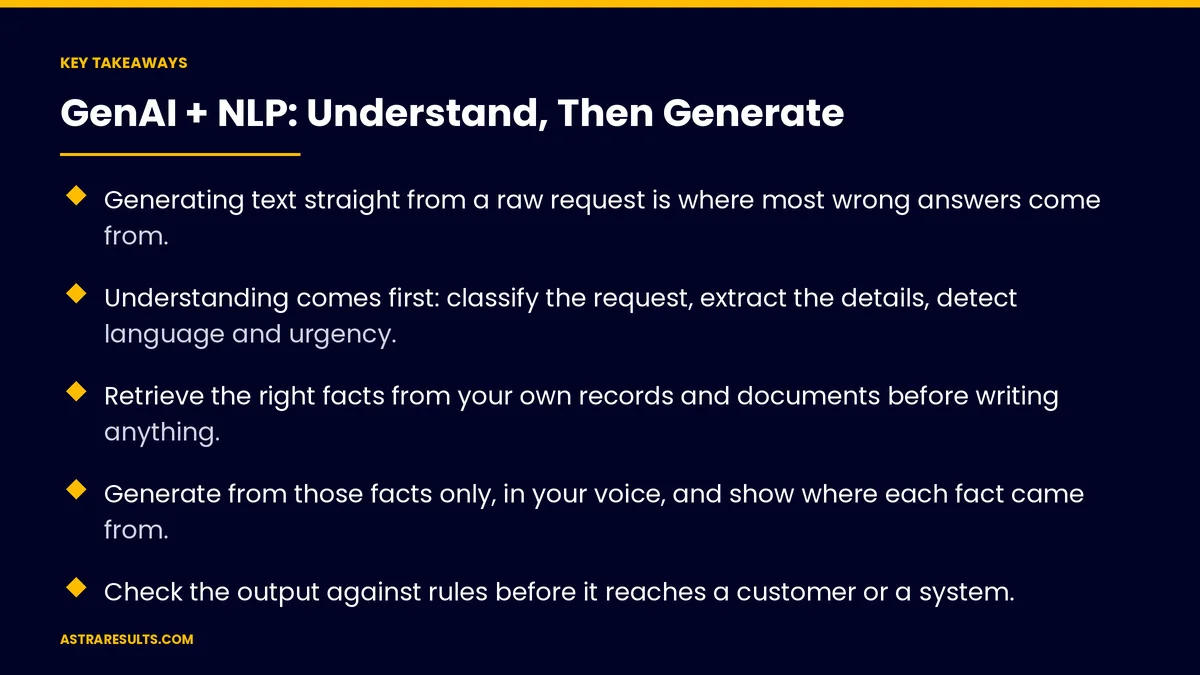
Key Takeaways
- Generating text straight from a raw request is where most wrong answers come from.
- Understanding comes first: classify the request, extract the details, detect language and urgency.
- Retrieve the right facts from your own records and documents before writing anything.
- Generate from those facts only, in your voice, and show where each fact came from.
- Check the output against rules before it reaches a customer or a system.
- Measure each step on its own, so you know which one to fix.
Published: October 19, 2026 | Reading Time: ~10 minutes | Category: Generative AI Services
This guide explains the pattern: use language processing to classify the request, pull out the key details and find the right sources, then let the model generate from that, and check the result. Put plainly: a model that knows what it's answering, and from which facts, writes answers you can trust.
In This Playbook
- Why generating first goes wrong
- Step one: classify the request
- Step two: extract the details
- Step three: retrieve the right facts
- Step four: generate from those facts
- Step five: check before it goes out
- Where this pattern works
- How do we measure each step of an AI reply pipeline?
- The first three months
Why generating first goes wrong
The model guesses what was asked. A message like "my order is wrong again" could be a return, a complaint, a billing issue or a repeat problem. Without classification, the reply picks one.
It fills gaps with plausible text. If the facts aren't provided, a model may produce a confident answer that sounds right and isn't.
It can't route. Some requests should go to a person, some to billing, some to an automatic action. Writing a reply first skips that decision.
It's hard to fix. When the whole job is one step, you can't tell whether the problem was understanding, facts or writing. The wider uses of generative AI are covered in generative AI at work.
Step one: classify the request
What kind of request is it? A question, a complaint, an order change, a cancellation, a new lead. Each type has its own handling.
How urgent is it? A safety issue or a payment failure goes to the front of the line.
What language is it in? Spanish requests get Spanish handling from the start, in the register the customer used, for the reasons in what changes when Spanish is a channel.
What's the tone? An angry customer may need a person, not a draft.
Route on the answers. Some types get an automatic reply, some get a draft for review, some go straight to a person. Classification is the core of natural language processing.
Step two: extract the details
Pull out the facts in the message. Order numbers, dates, names, products, addresses, amounts.
Fill a structured record. Turn free text into fields the system can use: customer, order, issue type, requested action.
Spot what's missing. If the order number isn't there, ask for it before going further, instead of guessing.
Match to your records. Link the extracted details to the right customer, order or case.
Step three: retrieve the right facts
Look things up before writing. The order's status, the customer's history, the relevant policy, the product details.
Search your own documents. Policies, price lists, manuals and past answers, so the reply reflects how your business works.
Give the model only what it needs. The specific facts for this request, not your whole knowledge base.
Keep sources current. An outdated policy document produces outdated answers. Someone must own the content the system draws from, a point covered in the foundation every AI project needs.
Step four: generate from those facts
Write from the retrieved facts only. The model's job is to turn known facts into a clear, friendly reply, not to know things itself.
In your voice. Tone, length and phrasing set by your style guide, as described in replies in your voice.
Show the sources. For drafts a person reviews, mark where each fact came from, so checking takes seconds.
Say "I'll find out" when facts are missing. A reply that admits a gap is better than one that invents an answer.
Step five: check before it goes out
Rule checks. Does the reply promise something it shouldn't, quote a price that doesn't match, or mention a policy that doesn't exist?
Fact checks. Do the numbers and dates in the reply match the retrieved records?
Tone and safety checks. No blame, no medical or legal advice where it isn't allowed, no sensitive data shared with the wrong person.
A person for the risky ones. High-stakes replies wait for approval. Routine ones can send once checks pass, following the tiering in intelligent support.
Action checks. If the system will also take an action, such as issuing a credit, the action must pass the same limits and approvals as any automated step.
Where this pattern works
Customer support. Classify, pull the order, retrieve the policy, draft the reply, check it.
Lead intake. Understand what the lead needs, extract contact details and job type, route it, draft a fast reply.
Document summaries. Classify the document, extract key terms and dates, then write a summary that cites them.
Claims and forms. Extract fields from free-text descriptions, flag what's missing, draft the next message.
Internal requests. IT, HR and facilities tickets sorted, routed and answered from the right policy.
How do we measure each step of an AI reply pipeline?
Classification accuracy. The share of requests sorted into the right type, checked against a sample.
Extraction accuracy. The share of fields pulled out correctly.
Retrieval quality. Whether the right documents and records were found.
Draft edit rate. How much people change before sending.
Check catches. How often the rule and fact checks stop a reply, and why.
Outcome. Resolution on first contact, response time and customer satisfaction.
The first three months
Days 1–30: map and classify
Pick one workflow, such as support email or lead intake. Sort a few hundred real messages into types and urgency levels. List the details to extract and the records and documents each type needs. Name an owner for the source content.
Days 31–60: build the pipeline
Build classification, extraction and retrieval for the chosen workflow. Generate drafts from retrieved facts only, in your voice, with sources marked. Add rule and fact checks, and route risky replies to a person.
Days 61–90: measure and tune
Measure accuracy at each step against reviewed samples. Fix the weakest step first. Let routine replies send automatically once checks prove reliable, and plan the next workflow.
How Astra builds it
Astra Results Marketing builds generative AI systems that understand before they write. We classify each request, extract its details, retrieve the right facts from your records and documents, and only then generate a reply in your voice.
Every output passes rule and fact checks, risky replies go to a person, and each step is measured on its own so problems are easy to find and fix. Engagements begin with a workflow review through our generative AI services team.
Related reading
Frequently asked questions
Why not let a model reply to messages directly?
Because it has to guess what was asked and may fill missing facts with plausible but wrong text. It also skips routing decisions. Understanding the request and retrieving facts first produces replies you can trust.
What does "understand, then generate" mean?
A pipeline that first classifies the request, extracts its details and retrieves the right facts, then has a model write a reply from those facts only, and finally checks the reply before it goes out.
What is retrieval in this context?
Looking up the specific records and documents a request needs, such as the order status, the customer's history and the relevant policy, and giving only those facts to the model before it writes.
How do we stop the model from inventing answers?
Generate only from retrieved facts, tell it to say "I'll find out" when facts are missing, check numbers and claims against your records before sending, and route high-stakes replies to a person.
Does this work in Spanish?
Yes. Detect the language during classification and handle Spanish requests in Spanish from the start, with sources and style rules written for that audience rather than translated replies.
How do we know which step to improve?
Measure each one separately: classification accuracy, extraction accuracy, retrieval quality, draft edit rate and check catches. The weakest step is the one to fix first.
Ready for generative AI that knows what it's answering? Astra Results Marketing builds systems that classify requests, extract details and retrieve your facts before writing, then check every reply, with each step measured so accuracy keeps improving. ▸ CALL (786) 321-2866 · ▸ REQUEST YOUR CONSULTATION





