 Rated 5 star on

ChatGPT Ads KPIs and Reporting
Quick answer
The ChatGPT Ads KPIs that matter most are cost per customer, conversion rate and lead quality. Read results in order: delivery, engagement, cost, conversions, then business results. Break them down by ad group and territory. Check operations weekly and make decisions monthly. Run lift tests where possible, because people often act later without clicking.
Many teams report ChatGPT Ads like search ads, then struggle to explain the results. Clicks may be fewer, people often read an ad and act later, and there are no reliable industry benchmarks yet. Clear KPIs, read in order and compared with your own baseline, turn early numbers into decisions.
Key Takeaways
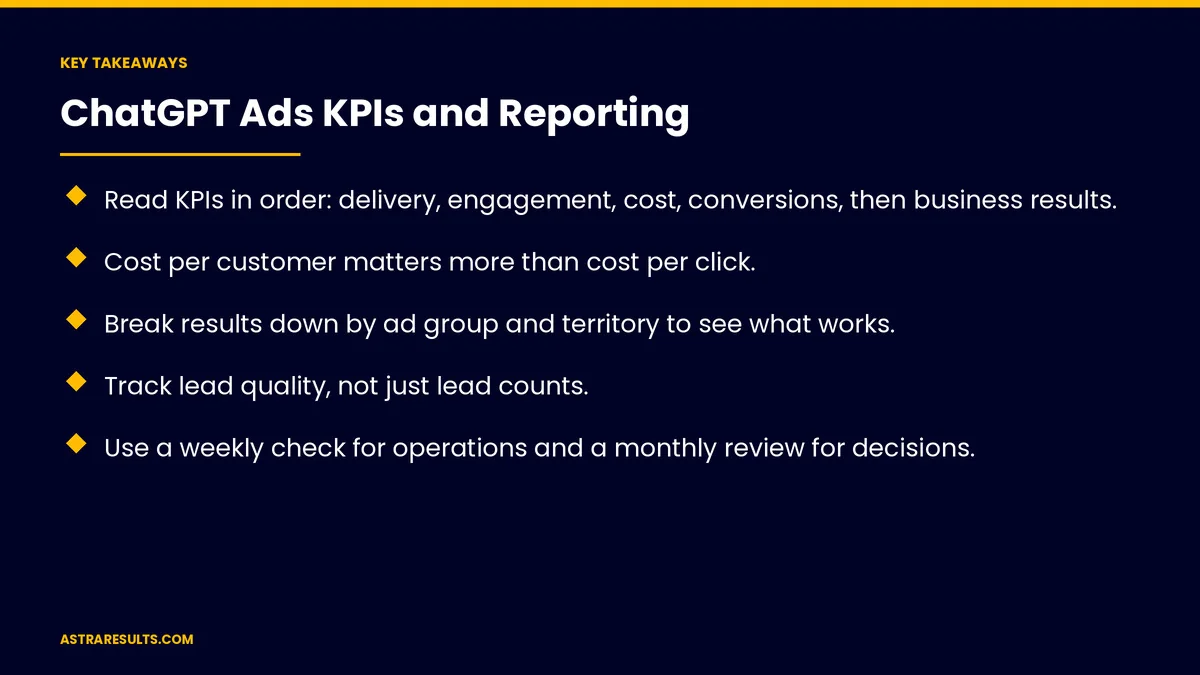
- Read KPIs in order: delivery, engagement, cost, conversions, then business results.
- Cost per customer matters more than cost per click.
- Break results down by ad group and territory to see what works.
- Track lead quality, not just lead counts.
- Use a weekly check for operations and a monthly review for decisions.
- Test for lift where possible, because people often act later without clicking.
Published: October 3, 2026 | Reading Time: ~8 minutes | Category: ChatGPT Ads
This guide covers which ChatGPT Ads KPIs to track, breaking them down by ad group and territory, lead quality, a reporting rhythm, attribution pitfalls and comparing with other channels. Put plainly: report from delivery to customers, and judge the channel on what it brings to the business.
ChatGPT Ads features change often. Check what Ads Manager reports in your account.
In This Playbook
- Read KPIs in order
- What data setup do ChatGPT Ads reports need?
- Breaking results down
- Lead quality
- A reporting rhythm
- Attribution caveats
- Benchmarks and targets
- How do ChatGPT Ads compare with other channels?
- Good KPI habits
- What to measure
- The first three months
Read KPIs in order
Delivery. Impressions and spend: are ads showing as planned?
Engagement. Clicks and click rate: do people find the ads relevant?
Cost. Cost per thousand impressions and cost per click.
Conversions. Leads, bookings or purchases tracked from the ads.
Business results. Customers, revenue and cost per customer.
Lift. The extra results the ads caused, beyond what would have happened anyway.
What data setup do ChatGPT Ads reports need?
Conversion tracking first. Without it, you only see delivery and clicks. Setup is covered in measuring ChatGPT Ads.
Connect to customer records. So leads can be followed to sales.
Consistent naming. Campaigns and ad groups named clearly so reports stay readable.
Breaking results down
By ad group. Each set of context hints shows which situations bring results.
By territory. Where location targeting is used, compare areas, as in franchise ChatGPT Ads by territory.
By device or platform. Web and app may behave differently.
By offer and landing page. Which messages and pages convert.
Regulated advertisers. Approval and compliance add steps for some, as in insurance agency ChatGPT Ads.
Lead quality
Not all leads are equal. Track how many become qualified opportunities and customers.
Feedback from sales. A simple rating for each lead.
Spot mismatches. Many leads with few customers can mean context hints are too broad.
Adjust targeting. Narrow hints and territories toward what brings customers.
A reporting rhythm
Weekly check. Delivery, spend, clicks and conversions, to catch problems early.
Monthly review. Customers, revenue, cost per customer and lead quality, to make decisions.
Quarterly look back. Trends, lift tests and budget changes.
Short reports. A few numbers that matter, with notes on what changed.
Attribution caveats
People act later. Someone may read an ad, then search your name days later.
Last-click undercounts. Reports based on the final click can miss the ad's influence.
Test for lift. Compare areas or periods with and without ads where possible.
Keep context in mind. Ads appear below answers in a conversation, as covered in where ads appear inside a conversation.
Benchmarks and targets
No reliable industry benchmarks yet. The platform is too new.
Use your own baseline. Set targets from your first months of results.
Compare with your goals. What cost per customer can the business afford?
Revisit often. Expect numbers to shift as the platform changes.
How do ChatGPT Ads compare with other channels?
Same measure for every channel. Cost per customer across ChatGPT Ads, search and social.
Search for intent. How Search and Performance Max compare is covered in Search, Performance Max or both.
Blend carefully. Channels influence each other, so look at overall results too.
Tie to revenue. Use the measures in website KPIs.
Good KPI habits
Fewer, clearer numbers. A short list everyone understands, the same principle as in task management KPIs.
Note changes. Record budget, targeting and creative changes next to the numbers.
Act on what you learn. Each review should end with a decision.
What to measure
Cost per customer. The deciding number.
Conversion rate. From click to lead or sale.
Lead quality. Share of leads that become customers.
Results by ad group and territory. Where to shift budget.
Lift. Extra results caused by the ads, where tested.
The first three months
Days 1–30: set up and baseline
Confirm conversion tracking, connect leads to customer records and name campaigns clearly. Record delivery, clicks, costs and conversions as your baseline.
Days 31–60: weekly checks
Run weekly checks on delivery, spend and conversions, and start rating lead quality with sales. Break results down by ad group and territory.
Days 61–90: monthly decisions
Hold a monthly review of customers, cost per customer and lead quality. Plan a lift test, compare with search and social, and shift budget toward what brings customers.
How Astra reports ChatGPT Ads
Astra Results Marketing reports ChatGPT Ads from delivery to customers. We set up conversion tracking, connect leads to sales, break results down by ad group and territory and track lead quality.
We run weekly checks and monthly reviews focused on cost per customer and lift. Engagements begin with a tracking and reporting review through our ChatGPT Ads team.
Related reading
Frequently asked questions
Which ChatGPT Ads KPIs matter most?
Cost per customer, conversion rate and lead quality matter most. Delivery, clicks and costs help diagnose problems along the way.
Why does ChatGPT Ads look different from search in reports?
People often read an ad and act later, sometimes by searching your name, so last-click reports can undercount its effect.
Are there benchmarks for ChatGPT Ads?
Not reliable ones yet. Set targets from your own first months of results and the cost per customer your business can afford.
How often should we report?
Weekly for delivery, spend and conversions, monthly for customers and cost per customer, and quarterly for trends and lift tests.
How do we know if ChatGPT Ads are working?
Compare cost per customer with your goals and other channels, track lead quality and run lift tests where possible.
Should we break results down by location?
Yes, where location targeting is used. Comparing territories shows where to shift budget.
Ready for ChatGPT Ads reports that lead to decisions? Astra Results Marketing sets up tracking, breaks results down by ad group and territory, tracks lead quality and reports cost per customer and lift on a clear rhythm. ▸ CALL (786) 321-2866 · ▸ REQUEST YOUR CONSULTATION





