Rated 5 star on

Advertising Inside ChatGPT: How It Works
Quick answer
Ads inside AI assistants appear within an answer rather than beside a list of results, so relevance is judged against the whole conversation instead of a single query. Intent is richer but less commercially certain, the creative has no scroll to earn, and attribution is poor. Test it with a budget you can afford to learn from.
A new advertising surface appears roughly once a decade, and the last few have followed the same pattern: early advertisers get unusual efficiency, the rules are unclear, the measurement is poor, and then it normalizes. Advertising inside AI assistants is at that early stage now, which makes it worth testing and unwise to build a plan around.
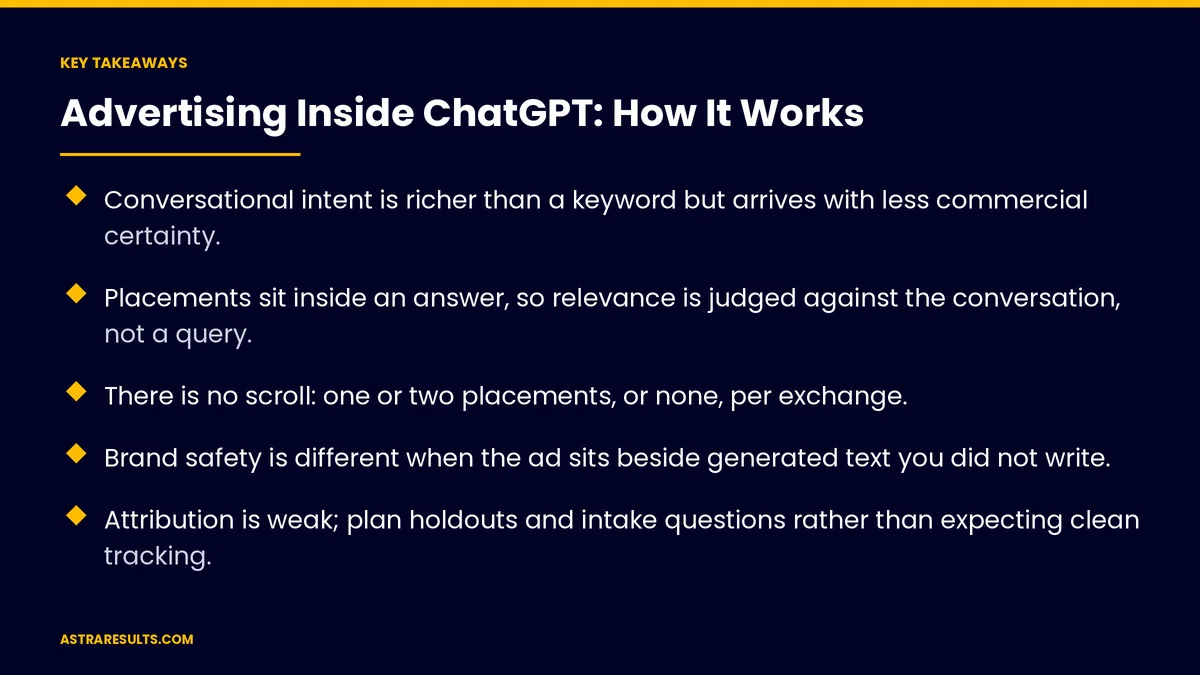
Key Takeaways
- Conversational intent is richer than a keyword but arrives with less commercial certainty.
- Placements sit inside an answer, so relevance is judged against the conversation, not a query.
- There is no scroll: one or two placements, or none, per exchange.
- Brand safety is different when the ad sits beside generated text you did not write.
- Attribution is weak; plan holdouts and intake questions rather than expecting clean tracking.
- Budget it as an experiment with a learning goal, not as a channel with a target.
Published: September 1, 2026 | Reading Time: ~12 minutes | Category: ChatGPT Ads
This piece explains what is involved: where ads appear in a conversation, why conversational intent behaves differently from a search query, what creative works in a format with no scrolling, the brand safety questions that are new, and how to measure something that resists conventional attribution. The short version: test it with money you can afford to learn from.
Guidance for owners and operators. Nothing here is legal advice. This surface is new and changing rapidly; formats, policies, availability and measurement tools differ by provider and change frequently, so verify current specifics before committing budget.
In This Playbook
- Why this surface is different
- Conversational intent
- What the creative has to do
- Brand safety, new questions
- Measurement, without the flattering numbers
- How to run a test
- Where it fits in a budget
- What to watch over the next year
- The first 90 days
Why this surface is different
- The unit is a conversation, not a query. A person does not type three words; they describe a situation across several turns. The system knows more about what they want and also knows they may be nowhere near buying.
- The answer is the content. Unlike a results page of ten links, the assistant produces one answer. An ad sits beside or within that answer, in far less real estate.
- There is no scroll. On a results page, position ten still exists. Here, if you are not in the one or two placements, you are absent.
- The user is in a different posture. They asked a question and expect an answer. An ad that interrupts that reads worse than an ad beside search results, and ad formats on this surface have to earn their place accordingly.
- It overlaps with being cited. Organic presence in the answer and a paid placement are two ways to appear in the same moment, which is why the two should be planned together, as laid out in budgeting across three surfaces.
Conversational intent
The central difference, and the one that decides whether this works for a given business.
- Richer signal. "I am moving to Miami in March with two kids and need to find a place near good schools" contains more targeting information than any keyword.
- Less commercial certainty. The same person may be six months from a decision, or idly planning. Search keywords carry urgency signals that conversation does not.
- Multi-turn context. The system may have several exchanges of context, which makes relevance better and raises the privacy questions users are increasingly aware of.
- What this means for fit. Categories with long consideration and high value — moving, renovating, choosing a professional service, buying equipment — have more to gain than categories driven by immediate need, where search still wins, as covered in what search advertising buys.
- The caveat. Nobody yet has enough data to say confidently which categories perform. That is what a test is for.
What the creative has to do
- Fit the conversation. An ad that reads like a banner in the middle of a helpful answer gets ignored or resented. The formats that work look like a relevant, clearly labeled suggestion.
- Be immediately specific. There is no room for a brand story. What the business does, for whom, and the next step.
- Match the moment in the conversation. Someone exploring needs different language from someone comparing two options they already named.
- Carry the disclosure. Ads should be clearly identifiable as ads, both because platforms require it and because a user who feels tricked by an assistant they trusted reacts strongly.
- Avoid overclaiming. In a context where the surrounding text is informational, a promotional claim stands out more than usual, and standing out badly is worse than not appearing.
Brand safety, new questions
This is the part that deserves more attention than it usually gets.
- The adjacency is generated, not published. Traditional brand safety means avoiding placement next to known bad content. Here, the text beside the ad was generated moments ago and did not exist before.
- The subject may be sensitive. A conversation can turn toward health, finance, legal trouble or personal difficulty in a sentence. Controls for excluding topics exist and vary by provider, and should be understood before spending.
- The implied endorsement problem. An ad beside an answer can read as though the assistant recommended the business. That is commercially attractive and carries a risk if the answer is wrong or the fit is poor.
- Accuracy is not the advertiser's to control. If the assistant states something incorrect about the category and the ad sits beside it, the association is still there.
- The practical posture. Understand the exclusion controls, start in categories with low sensitivity, and monitor where ads appeared rather than trusting settings.
Measurement, without the flattering numbers
- What is available varies by provider and is less mature than search reporting. Assume less than you are used to.
- Click-based attribution is weak. A user may read the ad, not click, and act later — which is true on every awareness surface and especially here.
- What to do instead. Capture the source question at intake so customers can say where they heard of the business. Watch branded search volume during and after a test. Run geographic or time-based holdouts where budget allows, as set out in the attribution problem.
- The metric that matters. Cost per closed customer, computed with the business's own numbers, compared against every other channel.
- The trap. Judging this surface on platform-reported conversions alone, which is how businesses conclude a channel works when it does not, or the reverse.
How to run a test
- Set a learning goal, not a revenue target. The question is whether this surface produces qualified customers at a defensible cost for this business, and the answer takes a defined budget and a defined period.
- Size it to be affordable. Money the business can lose entirely without consequence. Early surfaces have wide outcomes.
- Run it long enough. A two-week test on a new surface produces noise. Give it a period that covers a normal buying cycle.
- Isolate it. Do not launch it alongside three other changes, or nothing will be attributable.
- Instrument the intake. Add the source option before the test starts, not after, and brief whoever answers the phone.
- Decide in advance what would make you continue. Written down, so the decision is not made on enthusiasm.
Where it fits in a budget
- Not structural yet. This is experimental budget, drawn from the portion a business allocates to testing, not from the channels currently producing customers.
- After the fundamentals. A business whose intake does not answer the phone or whose site does not convert has better places to put the same money, as explored in where the leaks are.
- Alongside organic AI presence. Being cited in answers is earned and durable; paid placement is rented and immediate. The content and entity work that produces citations serves the business whether or not the ads work, as detailed in getting cited.
- The sequencing view. Earn the organic presence, test the paid placement, and scale the paid only if the numbers hold.
What to watch over the next year
- Format changes. Early ad formats on new surfaces change substantially, and what worked in a first test may not exist in the second.
- Policy tightening. Categories permitted early are often restricted later, particularly in regulated sectors.
- Measurement improving. Better attribution tools usually arrive after the early efficiency has gone.
- Pricing normalizing. Early efficiency is a feature of low competition, not of the surface being inherently cheap.
- User behavior settling. How people respond to ads in assistants is not yet established, and tolerance could go either way.
The first 90 days
Days 1–30: qualify and prepare
Whether the business's category fits conversational intent, assessed on the evidence. Current provider formats, policies and exclusion controls checked directly rather than from secondhand summaries. The intake source question added and the team briefed. The learning goal, budget and decision criteria written down.
Days 31–60: run clean
The test launched in isolation, with no other simultaneous changes. Placements monitored for where ads appeared. Intake answers logged. Branded search watched.
Days 61–90: decide
Cost per closed customer computed from the business's own data and compared to other channels. The written decision criteria applied. Continue, adjust or stop — and either way, the finding recorded, because this surface will be worth re-testing as it changes.
How Astra approaches this surface
Astra Results Marketing treats advertising inside AI assistants as an experiment with a learning goal rather than a channel with a target, funded from testing budget and never at the expense of intake or conversion work that is currently producing customers.
Before any spend, the category fit, the current formats and the brand safety controls are checked directly with the provider, because this surface changes faster than any published guide. Tests run in isolation with the intake source question instrumented first, and the decision is made on cost per closed customer from the business's own data. Engagements begin with a category fit assessment through our ChatGPT Ads team.
Related reading
Frequently asked questions
How is advertising inside an AI assistant different from search advertising?
The unit is a conversation rather than a query, so the system knows more about the situation but less about commercial urgency. The assistant produces one answer instead of ten links, so there is no scroll — you are in the one or two placements or absent. And the user asked a question and expects an answer, so an ad that interrupts that reads worse than one beside search results.
Which businesses is it likely to suit?
Categories with long consideration and high value — moving, renovating, choosing a professional service, buying equipment — where the richer conversational context helps, rather than categories driven by immediate need, where search still wins because urgency signals live in keywords. The honest position is that nobody yet has enough data to say confidently which categories perform, which is what a test is for.
What are the brand safety concerns?
They are new. The text beside the ad was generated moments ago rather than published, so traditional avoid-lists do not map cleanly. Conversations can turn toward health, finance or personal difficulty in a sentence. An ad beside an answer can read as an endorsement by the assistant, which is attractive and risky. And if the assistant states something incorrect, the association with the ad remains.
How should it be measured?
Not on platform-reported conversions alone. Click attribution is weak because users read, do not click and act later. Capture the source question at intake, watch branded search during and after the test, run geographic or time-based holdouts where budget allows, and judge on cost per closed customer computed from the business's own numbers against every other channel.
What should a test look like?
A learning goal rather than a revenue target, sized to money the business can lose entirely, run long enough to cover a normal buying cycle rather than two noisy weeks, isolated from other simultaneous changes, with the intake source question added before it starts and the team briefed. And the criteria for continuing written down in advance so the decision is not made on enthusiasm.
Where does it belong in the budget?
In experimental budget, not structural. It comes after the fundamentals — a business whose phone goes unanswered or whose site does not convert has better uses for the same money. And it sits alongside the organic work that earns citations in answers, which is durable and serves the business whether or not the ads perform. Earn the organic presence, test the paid, scale only if the numbers hold.
READY TO TEST A NEW SURFACE WITHOUT BETTING ON IT? Astra Results Marketing checks category fit and current formats directly with providers, runs the test in isolation with intake instrumented first, and decides on cost per closed customer from your own data. Astra Results Marketing · 1101 Brickell Ave, Miami, FL 33131 · +1 (786) 321-2866 · [email protected] Find us on Google · Yelp ▸ CALL (786) 321-2866 · ▸ REQUEST YOUR CONSULTATION