 Rated 5 star on

Construction Agents: Submittal Tracking
Quick answer
AI agents can handle most submittal tracking for contractors, while the design team keeps every approval decision. An agent builds the submittal register from the specifications. It tracks due dates against the schedule and supplier lead times. It also drafts reminders, checks packages for missing items and logs review results. Limited access keeps it safe.
A late submittal can stall a job for weeks. If the shop drawings for storefront glass aren't approved in time, the glass isn't ordered, and long lead times push the whole schedule. Project engineers spend hours on logs, reminders and package checks. AI agents can handle much of that tracking, so people focus on decisions.
Key Takeaways
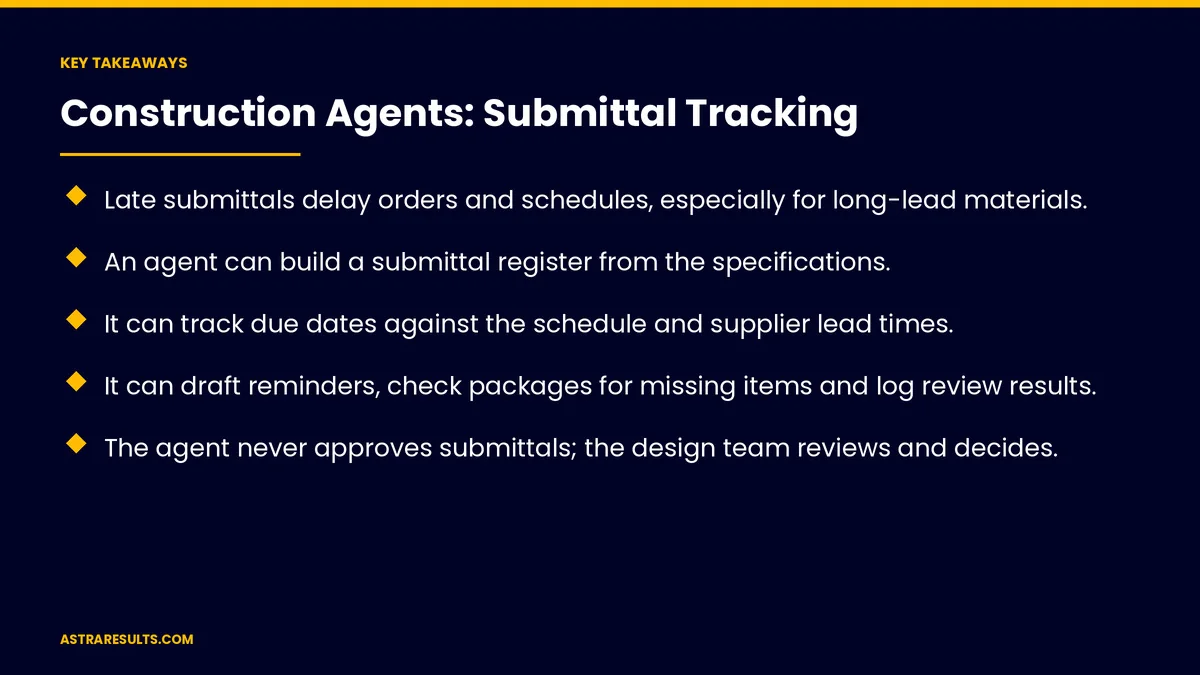
- Late submittals delay orders and schedules, especially for long-lead materials.
- An agent can build a submittal register from the specifications.
- It can track due dates against the schedule and supplier lead times.
- It can draft reminders, check packages for missing items and log review results.
- The agent never approves submittals; the design team reviews and decides.
- Limited access, logs and a quick way to stop the agent keep it safe.
Published: October 13, 2026 | Reading Time: ~9 minutes | Category: Custom AI Agents
This guide covers how construction teams use AI agents for submittal tracking: building the register from specs, watching due dates and lead times, drafting reminders, checking completeness, logging reviews, reporting and keeping people in charge of approvals. Put plainly: let the agent chase, check and log, and keep every approval with the people responsible.
In This Playbook
- Why submittals slip
- What an agent does
- Building the submittal register
- Tracking due dates and lead times
- Reminders and follow-ups
- Checking packages before review
- Logging reviews and resubmittals
- Keeping people in charge
- Connecting to your tools
- Which metrics show a submittal agent is working?
- The first three months
Why submittals slip
Long lists. Large projects have hundreds of required submittals across the specifications.
Many hands. Subcontractors, suppliers, the general contractor and the design team.
Lead times hide risk. A late approval on long-lead items delays everything after it.
Manual tracking. Logs kept in spreadsheets drift out of date, as covered in replacing spreadsheets with a custom internal tool.
What an agent does
Reads documents. Specifications, schedules and submittal packages.
Tracks status. Who has each submittal, and what's due next.
Drafts messages. Reminders and follow-ups for people to send or approve.
Reports. Weekly status and risk summaries.
Doesn't decide. Approvals, rejections and changes stay with people. How agents work is covered in AI agents that do the work.
Building the submittal register
From the specifications. The agent reads each spec section and lists required submittals: shop drawings, product data, samples and closeout documents.
Organized by section. Each item linked to its spec section and responsible subcontractor.
Reviewed by a project engineer. People confirm the list before it becomes the working register.
Updated with changes. New addenda or revisions add or change items.
Tracking due dates and lead times
Tie to the schedule. Each submittal gets a due date based on when the work or order must start.
Add lead times. Long-lead items such as windows, switchgear and elevators get earlier deadlines.
Allow review time. Build in time for the design team's review and possible resubmittals.
Flag risk early. The agent highlights items at risk of delaying orders.
Reminders and follow-ups
Draft reminders. Before due dates, to the responsible subcontractor.
Escalate overdue items. To the project manager after a set time.
People approve messages. At first, every message is reviewed; routine reminders can be automated once trusted.
Keep a record. Every reminder logged with the submittal.
Checking packages before review
Required items. Does the package include everything the spec section asks for?
Right section and labels. Correct numbering, project name and subcontractor details.
Signatures and stamps. Required contractor review stamps present.
Flag gaps, don't fix them. The agent notes problems for the project engineer and subcontractor; it doesn't alter documents.
Logging reviews and resubmittals
Record results. Approved, approved as noted, revise and resubmit, or rejected, as returned by the design team.
Track resubmittals. New due dates and reminders for items sent back.
Link to meetings. Submittal status discussed in project meetings feeds the log, as with meeting notes to action items.
Show it on site. Approved submittals reach field teams, as in construction iPad apps.
Keeping people in charge
No approvals by the agent. The architect or engineer of record reviews submittals.
Limited access. The agent reads project documents and drafts messages; it can't change contracts or drawings.
Logs and a stop button. Every action recorded, with a way to pause the agent, as covered in agent security.
Start small. One project or trade first, as in AI pilots that fail safely.
Consistent rules across jobs. The same approach used in franchise compliance agents.
Connecting to your tools
Project management software. Where submittals are stored and routed.
Email. For reminders and responses.
Schedules. To set due dates from activity dates.
Plan the connections. Decide which system holds the official log.
Which metrics show a submittal agent is working?
On-time submittals. Share submitted by the due date.
Review turnaround. Time from submission to response.
Resubmittal rate. Share sent back for revision.
Long-lead risks caught. Items flagged before they delayed orders.
Hours saved. Project engineer time no longer spent on manual tracking.
The first three months
Days 1–30: one project
Choose one project. Have the agent draft the submittal register from the specifications, then review and correct it. Connect the schedule and record current on-time and turnaround rates.
Days 31–60: tracking and reminders
Turn on due-date tracking with lead times, draft reminders for review before sending and add completeness checks on incoming packages.
Days 61–90: reporting and expansion
Add weekly status reports and resubmittal tracking. Compare on-time rates, turnaround and hours saved with the baseline, then extend to more projects.
How Astra builds construction agents
Astra Results Marketing builds AI agents for contractors that handle submittal tracking. Our agents build registers from specifications, track due dates against schedules and lead times, draft reminders, check packages for missing items and log review results.
Approvals stay with the design team, access is limited and every action is logged. Engagements begin with a project and process review through our custom AI agent development team.
Related reading
Frequently asked questions
What can an AI agent do with submittals?
Build the submittal register from specifications, track due dates against the schedule and lead times, draft reminders, check packages for missing items, log review results and report status.
Can the agent approve submittals?
No. The architect or engineer of record reviews submittals. The agent tracks, checks and logs; people decide.
How does it handle long-lead items?
It sets earlier due dates based on supplier lead times and review time, and flags items at risk of delaying orders.
Will it send emails to subcontractors on its own?
At first, people approve every message. Routine reminders can be automated once the team trusts them.
What tools does it connect to?
Typically project management software, email and the project schedule. Decide which system holds the official submittal log.
Where should we start?
With one project: let the agent draft the register, review it carefully, then add tracking, reminders and checks step by step.
Ready to stop chasing submittals by hand? Astra Results Marketing builds AI agents that build submittal registers, track due dates and lead times, draft reminders and log reviews, with approvals kept with your design team. ▸ CALL (786) 321-2866 · ▸ REQUEST YOUR CONSULTATION





