 Rated 5 star on

AI in Marketing: What Is Real and What Is Hype
Quick answer
AI is real in marketing for drafting, resizing, summarizing and routing, with people checking the results. Ad platform automation works well when tracking and data are good. Promises of guaranteed AI rankings or hands-off marketing are hype. Mass-produced content and fake reviews create real risk. Test any AI claim with a small pilot and clear measures.
Every marketing tool now claims to be powered by AI, and every agency promises AI-driven results. Some claims are solid; others promise what no tool can deliver. The useful question isn't whether something uses AI, but whether it saves time or improves results you can measure.
Key Takeaways
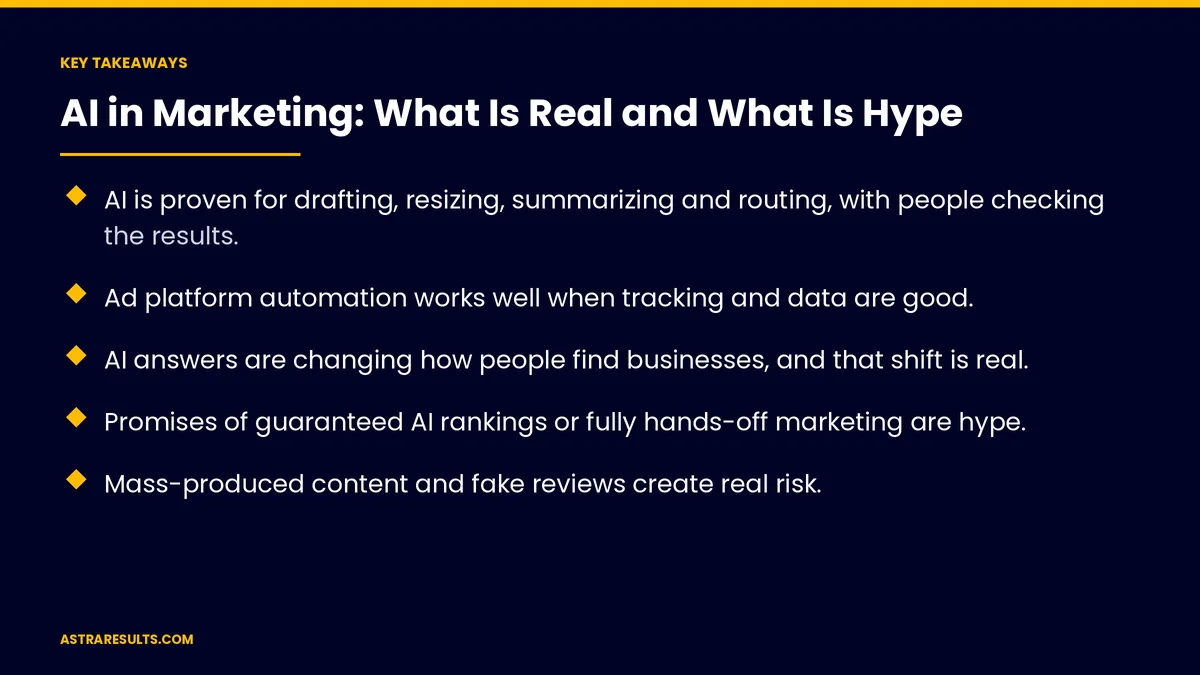
- AI is proven for drafting, resizing, summarizing and routing, with people checking the results.
- Ad platform automation works well when tracking and data are good.
- AI answers are changing how people find businesses, and that shift is real.
- Promises of guaranteed AI rankings or fully hands-off marketing are hype.
- Mass-produced content and fake reviews create real risk.
- Test any AI claim with a small pilot, clear measures and a comparison.
Published: October 6, 2026 | Reading Time: ~9 minutes | Category: AI SEO
This guide sorts AI in marketing into what's proven, what's overstated and what's still maturing, then explains how to test any AI claim. Put plainly: use AI where it's proven, test the rest carefully and ignore promises nobody can keep.
In This Playbook
- What's proven
- Ad platform automation
- AI answers are changing discovery
- Which AI marketing claims are overstated?
- What creates real risk
- What's still maturing
- How to test any AI claim
- What to measure
- The first three months
What's proven
Drafting copy. First drafts of ads, emails and descriptions, edited by people.
Creative variations. Resizing images and creating versions for different formats.
Transcripts and summaries. Meetings, calls and long documents condensed quickly.
Translation drafts. Fast first versions, checked by fluent speakers.
Routing and sorting. Support tickets and inquiries sent to the right person, as in support ticket routing.
Prediction with enough data. Scoring leads or forecasting demand, as weighed in the business case for predictive analytics.
Ad platform automation
Bidding and targeting. Platform automation can work well with good conversion tracking.
Garbage in, garbage out. Poor tracking teaches the system the wrong goals.
Keep control where it matters. Exact-match keywords, negatives and brand rules, as covered in Search, Performance Max or both.
AI answers are changing discovery
People ask AI assistants. For recommendations, comparisons and how-to answers.
Clear facts get cited. Businesses with specific, consistent information appear more often, as covered in getting cited by ChatGPT and Google AI.
Search still matters. AI answers and rankings overlap, as covered in AI Overviews vs classic rankings.
Which AI marketing claims are overstated?
"Fully autonomous marketing." Strategy, judgment and brand decisions still need people.
Guaranteed AI rankings. Nobody controls what AI assistants say.
AI replacing strategy. Tools speed up work; they don't decide what's worth doing.
Instant results. Most gains come from steady testing and improvement.
What creates real risk
Mass-produced content. Thin, near-identical pages can count as scaled content abuse under Google's spam policies, as covered in SaaS SEO.
Fake reviews. The FTC bans fake reviews and testimonials, including AI-generated ones.
AI people as customers. Synthetic faces presented as real testimonials mislead buyers, as covered in creative compliance.
Unchecked facts. AI can state things that aren't true.
AI-written content isn't banned. Google's position is that quality and helpfulness matter, not whether AI helped write it.
What's still maturing
Agents that take actions. Useful with approvals and limits, as covered in the action layer.
AI video. Improving quickly, with rights and consent questions to settle.
AI ad formats. New placements, such as ads in AI assistants, still being measured.
How to test any AI claim
Ask for evidence. Real results from similar businesses, not just demos.
Run a small pilot. One team, one task, a few weeks.
Set measures first. Time saved, cost per lead or conversion rate.
Compare. Results with and without the tool.
Check the hidden costs. Subscriptions, setup, data work and review time.
Keep people in charge. For brand, facts and customer-facing decisions.
Vet partners. Warning signs are covered in AI SEO partners.
What to measure
Time saved. On tasks AI helps with.
Quality. Edits needed before publishing.
Results. Leads, sales and cost per customer.
Errors caught. Mistakes found in review.
Total cost. Tools plus people's time.
The first three months
Days 1–30: list and sort
List the AI tools and claims in your marketing today. Sort them into proven, overstated and maturing, and stop anything that creates risk, such as mass-produced pages.
Days 31–60: pilot the proven
Pilot one proven use, such as drafting or summarizing, with clear measures and people reviewing. Check that ad tracking supports any automation.
Days 61–90: measure and decide
Compare results with and without the tool, count total costs and decide what to keep, expand or drop.
How Astra approaches AI in marketing
Astra Results Marketing uses AI where it's proven and tests the rest. We help businesses sort real AI value from hype, pilot useful tools with clear measures and keep people in charge of strategy, facts and customer-facing work.
We avoid tactics that create risk and measure results in leads and sales. Engagements begin with an AI and marketing review through our AI SEO team.
Related reading
Frequently asked questions
Where is AI proven in marketing?
Drafting copy, creating creative variations, summarizing, first-draft translation, routing inquiries and prediction with enough data, with people checking results.
Can AI guarantee rankings or AI citations?
No. Nobody controls search rankings or what AI assistants say. Clear facts and useful content improve your chances.
Does Google penalize AI-written content?
Not for being AI-written. Google focuses on quality and helpfulness. Mass-produced, thin pages can count as spam regardless of how they're made.
Are AI-generated reviews allowed?
No. The FTC bans fake reviews and testimonials, including ones created with AI.
Should we let AI run our ads automatically?
Platform automation can work well with good tracking, but keep control of brand rules, exact keywords and exclusions, and judge results on cost per customer.
How do we test an AI tool?
Run a small pilot with measures set in advance, compare results with and without the tool and count all costs, including review time.
Ready to separate AI value from AI hype? Astra Results Marketing helps businesses use AI where it's proven, pilot new tools with clear measures and avoid tactics that create risk, with results measured in leads and sales. ▸ CALL (786) 321-2866 · ▸ REQUEST YOUR CONSULTATION





