 Rated 5 star on

Custom AI Mistakes: Building Before Measuring
Quick answer
Many custom AI projects fail because the business builds before measuring. Without a baseline, nobody can prove the AI helped. Define success in writing before the build begins. Check that the data exists and is clean enough. Count exceptions, because they often decide whether AI works. Measure errors and revenue, not just speed.
Most failed custom AI projects don't fail because the technology was wrong. They fail because the business started building before measuring: before knowing how the work performs today, what success would look like or whether the data even exists. Months later, nobody can say whether the AI helped. Avoiding a few common mistakes makes results clear.
Key Takeaways
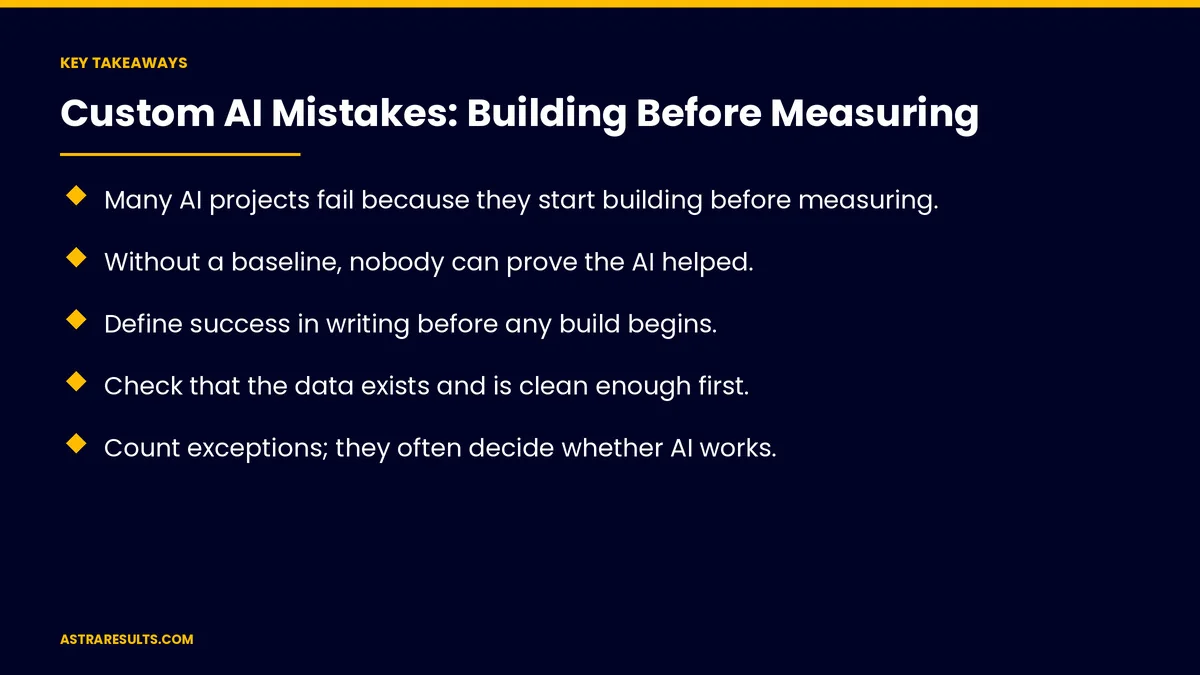
- Many AI projects fail because they start building before measuring.
- Without a baseline, nobody can prove the AI helped.
- Define success in writing before any build begins.
- Check that the data exists and is clean enough first.
- Count exceptions; they often decide whether AI works.
- Measure outcomes like errors and revenue, not just speed.
Published: October 3, 2026 | Reading Time: ~8 minutes | Category: Industry-Specific AI
This guide covers the most common mistakes in custom AI projects: no baseline, no definition of success, assuming the data exists, ignoring exceptions, piloting too broadly, measuring speed instead of outcomes, skipping ready-made tools, no owner and stopping measurement after launch. Put plainly: measure first, define success in writing and build only what the numbers justify.
In This Playbook
- Mistake 1: No baseline
- Mistake 2: No definition of success
- Mistake 3: Assuming the data exists
- Mistake 4: Ignoring exceptions
- Why does piloting custom AI too broadly backfire?
- Mistake 6: Measuring speed, not outcomes
- Mistake 7: Skipping ready-made tools
- Mistake 8: Automating a broken process
- Mistake 9: No owner
- Mistake 10: Stopping measurement after launch
- Is custom right at all?
- What to measure
- The first three months
Mistake 1: No baseline
What goes wrong. Nobody knows how long the work takes today, or how often it goes wrong.
The fix. Measure time, errors and cost per case before building, as covered in discovery.
Mistake 2: No definition of success
What goes wrong. Everyone has a different idea of what "working" means.
The fix. Write down the target: hours saved, error rate or revenue, by a date.
Mistake 3: Assuming the data exists
What goes wrong. The data is missing, messy or owned by someone else.
The fix. Check data before building, as covered in clean inputs first.
Mistake 4: Ignoring exceptions
What goes wrong. Unusual cases turn out to be common.
The fix. Count exceptions in real samples, as covered in why generic AI fails on specific workflows.
Why does piloting custom AI too broadly backfire?
What goes wrong. Everything changes at once, and nothing can be measured.
The fix. One task, one team, a fixed time, as covered in AI pilots that fail safely.
Mistake 6: Measuring speed, not outcomes
What goes wrong. Tasks finish faster, but errors rise or customers leave.
The fix. Track errors, customer results and revenue alongside time.
Mistake 7: Skipping ready-made tools
What goes wrong. Months spent building what already exists.
The fix. Test off-the-shelf tools fairly first, as covered in off-the-shelf first.
Mistake 8: Automating a broken process
What goes wrong. AI speeds up waste and workarounds.
The fix. Fix the process first, as covered in fixing the process first.
Mistake 9: No owner
What goes wrong. Nobody watches results or fixes problems after launch.
The fix. Name one owner responsible for results, reporting to leadership as in AI agents explained to a board.
Mistake 10: Stopping measurement after launch
What goes wrong. Accuracy slips as the business changes, and nobody notices.
The fix. Keep measuring monthly against the baseline.
Is custom right at all?
Sometimes not. As weighed in is custom AI right for your size.
When it is. Build around your process, as covered in industry-specific AI.
What to measure
Baseline. Time, errors and cost before building.
Target met. Against the written definition of success.
Outcomes. Errors, customer results and revenue.
Net value. Savings after costs, as in the business case for GenAI.
Ongoing accuracy. Monthly after launch.
The first three months
Month one: measure
Record the baseline, write down success targets, check the data and count exceptions.
Month two: test small
Test ready-made tools fairly, then pilot one task with one team for a fixed time.
Month three: decide
Compare outcomes with the baseline and targets, then build, adjust or stop, with an owner named.
How Astra avoids building before measuring
Astra Results Marketing measures before building custom AI. We record the baseline, define success in writing, check data and exceptions, test ready-made tools and pilot small before recommending a build.
Engagements begin with a discovery session through our industry-specific AI team.
Related reading
Frequently asked questions
Why do custom AI projects fail?
Often because building starts before measuring: no baseline, no success target and no check of the data.
What is a baseline?
How long the work takes, how often it goes wrong and what it costs today, before any AI.
How should success be defined?
In writing, with a target such as hours saved, error rate or revenue, by a set date.
Why do exceptions matter so much?
Unusual cases are often more common than expected, and they decide whether AI handles the work well.
What should we measure besides speed?
Errors, customer results and revenue, plus net value after costs.
What happens after launch?
Keep measuring against the baseline monthly, with one owner responsible for results.
Want to measure before you build? Astra Results Marketing records your baseline, defines success, checks data and exceptions and pilots small before recommending a custom AI build. ▸ CALL (786) 321-2866 · ▸ REQUEST YOUR CONSULTATION





