 Rated 5 star on

Discovery: Mapping the Process Before Building
Quick answer
Discovery maps the process before any AI gets built, so problems surface before money is spent. Watch people do the real work, since documents often differ. Map steps, handoffs and decisions. Check whether clean data exists and who owns it. Count exceptions, set accuracy targets and end with a clear recommendation.
Many AI projects fail for reasons visible on day one: missing data, more exceptions than anyone said or a paper process nobody follows. A short discovery phase finds those problems before money goes into building. It watches the real work and answers the questions AI depends on.
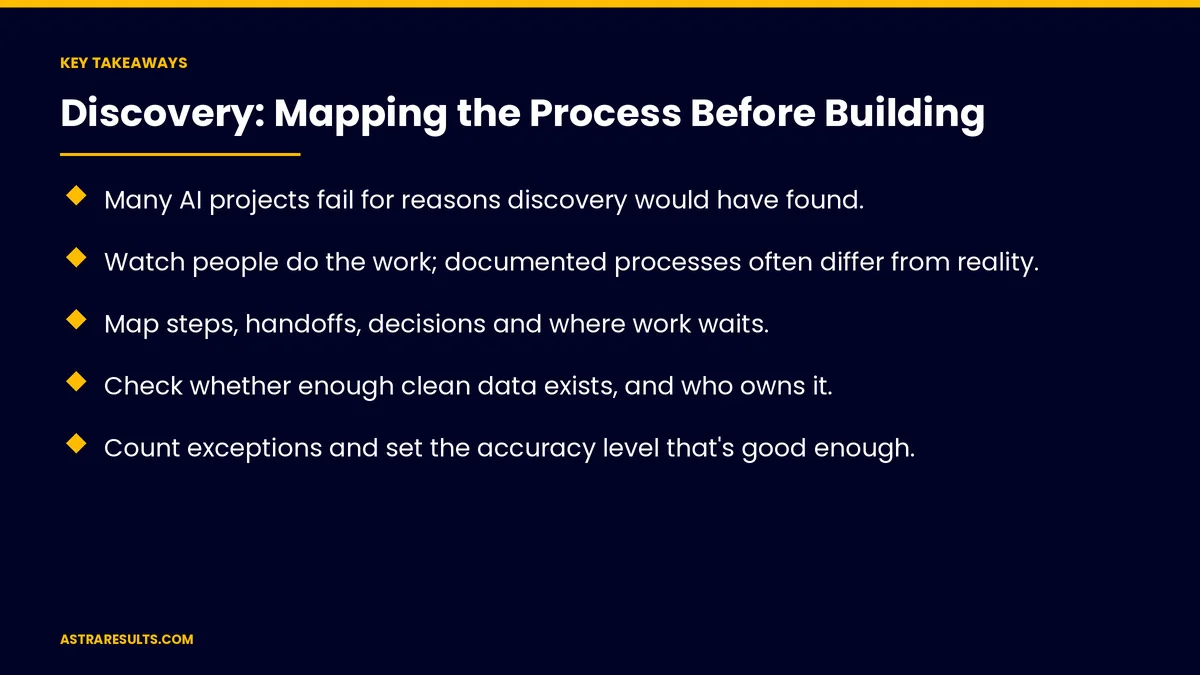
Key Takeaways
- Many AI projects fail for reasons discovery would have found.
- Watch people do the work; documented processes often differ from reality.
- Map steps, handoffs, decisions and where work waits.
- Check whether enough clean data exists, and who owns it.
- Count exceptions and set the accuracy level that's good enough.
- End with a clear recommendation: build, buy, adjust or stop.
Published: October 8, 2026 | Reading Time: ~9 minutes | Category: Industry-Specific AI
This guide covers AI discovery: why it matters, watching the real work, mapping steps and handoffs, checking the data, counting exceptions, setting accuracy targets, deciding where people stay involved, rules and regulations, the baseline, the discovery report and what to measure. Put plainly: watch the real work, check the data and decide before writing any code.
For software discovery in general, see custom software discovery.
In This Playbook
- Why discovery matters
- Who should AI discovery observe doing the work?
- Map steps and handoffs
- Check the data
- Count exceptions
- How accurate does an AI process need to be?
- Where people stay involved
- Rules and regulations
- The baseline
- The discovery report
- What to measure
- A typical discovery
Why discovery matters
Missing data. Found after building.
Common exceptions. Treated as rare.
Paper processes. Different from real ones.
A few weeks now. Saves months later.
Who should AI discovery observe doing the work?
Shadow the people doing it. Not just managers.
Real cases. Including messy ones.
Ask why. Behind every workaround.
Map steps and handoffs
Every step. Who does it and how long it takes.
Handoffs. Where work passes between people or systems.
Decisions. Rules people follow, written down.
Waiting. Where work sits, as covered in work that never stalls.
The process layer is covered in industry AI + automation.
Check the data
Does it exist? For each step AI would touch.
Is it clean enough? Duplicates, gaps and formats, as covered in clean inputs first.
Who owns it? And can AI use it under your agreements?
Count exceptions
How often. Sample real cases and count.
What kind. Unusual requests, missing details or special customers.
Why generic tools struggle. As covered in why generic AI fails on specific workflows.
How accurate does an AI process need to be?
Good enough for what? Drafts need less than decisions.
Compared with people. Today's error rate.
Costs of mistakes. Small, recoverable or serious.
Where people stay involved
Approvals. Money, customer messages and records.
Exceptions. Routed to people.
Final decisions. Where judgment matters.
Rules and regulations
Industry rules. Privacy, licensing and disclosures.
Customer agreements. What data may be used.
Counsel early. Before building, not after.
The baseline
Time per case. Today, the starting point for the business case for GenAI.
Error rate. Today.
Cost per case. Including people's time.
The discovery report
What we found. Process, data, exceptions and rules.
A recommendation. Build, buy off-the-shelf, adjust the process or stop.
Try ready-made tools fairly first, as covered in off-the-shelf first.
A pilot scope. As covered in AI pilots that fail safely.
Sized for you. As weighed in is custom AI right for your size.
What to measure
Discovery length. Usually two to four weeks.
Issues found early. Data gaps and exceptions.
Recommendation followed. And results from the pilot.
Rework avoided. Changes that didn't need building twice.
Time to first working pilot. After discovery.
A typical discovery
Week one: watch and map
Shadow the people doing the work, map steps, handoffs and decisions and collect real cases.
Week two: data and exceptions
Check data quality and ownership, count exceptions and set accuracy targets with the team.
Weeks three and four: decide
Measure the baseline, review rules with counsel and deliver the report with a recommendation and pilot scope.
How Astra runs AI discovery
Astra Results Marketing runs short discovery phases before building AI. We watch the real work, map every step, check data and exceptions, set accuracy targets and recommend whether to build, buy, adjust or stop.
Engagements begin with a discovery session through our industry-specific AI team.
Related reading
Frequently asked questions
What is AI discovery?
A short phase before building that watches the real work, maps the process and checks data, exceptions and accuracy needs.
Why watch people instead of reading process documents?
Because real work often differs from the documented process, especially in exceptions and workarounds.
What data questions matter?
Whether the data exists, whether it's clean enough and who owns it.
How do we decide what accuracy is good enough?
Compare with today's error rate and the cost of mistakes. Drafts need less accuracy than decisions.
What does discovery produce?
A report with findings, a recommendation to build, buy, adjust or stop and a pilot scope.
How long does discovery take?
Usually two to four weeks.
Ready to know what AI can do for your process before you build? Astra Results Marketing runs short discovery phases that watch the real work, check data and exceptions and recommend the right next step. ▸ CALL (786) 321-2866 · ▸ REQUEST YOUR CONSULTATION





