 Rated 5 star on

From MVP to Product: Rebuild or Extend?
Quick answer
Extend your MVP when the code is reasonably clean and can grow. Rebuild only when tools hit hard limits, security falls short or every change breaks something. Even then, a part-by-part rebuild often beats starting over. Full rewrites take longer and freeze features. Plan how users and data move first.
Once a first version proves people want the product, the next question is harder: build on what exists or start over? Extending is faster and cheaper, unless the first version was built in a way that blocks growth. Rebuilding gives a clean start but freezes progress. The answer depends on what's underneath.
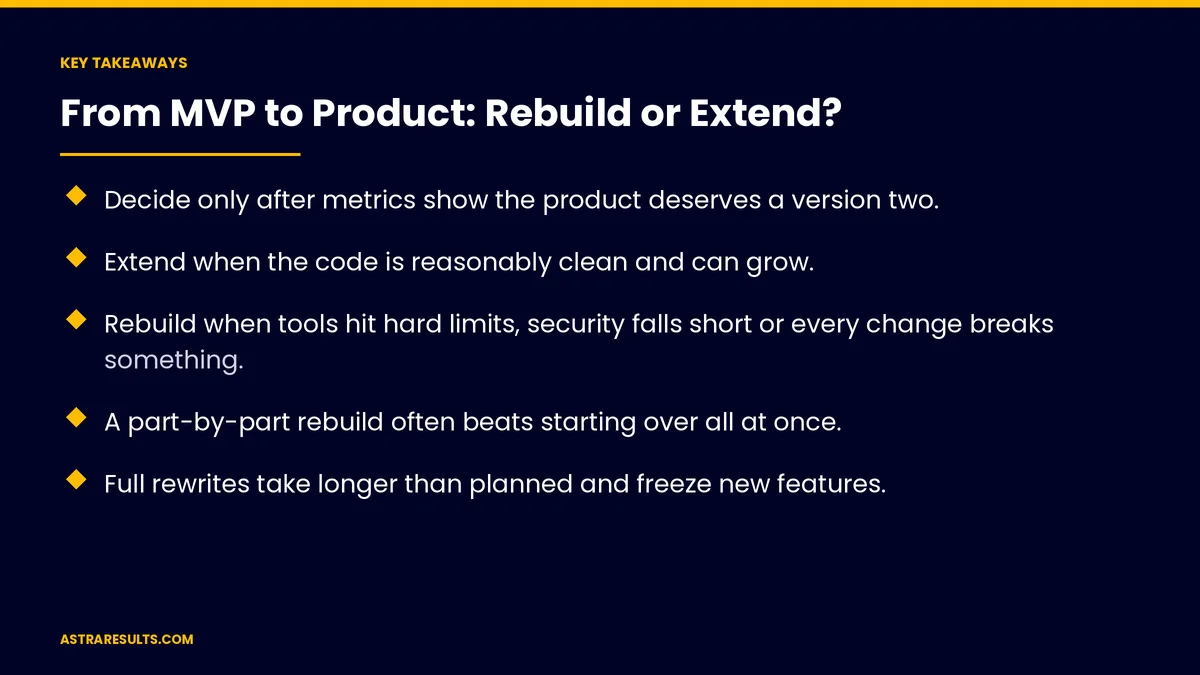
Key Takeaways
- Decide only after metrics show the product deserves a version two.
- Extend when the code is reasonably clean and can grow.
- Rebuild when tools hit hard limits, security falls short or every change breaks something.
- A part-by-part rebuild often beats starting over all at once.
- Full rewrites take longer than planned and freeze new features.
- Plan how users and data move before changing anything.
Published: October 11, 2026 | Reading Time: ~8 minutes | Category: MVP Development
This guide covers choosing between extending and rebuilding an MVP: signals for each, the part-by-part middle path, the risks of a full rewrite, moving users and data, getting an audit, budgets and timelines, and a decision checklist. Put plainly: keep what works, replace what blocks growth and avoid stopping everything for a rewrite.
In This Playbook
- First, confirm version two
- When should you extend an MVP instead of rebuilding?
- Signals to rebuild
- The middle path: part by part
- Risks of a full rewrite
- Moving users and data
- Get an audit
- Budget and timeline
- A decision checklist
- What to measure
- The first three months
First, confirm version two
Look at the signals. Retention, payment and demand, as covered in MVP metrics.
Then look underneath. How the first version was built.
When should you extend an MVP instead of rebuilding?
Reasonably clean code. New features can be added without breaking old ones.
A structure that can grow. More users and data won't overwhelm it.
Some tests. Changes can be checked.
A team that knows it. Or clear documentation.
Signals to rebuild
Tools at their limits. No-code or prototype tools that can't handle what's next, as weighed in no-code, low-code or custom.
Security or compliance gaps. Problems too deep to patch.
Slowdowns as usage grows. Fixes keep failing.
Tangled code. Every change breaks something else.
The wrong platform. A choice that limits where the product needs to go.
The middle path: part by part
Replace one part at a time. While the product keeps running.
Start with the biggest blocker. Sign-in, payments or the slowest feature.
Keep shipping. Users see progress during the rebuild.
The same idea for websites is weighed in redesign vs rebuild.
Risks of a full rewrite
Longer than planned. Rewrites often take far more time than expected.
Feature freeze. New work waits while the rewrite finishes.
Old features forgotten. Small things users rely on get missed.
Scope creep. "While we're at it" additions pile up.
Moving users and data
Plan the move first. Accounts, history and settings.
Test with real data. Before switching users.
Beta test the new version. With real customers first, as covered in beta testing.
No forced restarts. Users shouldn't lose data or have to sign up again.
Run both briefly. Where possible, with a clear switch date.
Get an audit
An outside review. Code quality, structure, security and tests.
Clear findings. What can stay, what must go and why.
Ownership check. Make sure you own the code and accounts, as covered in owning your code.
Switching teams. As covered in taking over an app.
Budget and timeline
Extending. Usually the lowest cost and fastest path.
Part-by-part rebuild. Spread over months, with steady releases.
Full rewrite. Highest cost and longest freeze.
Write the plan down. A clear spec for version two, as covered in writing a software spec.
A decision checklist
Do metrics justify version two?
Can new features be added without breaking old ones?
Are there security or compliance gaps that can't be patched?
Will the current tools handle the next year of growth?
Can users and data move safely?
What to measure
Time to add a feature. Before and after.
Bugs per release. Fewer as the foundation improves.
Performance under load. As usage grows.
User retention during changes. No drop from the transition.
Budget and timeline. Against plan.
The first three months
Days 1–30: confirm and audit
Confirm version two with metrics, get an outside review of the code and decide which parts can stay.
Days 31–60: plan the path
Choose extend, part-by-part or full rebuild, plan how users and data move and write the version two spec.
Days 61–90: start and keep shipping
Begin with the biggest blocker, release improvements steadily and track feature speed, bugs and retention.
How Astra moves MVPs to products
Astra Results Marketing helps founders and businesses grow an MVP into a product. We audit what exists, recommend extending, rebuilding part by part or starting over, plan how users and data move and keep releases flowing.
Engagements begin with an MVP review through our MVP development team.
Related reading
Frequently asked questions
Should we rebuild our MVP for version two?
Only if what's underneath blocks growth. Extend when the code is reasonably clean and can grow; rebuild when tools hit limits, security falls short or every change breaks something.
What is a part-by-part rebuild?
Replacing one part of the product at a time while it keeps running, starting with the biggest blocker, so users see steady progress.
Why are full rewrites risky?
They usually take longer than planned, freeze new features and can miss small things users rely on.
How do we move users to a rebuilt product?
Plan the data move first, test with real data and switch without forcing users to sign up again or lose history.
Do we need an outside review?
It helps. An independent review of code, structure, security and tests shows what can stay and what must go.
Can a no-code MVP grow into a full product?
Sometimes. When the tool can't handle what's next, a rebuild is usually needed, often part by part.
Ready to turn your MVP into a product? Astra Results Marketing audits your first version, recommends extending or rebuilding part by part, plans how users and data move and keeps releases flowing. ▸ CALL (786) 321-2866 · ▸ REQUEST YOUR CONSULTATION





