 Rated 5 star on

MVP Development: Launching the Smallest Useful Product
Quick answer
An MVP is the smallest version of a product that real people can use for a real task, built to answer whether they will use it and pay. Focus on one job for one type of user. Test the riskiest assumption first and cut every other feature. Launch to a small group and decide on evidence.
A minimum viable product is not a cheap version of the full product. It is the smallest thing real people can use that answers your most important question: will they use it, and will they pay? Built that way, an MVP saves months. Built as a smaller copy of a big plan, it just ships the same mistakes sooner.
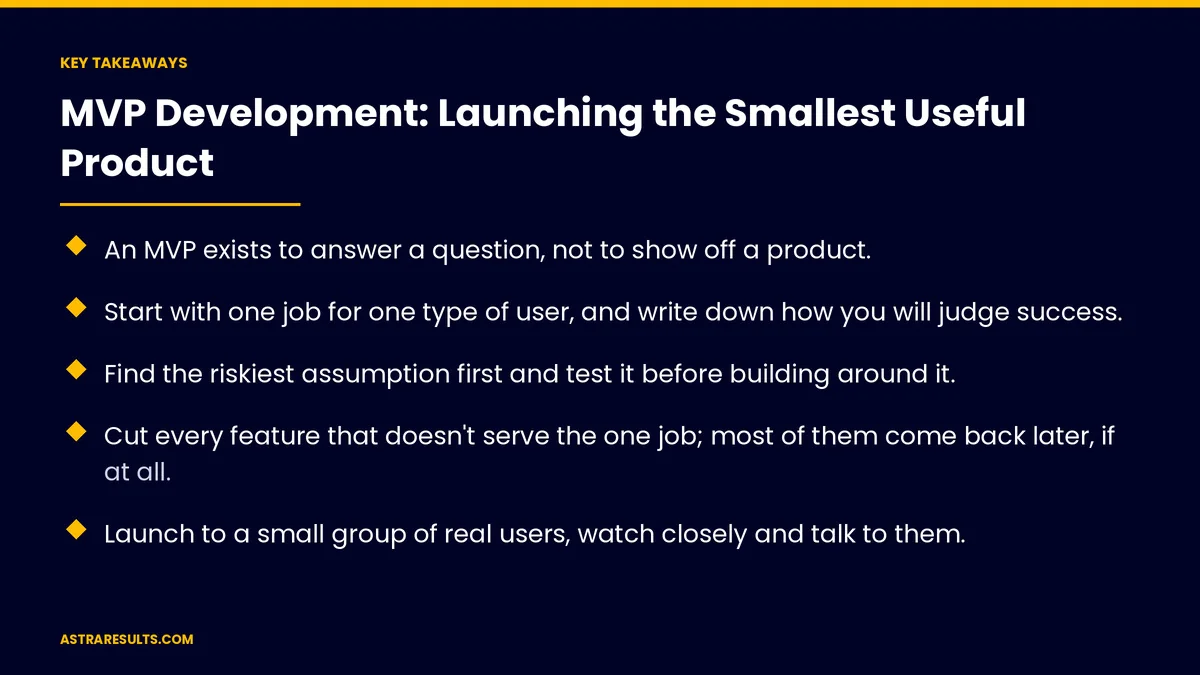
Key Takeaways
- An MVP exists to answer a question, not to show off a product.
- Start with one job for one type of user, and write down how you will judge success.
- Find the riskiest assumption first and test it before building around it.
- Cut every feature that doesn't serve the one job; most of them come back later, if at all.
- Launch to a small group of real users, watch closely and talk to them.
- Decide on evidence: improve, change direction or stop.
Published: October 3, 2026 | Reading Time: ~11 minutes | Category: MVP Development
This guide covers how to build an MVP that teaches you something. It applies to startups and to established businesses testing a new product line. It covers picking one job and one user, finding the riskiest assumption, cutting scope, launching small and deciding what to do next. Put plainly: build only what you need to learn the next thing.
In This Playbook
- What an MVP is, and isn't
- One job, one user, one number
- Find the riskiest assumption
- Cut scope hard
- Choose how to build it
- Launch small
- Decide on evidence
- Common MVP mistakes
- What to measure
- The first three months
What an MVP is, and isn't
It is a test you can use. Real people do a real task with it, and you learn whether the idea works.
It is not a demo. A demo shows what the product could be. An MVP shows what people do when it's in their hands.
It is not a smaller full product. Cutting every feature by half gives you a weak version of everything. An MVP does one thing well.
It is not a prototype, but it can follow one. A clickable prototype tests whether people understand the idea. An MVP tests whether they use it and come back.
It is not only for startups. A business adding a service, a portal or an app can test it the same way before committing a full budget, as with any custom software investment.
One job, one user, one number
One job. The single task the product does: book a repair, track a delivery, order supplies, file a claim. Write it in one sentence.
One user. The specific person who has that job and feels the problem most. Not "small businesses." Something like "owners of two-truck plumbing companies who book jobs by phone."
One number. The result that will tell you it works. For example, 30 active users after six weeks, or half of trial users completing a second order.
Write all three down before building. If the team can't agree on them, it isn't ready to build.
Find the riskiest assumption
Every idea rests on assumptions. People have this problem. They'll try a new tool. They'll switch from what they use now. They'll pay this price.
Rank them by risk. Which one, if wrong, kills the idea? Test that one first.
Test it cheaply. A landing page with a sign-up, a few interviews, a manual version run by hand behind a simple screen. Sometimes the riskiest assumption can be tested before writing any code.
A landing page counts. A clear page that explains the offer and asks for a sign-up tells you whether anyone cares. Design basics are in websites that sell.
Do it by hand first when you can. If the product will match customers with service providers, match the first twenty by hand. You'll learn what the software needs to do.
Cut scope hard
List every feature you imagine. Then sort each into three groups: needed for the one job, nice to have, and later.
Build only the first group. Everything else waits until users ask for it, or the numbers show you need it.
Common cuts. Admin dashboards, detailed settings, multiple user roles, integrations with every tool, and polished design beyond clean and clear.
Common things not to cut. Sign-up and login that work, the core task done well, basic security, analytics, a way for users to send feedback, and English and Spanish if your users need both.
Do it manually behind the scenes. Reports, approvals and data entry can be done by your team at first, while users see a simple product.
Choose how to build it
No-code and low-code tools. Fast for simple workflows, forms and internal tools. They can hit limits as the product grows.
Custom code. More flexible and easier to grow from, at a higher starting cost.
Web, cross-platform or native. For most MVPs, a web app or a cross-platform app reaches the most users fastest. The choice is explained in native, cross-platform or web, and an iPhone-first launch is covered in building an iPhone app.
Pick for speed to learning. The right tool is the one that gets real users using the core job soonest, without trapping you if it works.
Own what's built. Whatever you use, keep the accounts, data and any code under your business's name.
Launch small
Pick a small group. Ten to fifty real users who match your one user. Not friends being polite.
Help them start. Onboard the first users personally. Watch where they get stuck.
Track everything that matters. Sign-ups, first use of the core job, repeat use and drop-off points.
Talk to them weekly. Ask what they tried, what failed and what they'd pay for. Numbers show what happens; conversations show why.
Fix fast. Ship small improvements every week or two while the group is engaged. The same careful rollout applies to AI pilots that fail safely.
Decide on evidence
Improve. The number is close or rising, and users ask for clear next steps. Keep building on what works.
Change direction. People use it, but not the way you planned, or a different user cares more. Shift the job or the user and test again.
Stop. Few people use it, they don't come back, and the conversations don't point anywhere. Stopping early is a good result: it saved the full budget.
Set the deadline in advance. Decide when you will judge the number, such as six or eight weeks after launch, so the decision isn't put off forever.
Common MVP mistakes
Building too much. Months of work before any user touches it.
No success number. Without one, every result looks like progress.
Testing with the wrong people. Friends, staff or investors instead of the real user.
Skipping analytics. You can't learn from use you didn't measure.
Polishing too early. Design that impresses but delays the launch.
Ignoring what users do. Listening to what people say they want instead of watching what they use.
What to measure
Activation. The share of new users who complete the core job once.
Retention. The share who come back and do it again after one, four and eight weeks.
Time to value. How long it takes a new user to get a result.
Willingness to pay. Pre-orders, paid pilots or direct answers to a real price.
Feedback themes. The problems users mention most, logged every week.
Cost per learning. What each test cost and what it taught you.
The first three months
Days 1–30: define and test assumptions
Write the one job, the one user and the success number. List and rank the assumptions. Test the riskiest one with interviews, a landing page or a manual version. Cut the feature list to what the one job needs.
Days 31–60: build the smallest version
Build the core job, sign-up, analytics and a feedback channel. Keep design clean and simple. Do the back-office work by hand where you can. Prepare onboarding for the first users.
Days 61–90: launch and decide
Launch to a small group of real users, onboard them personally and talk to them every week. Ship small fixes quickly. At the deadline you set, compare the result with your success number and decide: improve, change direction or stop.
How Astra builds MVPs
Astra Results Marketing starts every MVP with three written answers: the one job, the one user and the number that proves it works. We find the riskiest assumption and test it as cheaply as possible, often before writing code.
Then we build only what the one job needs, launch to a small group of real users, and track activation, retention and willingness to pay from day one. You own the accounts, data and code. Engagements begin with a scoping workshop through our MVP development team.
Related reading
Frequently asked questions
What is a minimum viable product?
The smallest version of a product that real people can use for a real task, built to answer your most important question: will they use it, and will they pay? It does one job well rather than many jobs partly.
How is an MVP different from a prototype?
A prototype, often clickable but not working, tests whether people understand the idea. An MVP works for real users and tests whether they use it and come back. Many projects start with a prototype, then build the MVP.
How long should an MVP take to build?
A focused MVP can often be in front of real users within weeks. If it is taking many months, the scope is probably too large. Cut features that don't serve the one job.
What should an MVP include?
The core job done well, working sign-up and login, basic security, analytics, a way for users to send feedback, and the languages your users need. Admin dashboards, detailed settings and many integrations can usually wait.
Should we use no-code tools for an MVP?
They can be a good choice for simple workflows and fast tests. For products that need to grow, custom code is more flexible. Choose whichever gets real users using the core job soonest without trapping you later.
When should we stop an MVP?
When few people use it, they don't come back, and conversations don't point to a better direction by the deadline you set. Stopping early is a good outcome: it saves the full build budget for a better idea.
Ready to test your idea before the full build? Astra Results Marketing defines the one job, the one user and the number that proves it works, tests the riskiest assumption cheaply, and builds a focused MVP you own, launched to real users and measured from day one. ▸ CALL (786) 321-2866 · ▸ REQUEST YOUR CONSULTATION





