Rated 5 star on

HIPAA-Aware Marketing for Medical Practices
Quick answer
HIPAA-aware marketing treats everyday tactics as privacy decisions. A practice should inventory its website tracking tags, know what each vendor receives, and get marketing-specific consent before featuring a patient. A review reply must never confirm someone is a patient. Counsel decides how the law applies. A documented review path and trained staff prevent most failures.
Almost no medical practice sets out to mishandle patient information in its marketing. The failures come from ordinary tactics that nobody flagged, and each one is a marketing decision with a privacy consequence, made routinely by people who were never told where the line sits.
Key Takeaways
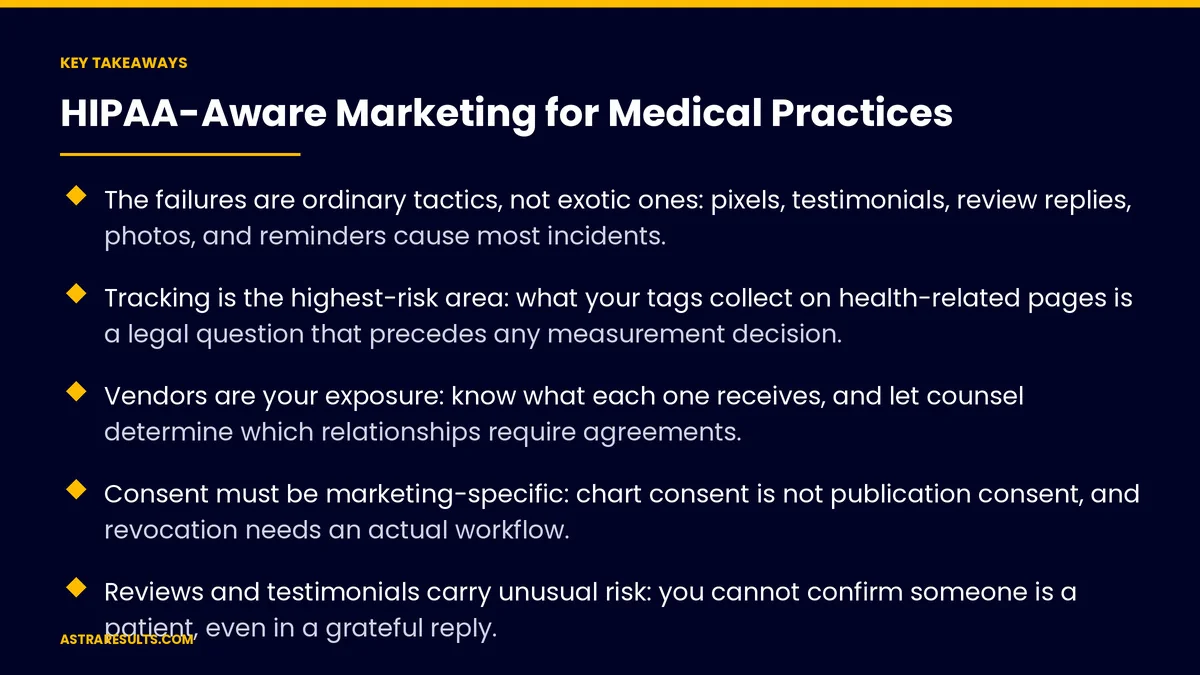
- The failures are ordinary tactics, not exotic ones: pixels, testimonials, review replies, photos, and reminders cause most incidents.
- Tracking is the highest-risk area: what your tags collect on health-related pages is a legal question that precedes any measurement decision.
- Vendors are your exposure: know what each one receives, and let counsel determine which relationships require agreements.
- Consent must be marketing-specific: chart consent is not publication consent, and revocation needs an actual workflow.
- Reviews and testimonials carry unusual risk: you cannot confirm someone is a patient, even in a grateful reply.
- Governance makes it routine: a documented review path, trained staff, an inventory, and a calendar audit prevent nearly everything.
Published: October 6, 2026 | Reading Time: ~13 minutes | Category: Compliance · National
The tactics are familiar:
- An analytics tag on an appointment-request page
- A testimonial that a staff member solicited enthusiastically
- A friendly reply to a review that confirms the reviewer was a patient
- A treatment photo whose consent form covered the chart but not the internet
- A scheduling reminder sent by text to a number nobody asked permission to use
This playbook exists to move that line into view before it's crossed. The kicker states the sequence: counsel first, then campaigns.
A necessary clarity about what this piece is. It is a marketing-operations framework: a map of where privacy questions arise in marketing work, and how to build the review process, vendor discipline, consent structure, and staff habits that keep those questions from becoming incidents.
It is not legal advice, and it is not a compliance opinion. HIPAA applies to covered entities and their business associates and interacts with state privacy law, FTC requirements, professional board rules, and vendor contract terms. How any specific tactic applies to your practice is a determination for your privacy officer and legal counsel.
Every recommendation below is written on the assumption that counsel reviews before implementation, because in this domain, the practices that stay out of trouble are the ones that treat legal review as part of the marketing workflow rather than an obstacle to it.
In This Playbook
- Where Protected Information Hides in Marketing
- The Tracking Question
- Vendors Are Your Exposure
- Consent Must Be Marketing-Specific
- Reviews, Testimonials, and Replies
- Staff, Training, and the Human Layer
- Communication Channels
- Governance That Makes It Routine
- What You Can Still Do
- A 90-Day Implementation
Where Protected Information Hides in Marketing
The inventory most practices have never made.
The appointment-request form. A page where someone types a name, a phone number, and the reason for the visit is collecting sensitive information. Every third-party script running on that page is potentially receiving something.
The intake and scheduling stack. Reminder texts and emails, waitlist tools, patient-portal messaging, and online booking each involve identifiable information moving through systems the marketing team may have selected.
The review ecosystem. Patient names attached to specific practices are, in effect, health information published by the patient, which constrains what the practice may say in response.
Imagery and case content. Before-and-after photographs, video, and case narratives are patient information regardless of how anonymized they feel, per the consent-infrastructure standard Astra holds: a smile identifies, a tattoo identifies, a room identifies.
Call recording and chat transcripts. Intake calls contain clinical detail and are frequently recorded by marketing tools.
Internal marketing conversations. The Slack message with a patient's story, the AI tool used to summarize a chart into a case study, the confidentiality failure that happens because someone wanted to save fifteen minutes.
The pattern. Exposure follows the sensitive data, and sensitive data travels further through marketing systems than most practices realize.
The Tracking Question
The highest-risk area in medical marketing, and the one most practices got wrong by default.
What happened. For years the standard practice was to install analytics and advertising tags site-wide, including on pages where a visitor's presence implies a health condition (a specific-condition page, a treatment inquiry form, a patient portal login) and to pass conversion events back to advertising platforms. Regulatory attention to exactly that pattern has increased substantially.
Practices should not assume that what was normal is now safe.
The questions counsel must answer before implementation.
- Which pages and events may carry tracking at all
- Whether any third-party tag on a health-related page creates a disclosure
- What data each tag transmits
- Whether a vendor relationship requires a business associate agreement
- Whether the practice's consent mechanisms are adequate for what's being collected in its jurisdiction
The design principle that reduces risk. Measure aggregate outcomes internally (kept appointments, treatment starts, and source-of-truth intake answers held in the practice's own systems) rather than pushing granular patient-level conversion data outward, which is the privacy-first measurement architecture Astra recommends and which is also, conveniently, more accurate.
The practical audit. Inventory every tag, script, and pixel on the site; document what each does and why it's there; remove anything unjustified. Let counsel decide what remains on sensitive pages.
Vendors Are Your Exposure
The relationships that carry the risk.
The principle. A practice's marketing stack routinely includes agencies, website hosts, form and chat tools, call-tracking services, CRM and patient-communication platforms, review-management software, and analytics vendors. Each one that touches identifiable patient information is a relationship counsel must evaluate, including whether a business associate agreement is required.
The questions to ask every vendor. What data do you receive, where is it stored, who at your company can access it, what do you do with it, do you use it to train models or improve products, what happens to it if we terminate. Will you sign the agreements our counsel requires.
The uncomfortable finding most practices make. Several tools already in use cannot answer those questions satisfactorily. The resolution is a decision for counsel and the privacy officer, not a marketing preference.
The subprocessor problem. Vendors have vendors, and the practice's obligations don't stop at the first tier.
The agency standard. A marketing partner working with medical practices should expect to sign agreements, should never ask for patient information it doesn't need, and should have a documented process for handling anything sensitive it does receive, the governance-as-partnership expectation Astra holds for its own work.
Consent Must Be Marketing-Specific
The distinction that prevents most imagery incidents.
What chart consent isn't. Authorization to treat, to bill, or to share records with another provider is not authorization to publish a photograph on a website, in an advertisement, or on social media. What marketing authorization requires, per the full consent doctrine
Astra built: specific to the uses contemplated (website, social, paid advertising, print), specific to the media involved (photograph, video, written case narrative), open about durability and reach (including that published content can be downloaded, re-shared, and duplicated beyond the practice's control) and revocable with an actual workflow behind the promise: who receives the request, what gets removed where, and on what timeline.
The video escalation per the short-form standard. Motion, voice, and ambient details identify in ways a still photograph doesn't, so video needs its own authorization rather than an assumption.
The absolutes that never bend. No minors in public marketing imagery, no other patients visible in any frame, no AI-generated or altered results, and no publication where the consent record is unclear, the working rule being that if the practice cannot state which authorization covers a given asset, the asset doesn't publish.
The record-keeping. Consent documentation retained and linked to each published asset, so a question years later has an answer.
Reviews, Testimonials, and Replies
The area where good intentions cause the most incidents.
The constraint that surprises practices. A practice generally cannot confirm that a specific person is or was a patient. That means the warm, natural reply ("Thank you for trusting us with your surgery, Maria!") can itself be a disclosure.
The safe pattern. Generic responses that thank the reviewer without confirming a relationship or referencing any clinical detail, drafted once with counsel and used consistently: plus a documented decision about whether the practice responds to negative reviews at all. How, since the temptation to correct a factual claim is exactly where practices disclose too much.
Solicitation discipline. never-gated as Astra requires everywhere, never incentivized, and never in a way that pressures a patient toward a public health disclosure she may not want, with the reminder that in some verticals professional ethics codes add their own constraints, most sharply in behavioral health.
Testimonials, when used. With written marketing-specific authorization, open about typicality, reviewed for clinical claims, and never edited into an implied guarantee.
The staff-enthusiasm problem. Most testimonial and review-reply incidents originate with someone who was proud of the practice's work. That makes this a training issue rather than a policy-document issue.
Staff, Training, and the Human Layer
Where policy meets practice.
The reality. The front desk, the clinical staff, and the practice's most enthusiastic team members make marketing-adjacent decisions constantly: a photo taken in the hallway, a patient story shared in a caption, a text sent to a number that seemed fine, a chart detail pasted into a chat tool.
What training must cover concretely.
- What may and may not be photographed and where
- Who may post practice content and from which accounts
- The rule that patient information never enters general-purpose tools
- How to respond when a patient asks to be featured (the answer is enthusiasm plus the authorization process, not immediate posting)
- What to do when someone realizes a mistake — because the practices that handle incidents well are the ones where reporting isn't punished
The personal-account boundary. Staff and clinicians posting on their own accounts is a real risk area requiring a written policy, per the staff-content governance standard.
The onboarding hook. Marketing-privacy training belongs in onboarding rather than in an annual reminder, because turnover is when institutional knowledge disappears.
Communication Channels
Where convenience creates exposure.
Text and email. Reminders, follow-ups, and marketing messages to patients involve identifiable information and require attention to channel authorization, content limits, and, for anything promotional, the separate marketing-communication rules counsel will identify.
Messaging platforms. Patients increasingly initiate contact through social direct messages and chat widgets, frequently including clinical detail and unsolicited photographs, which requires the rails architecture Astra specifies: strict content limits in-thread, defined handling for what patients send, scripted escalation to secure channels, and a documented decision about what those transcripts are.
Chatbots and automated intake. Useful for capture and routing, dangerous when they collect clinical detail into systems nobody evaluated, so scope them narrowly and let counsel review the data path, per the AI-tooling rails.
The recorded call. Call recording is common in marketing measurement and captures clinical conversation. That makes it a counsel question rather than a vendor setting.
Governance That Makes It Routine
The system that prevents nearly everything above.
The review path. A documented route from marketing idea to published asset with the privacy officer or counsel in it for anything touching patient information, imagery, tracking, or patient communication, the same approval-workflow discipline Astra installs wherever claims and consents can drift.
The inventories. A tag-and-script inventory, a vendor inventory with data-flow notes, and a published-asset tone linked to consent records.
The calendar audit. Quarterly review of tags, vendor list, consent completeness, review-reply compliance, and staff-training currency, with findings assigned owners and a fix clock.
The incident habit. A defined path for reporting and escalating a suspected problem, because speed matters and blame prevents speed.
The measurement. Governance metrics reported alongside marketing metrics on the one-page report (review completion, consent-record completeness, tag-inventory currency, training completion) because what gets reported gets maintained.
The cultural point. Practices that treat this as an ongoing operational discipline rather than a one-time project spend far less time on it and encounter far fewer problems.
What You Can Still Do
The reassurance the category needs, because privacy-anxious practices frequently over-restrict and stop marketing effectively.
Fully available. Educational content under named-physician authorship, condition and procedure explainers, the access and process transparency that converts, credentials and affiliations stated exactly, framework pricing, physician video, community education, the referral web, search and the AI answer layer, and properly consented case content.
The strategic observation. The marketing Astra recommends across every medical vertical (education, transparency, access, and demonstrated expertise) happens to be the marketing least entangled with patient information, which means the privacy-safe program and the high-performing program are largely the same program. Practices that discover this stop treating compliance as a tax on growth.
A 90-Day Implementation
Days 1–30: Inventory and review path
Every tag, script, and pixel inventoried with purpose documented. The vendor list assembled with data-flow notes and forwarded to counsel; the marketing review path documented with the privacy officer in it. The consent-authorization templates reviewed with counsel for marketing-specific use; the review-reply standard drafted.
Days 31–60: Remediate and train
- Unjustified tags removed and sensitive-page tracking decided by counsel
- Vendor agreements pursued where counsel requires
- The published-asset tone built and linked to consent records with gaps resolved or assets retired
- Staff training delivered with the concrete rules and the incident-reporting path
- Messaging and chatbot rails set
Days 61–90: Operationalize
- The quarterly audit scheduled with owners assigned
- Governance metrics added to the marketing report
- Onboarding updated to include marketing-privacy training
- The marketing program rebuilt around the education-and-transparency assets that carry no patient information — which is where most of the performance was available anyway
How Astra Works With Medical Practices
Astra Results Marketing builds medical marketing on the assumption that counsel reviews before campaigns run. Tracking decided deliberately rather than installed by default, vendors evaluated for what they receive, consent handled as marketing-specific infrastructure with real revocation, reviews and testimonials managed to avoid confirming relationships, staff trained on the decisions they make, and governance reported alongside performance.
Engagements begin with a tracking, vendor, and consent audit through our business consulting team.
Related reading
Frequently asked questions
Is this legal advice?
No. This is a marketing-operations framework: a map of where privacy questions arise in marketing work and how to build review, vendor, consent, and training habits around them. How HIPAA, state privacy law, FTC requirements, board rules, and your vendor contracts apply to any specific tactic is a determination for your privacy officer and legal counsel. The single most useful habit is putting that review inside your marketing workflow rather than after it.
What's the highest-risk thing in a typical practice's marketing?
Website tracking. Analytics and advertising tags installed site-wide (including on condition pages, appointment-request forms, and portal logins) with conversion data passed back to platforms is the pattern that has drawn the most regulatory attention. Inventory every tag, document what each transmits, remove what isn't justified. Have counsel decide what may remain on health-related pages before you optimize anything.
Our patient loves us and wants to be featured. Can we post her photo?
Not on enthusiasm alone. Chart consent isn't publication consent. You need marketing-specific written authorization naming the uses (website, social, paid) and media (photo, video, written narrative), candid disclosure that published content can be re-shared beyond your control, and a revocation workflow that works. Train staff that the right response to an eager patient is enthusiasm plus the authorization process, never immediate posting.
How should we respond to a glowing review that names a procedure?
Generically, and without confirming anything: thank the reviewer for the kind words without acknowledging a patient relationship or referencing clinical detail, using language drafted once with counsel and applied consistently. The warm, specific, natural reply is precisely where practices disclose. The same caution applies, more strongly, to negative reviews where the urge to correct the record is strongest.
Do we really need agreements with our marketing vendors?
That's counsel's determination, and it depends on what each vendor receives. Your job is to be able to answer the prerequisite questions: what data does this vendor get, where does it live, who can access it, what do they do with it, and what happens at termination. Many practices discover tools already in use that can't answer satisfactorily, which is exactly the finding the inventory exists to surface.
Will compliance cripple our marketing?
The opposite, usually: the highest-performing medical marketing in our experience (physician-authored education, candid access and process transparency, exact credentials, framework pricing, referral relationships, and properly consented case content) is also the marketing least entangled with patient information. The privacy-safe program and the effective program are largely the same program. That is why practices that build the governance stop experiencing it as a tax on growth.
Ready to Put Counsel Before Campaigns? Astra Results Marketing builds medical marketing with tracking decided deliberately, vendors evaluated, consent handled as infrastructure, and governance reported alongside performance. Start with a tracking, vendor, and consent audit for your practice. ▸ CALL (786) 321-2866 · ▸ REQUEST YOUR CONSULTATION