Rated 5 star on


AI Marketing Tools for Professional Practices
Quick answer
AI is useful for drafting, translation, research summaries and test variations in practice marketing. It is never the authority on what is true or compliant. A named professional should review everything before publication. Patient and client data stays out of general-purpose tools. Astra recommends a written policy, a review trail and regular audits.
AI tooling has become useful in practice marketing. It drafts faster than a human, translates in seconds, summarizes research, generates variations for testing, and handles the volume of small production tasks that used to consume an agency's week. Any playbook that pretends otherwise is arguing with arithmetic.
Key Takeaways
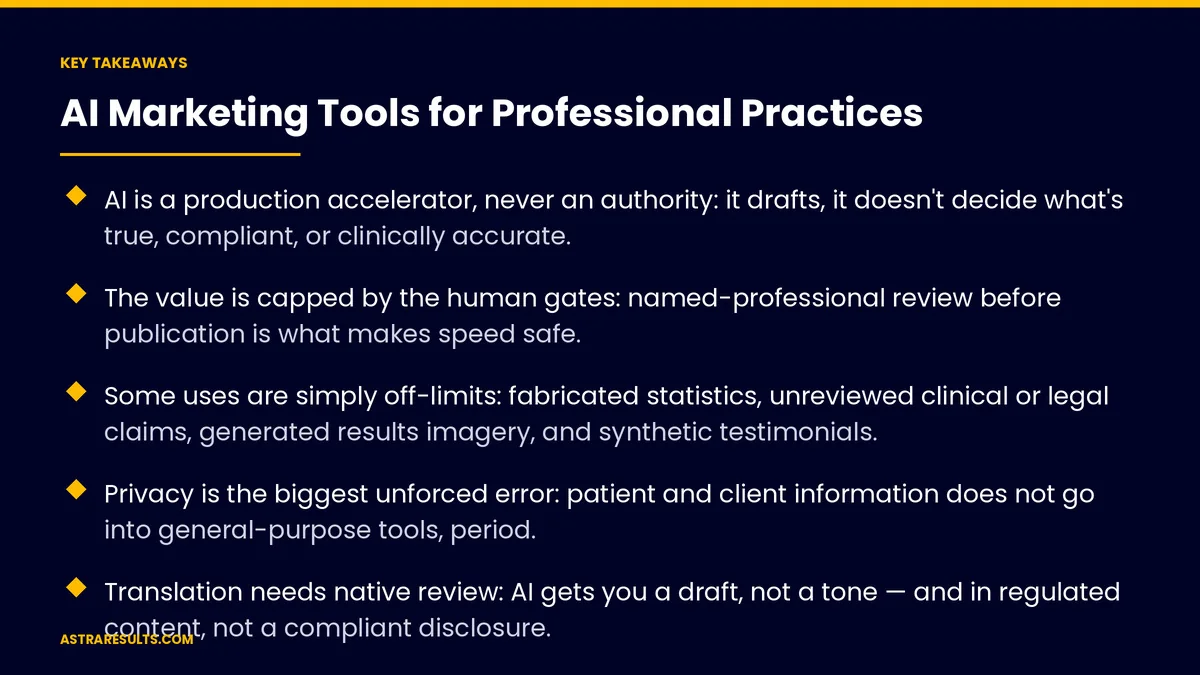
- AI is a production accelerator, never an authority: it drafts, it doesn't decide what's true, compliant, or clinically accurate.
- The value is capped by the human gates: named-professional review before publication is what makes speed safe.
- Some uses are simply off-limits: fabricated statistics, unreviewed clinical or legal claims, generated results imagery, and synthetic testimonials.
- Privacy is the biggest unforced error: patient and client information does not go into general-purpose tools, period.
- Translation needs native review: AI gets you a draft, not a tone — and in regulated content, not a compliant disclosure.
- Govern it like a process: a written policy, a documented review trail, disclosure decided deliberately, and an audit on calendar.
Published: October 2, 2026 | Reading Time: ~13 minutes | Category: AI Marketing · National
But in the verticals Astra serves (medical, dental, legal, aesthetic, financial) the same tooling multiplies something else: the number of ways a practice can publish, at speed and at scale, something it cannot defend. A fabricated statistic in a legal explainer. A clinical claim nobody licensed reviewed. A patient's photograph fed to a third-party service.
A generated "result" image on a page selling outcomes. The kicker states the frame: leverage, not license.
The organizing principle is simple and it resolves nearly every question below.
AI is a production accelerator, never an authority. It can help a practice say what it already knows faster. It cannot decide what is true, what is compliant, what is clinically accurate, or what a licensed professional is willing to stand behind.
Which means the value of AI in a regulated practice is capped not by the model's capability but by the quality of the human gates around it. Practices that build those gates get most of the speed with almost none of the exposure.
Nothing here is legal advice; AI use in regulated marketing intersects with advertising rules, privacy and confidentiality obligations, professional-responsibility standards, and vendor contract terms that only your counsel can apply to your practice.
In This Playbook
- Where AI Genuinely Helps
- Where AI Must Never Touch
- Privacy and Confidentiality
- Translation Needs Native Review
- The Human Gates
- The Disclosure Question
- AI and the Answer Layer
- Chatbots, Intake, and the Rails
- Governance and Measurement
- A 90-Day Adoption
Where AI Genuinely Helps
The plain inventory, because a playbook that only warns gets ignored.
Drafting and restructuring. First drafts of educational content the practice already knows the answer to, outlines from a practitioner's dictated notes, reformatting long-form material into other shapes, and turning a physician's or attorney's verbal explanation into a clean draft that person then edits, the highest-value use in the category, because it converts expertise the practice already has into published assets it never had time to write.
Research help with verification required. Gathering context, surfacing considerations to check, and organizing what a professional then confirms against primary sources.
Variation and testing production. Headline and description variants, ad-copy alternatives, and subject-line sets, low-risk, high-volume work where human review is fast.
Operational drafting. Internal process documents, intake script drafts, FAQ inventories, and the unglamorous production work that otherwise never gets done.
Analysis support. Summarizing call-log patterns, clustering review themes, and organizing the ledger data a practice already collects into something readable. Language-draft acceleration, with the review requirement below. The pattern across all of these. AI compresses production time, not judgment time. The practices that gain most are the ones whose bottleneck was always production.
Where AI Must Never Touch
The hard list. Each item exists because Astra has documented the damage its absence causes.
Fabricated specifics. Statistics, study citations, case outcomes, deadlines, dosages, prices, or credentials generated rather than verified, the failure mode most likely to ship, because fabrications read fluently. In legal content this means invented case law or misstated limitations periods; in medical content, invented figures presented as clinical fact.
Unreviewed professional claims. Any clinical, legal, or financial statement published without the named licensed professional who is accountable for it reading and approving it, per the named-authority standard Astra holds across every expertise vertical.
Generated or altered results imagery. No AI-simulated before-and-afters, no enhanced outcome photos, no synthetic patient images presented as real. The imagery doctrine's absolute, and one AI makes trivially easy to violate.
Synthetic testimonials or reviews. Generated patient or client voices are fabrication regardless of framing. In several verticals they're a regulatory matter as well as an ethical one.
Confidential and protected information. Covered below.
Auto-published anything. Content that reaches the public without a human in the path, including AI-generated social replies and chatbot answers that make professional claims.
Privacy and Confidentiality
The biggest unforced error in the category.
The rule. Patient information, client information, case details, and any protected or confidential material do not go into general-purpose AI tools: not to summarize a chart, not to draft a case study, not to clean up a testimonial, not "with the name removed."
Why the anonymization instinct fails. De-identification is harder than it looks, small details recombine into identity, and the obligation attaches to the disclosure rather than to the practice's confidence about it, which is exactly the reasoning the consent-infrastructure standard applies to imagery.
The vendor question your counsel must answer. What a given tool does with inputs, whether enterprise or contractual terms change that, what data-handling agreements are required in your vertical. Whether the arrangement satisfies your privacy obligations, with the practical default being that consumer-grade tools are not the place for anything confidential.
The staff-behavior reality. The exposure almost never comes from a policy decision. It comes from someone pasting a chart note or a client email into a chat window to save fifteen minutes. Which makes this a training-and-policy problem more than a technology one, and puts it in the same category as every other governance discipline Astra installs.
Translation Needs Native Review
The trap that catches multilingual practices.
What AI does well. Produces a fast, grammatically competent draft in another language, useful as a starting point, and a real accelerator for practices whose alternative was nothing.
What it doesn't do. Carry tone. Astra's native-creation standard exists because communities read translated content as imported within a paragraph. The vocabulary is technically correct and socially wrong. In this region's Spanish the difference between tones is the difference between belonging and visiting.
The regulated-content layer. Disclosures, consent language, and compliance-required statements must be accurate in every language, and a disclosure whose meaning shifts in translation is a compliance problem rather than a copy problem, per the reviewed-in-every-language rule Astra set for financial marketing and applies to all regulated verticals.
The workable model. AI drafts, a native speaker rewrites for tone, and the professional or compliance reviewer approves the final in that language, which is faster than writing from scratch and open about what the tool contributed.
The Human Gates
The structure that makes speed safe.
Gate one, factual verification. Every specific claim traced to a source a human confirmed, with fabrication-prone categories (statistics, citations, deadlines, prices, credentials) checked explicitly rather than assumed.
Gate two, professional review. The named practitioner accountable for the content reads and approves it, which is both the E-E-A-T requirement and the reason the byline means anything.
Gate three, compliance review. The vertical's advertising rules applied before publication, with recordkeeping where required.
Gate four, tone and brand. The content sounds like the practice rather than like a model, which matters more than it sounds, because AI defaults toward exactly the category-average voice that differentiates nothing.
The documented trail. Who drafted, who verified, who approved, and when, the same approval-workflow discipline Astra requires for social content, applied to everything AI touches.
The efficiency point. These gates are what make AI usable at all. A practice without them isn't moving faster, it's accumulating unreviewed liability at speed.
The Disclosure Question
Handled deliberately rather than by default.
The plain framing. Whether and how to disclose AI help in marketing content is a question your counsel should answer for your vertical and jurisdiction, and the answer varies.
What's clearly true regardless. Content published under a named professional's byline must be content that professional reviewed and stands behind. The accountability doesn't shift because a tool helped produce it. The byline is a representation about review rather than about typing.
What's clearly not acceptable. Presenting AI-generated material as a person's original expertise without their involvement, generating a practitioner's "voice" for content they never saw, or using synthetic voices and likenesses in ways that mislead.
The practical posture. Build the review trail so the practice can plainly describe its process if asked, because the question that matters isn't whether AI helped, it's whether a qualified human is accountable for what was published.
AI and the Answer Layer
Where the two AI conversations meet. Practices ask about AI tooling and about AI search visibility as if they were the same topic. They're related in one specific way worth naming. The assistants that answer patient and client questions cite content that answers them (cost explainers, candidacy candor, deadline education, process walkthroughs) under identifiable, credentialed authorship.
Which means the tooling question feeds the visibility question in exactly one direction. AI-accelerated production of reviewed, specific, authored content builds the asset that gets cited, while AI-generated volume of generic content builds the thing that doesn't. The answer-layer economics reward specificity and accountability. The two properties unreviewed AI output most reliably lacks.
The corollary. The practices that win the answer layer will be the ones that used AI to publish more of what only they know, per the demonstration doctrine Astra holds everywhere.
Chatbots, Intake, and the Rails
The operational deployment that carries the most risk and the most upside.
Where it works. Capture, routing, scheduling, hours-and-location answers, and after-hours acknowledgment, the never-voicemail problem Astra documents in every vertical, improved by tooling that never sleeps.
Where the rails go. no clinical or legal advice, no candidacy determinations, no eligibility or outcome statements, no fee quotes beyond published frameworks, and immediate escalation to a human on anything approaching those, the messaging-rails standard with an automated participant.
The disclosure basics. People should be able to tell they're talking to an automated system and should always have a fast path to a person, because a patient in distress or a client with a deadline needs a human and knows it.
The records question. Conversations may be records, handled per your counsel's guidance. The human-escalation promise, which every playbook in Astra repeats. The tool captures, the human decides, and the configuration our AI Inbound service builds exists to make that handoff reliable rather than optional.
Governance and Measurement
The written policy. Approved uses, prohibited uses, the confidentiality rule stated unambiguously, which tools are permitted, who reviews what. What the documented trail looks like, trained rather than filed.
The audit on calendar. Sampled published content checked for unverified specifics, review-trail completeness, and tone drift; the confidentiality rule spot-checked with staff; chatbot transcripts sampled for rail violations.
The measurement. Production throughput and time-to-publish (the actual benefit), fabrication catches at the verification gate (the metric that proves the gate works), review-trail completeness, rail-violation count, and, the number that matters most, whether the content produced this way performs on the ledger the practice already keeps: kept consults, signed cases, and qualified conversations by source.
The plain test. If AI-accelerated content isn't producing better ledger numbers, the practice bought speed rather than value, which is worth knowing early.
A 90-Day Adoption
Days 1–30: Policy and gates
- The written AI policy drafted with counsel and trained to staff, with the confidentiality rule stated unambiguously and permitted tools named
- The four gates documented with owners
- The review-trail format built
- A small pilot scope chosen (educational drafting from practitioner dictation is the usual best starting point)
Days 31–60: Pilot and verify
The pilot run with every gate applied and fabrication catches logged. Translation workflow tested as draft-then-native-rewrite-then-review; chatbot rails set with counsel if deployment is planned; production-throughput and time-to-publish baselined against the prior process.
Days 61–90: Scale and audit
Scope expanded only where the gates held. The first governance audit completed (sampled content, review trails, staff confidentiality spot-check, chatbot transcripts); ledger performance of AI-accelerated content compared against the practice's existing baseline. The policy updated from what the audit found.
How Astra Uses AI in Practice Marketing
Astra Results Marketing treats AI as leverage rather than license. Production accelerated where it helps, hard limits where it must never touch, confidentiality protected absolutely, translation drafted by tooling and finished by native speakers, four human gates before anything publishes, chatbots deployed with rails and human escalation, and everything measured on the same ledger every other channel answers to.
Engagements begin with an AI-policy, gate, and governance audit through our business consulting team.
Related reading
Frequently asked questions
What's the single highest-value use of AI in a professional practice?
Turning your practitioners' existing expertise into published assets. Record a physician or attorney explaining something they explain to patients or clients weekly, have AI produce a clean draft, then have that person edit and approve it. The bottleneck in expert content was never knowledge, it was production time. This workflow removes it without removing the accountability that makes the content worth reading.
Can we use AI to write clinical or legal content if we review it after?
Yes, and the review is the whole point. But it has to be real: a named licensed professional reading, correcting, and approving before publication, with specifics traced to sources rather than trusted because they read fluently. Fabricated statistics and invented citations are the most likely failure mode precisely because they're plausible. Build a verification gate that checks those categories explicitly rather than assuming a skim will catch them.
Is it safe to put patient or client details into AI tools if we remove names?
No: treat that as prohibited. De-identification is harder than it appears, small details recombine into identity, and the obligation attaches to the disclosure rather than to your confidence about it. Your counsel should determine what tools and contractual terms could ever be appropriate for confidential material in your vertical. Meanwhile the practical rule that prevents nearly all exposure is that confidential information never enters general-purpose tools.
Can AI handle our Spanish or Portuguese content?
As a draft, not as the deliverable. AI produces competent grammar and misses tone, and communities read translated content as imported within a paragraph. Use it to accelerate, then have a native speaker rewrite for tone and the professional or compliance reviewer approve the final in that language. With disclosures and consent language checked especially carefully, since meaning that shifts in translation becomes a compliance problem rather than a wording one.
Should we disclose that we use AI in our marketing?
Ask your counsel, because the answer varies by vertical and jurisdiction. But two things hold regardless. Content under a professional's byline must be content that professional reviewed and stands behind, and generating a practitioner's voice for material they never saw is not acceptable in any framing. Build the review trail so you can describe your process plainly if asked. Accountability, not authorship mechanics, is what the question is really about.
How do we know if AI is actually helping?
Measure two things: production throughput and time-to-publish, which is the real benefit. Then the ledger you already keep, kept consults and signed cases by source. If AI-accelerated content moves throughput but not the ledger, you bought speed rather than value. Also track fabrication catches at the verification gate, because a gate that never catches anything usually isn't a gate.
Ready to Use AI as Leverage Rather Than Liability? Astra Results Marketing builds AI adoption on hard limits, four human gates, absolute confidentiality, native-reviewed translation, and rails on anything patient-facing. Measured on throughput and the ledger you already keep. Start with an AI-policy, gate, and governance audit for your practice. ▸ CALL (786) 321-2866 · ▸ REQUEST YOUR CONSULTATION