Rated 5 star on


Analytics & Attribution for Professional Practices
Quick answer
Professional practices should attribute marketing from intake, not platform dashboards. Ask every new patient or client how they found the practice and record the answer consistently. Count kept consultations or signed cases, not clicks. Measure referrals by name. Settle privacy rules before adding tracking. Astra summarizes it all on one monthly report.
Attribution in professional practices is harder than in the e-commerce world most analytics advice comes from. The decisive conversion happens on a phone call or in a consultation room. The decision cycle runs weeks or months, across devices and away from cookies. The most valuable clients arrive through referrals that no platform will ever claim.
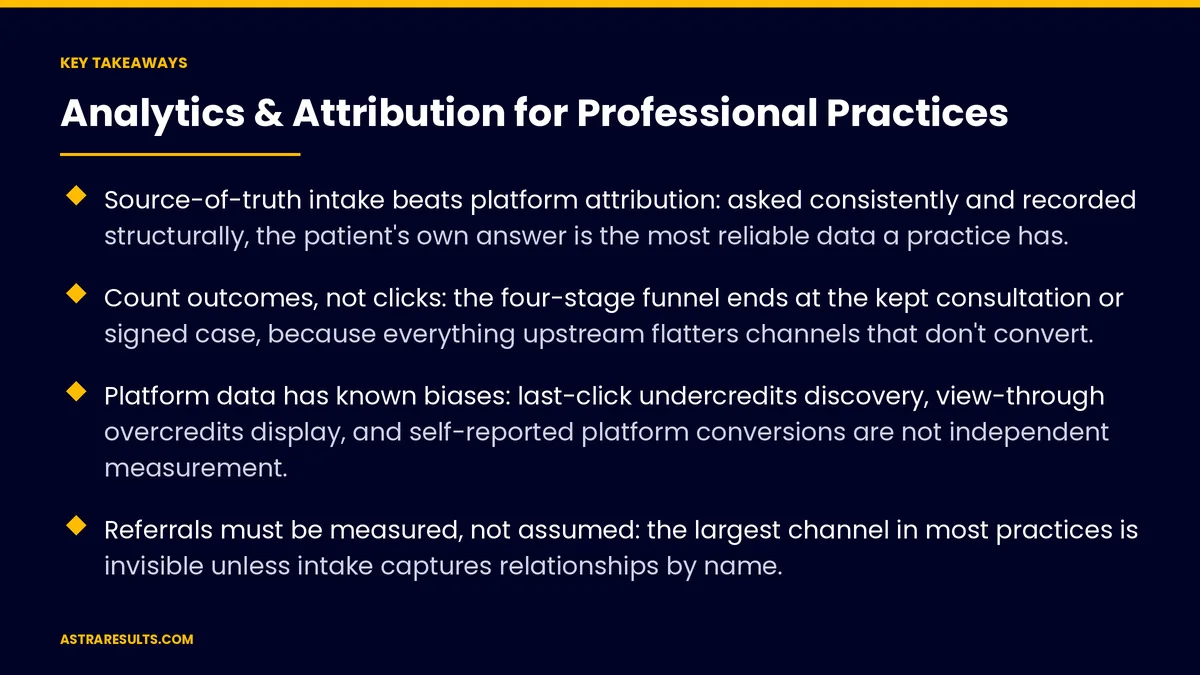
Key Takeaways
- Source-of-truth intake beats platform attribution: asked consistently and recorded structurally, the patient's own answer is the most reliable data a practice has.
- Count outcomes, not clicks: the four-stage funnel ends at the kept consultation or signed case, because everything upstream flatters channels that don't convert.
- Platform data has known biases: last-click undercredits discovery, view-through overcredits display, and self-reported platform conversions are not independent measurement.
- Referrals must be measured, not assumed: the largest channel in most practices is invisible unless intake captures relationships by name.
- Privacy constrains the toolkit: what you may collect, send, and store is a legal question that precedes every tracking decision.
- One page runs the practice: cost per outcome by source, cohort value, and stage conversion — read monthly, acted on quarterly.
Published: October 4, 2026 | Reading Time: ~13 minutes | Category: Analytics · National
Privacy rules constrain what a practice may collect and pass to a vendor. And the actual unit of value (a signed case, a completed plan of care, a retained relationship) happens in a practice management system that has never spoken to an ad platform in its life.
Faced with that, practices tend to do one of two things: trust platform dashboards that systematically overstate the channels they belong to, or abandon measurement and buy on instinct. There's a third option, and it's the one Astra has been building toward across every measurement section it has written.
It rests on two moves so simple they get dismissed: ask every patient or client how they found you, and count what happened rather than what got clicked. The kicker states it: ask the patient, count the case. Nothing here is legal advice.
Privacy and data-handling obligations (including health-information rules where they apply, state privacy laws, and vendor contract terms) vary by practice type and jurisdiction and require your counsel's review before you implement tracking of any kind.
In This Playbook
- Why Practice Attribution Is Hard
- Source-of-Truth Intake
- The Four-Stage Funnel
- What Platform Data Can and Can't Tell You
- Privacy First
- Cohort Economics
- Where Practices Get It Wrong
- The One-Page Report
- A 90-Day Implementation
Why Practice Attribution Is Hard
The plain inventory, because most analytics advice was written for a different business.
The phone problem. In every vertical Astra has mapped, the highest-intent action is a call, and calls break the click-to-conversion chain that platform reporting assumes.
The long cycle. A family-law prospect researches for months, a surgical patient compares practices over weeks, and an advisory prospect may take a year: across devices, in incognito windows, and past most attribution windows.
The referral invisibility. The professional webs that carry most volume in advisory and specialty medicine leave no digital trace, so a dashboard-driven practice systematically underfunds its best channel.
The offline conversion. The signed engagement, the completed plan, the retained client, all recorded in systems designed for billing rather than marketing.
The privacy constraint. Health and legal contexts limit what may be collected and transmitted, which rules out several standard tactics before optimization even begins.
The consequence. Any practice that treats platform dashboards as measurement is reading a document written by the party being evaluated.
Source-of-Truth Intake
The single highest-return measurement investment available to a practice.
The mechanic. Every new inquiry is asked how they found the practice, in a consistent format, recorded as structured data rather than a free-text note nobody analyzes.
Not "how did you hear about us" buried in a form field, but a deliberate question asked by whoever answers the phone, with a fixed set of options plus a specificity prompt, which physician referred you, which friend, which search, which event.
Why it outperforms tracking. It captures referrals, word of mouth, prior relationships, and offline discovery that no pixel sees. It survives privacy changes. It reflects what the patient believes brought her in, which is the only version that explains her decision.
The known weaknesses, stated plainly. Patients misremember, they name the last touch rather than the first. "I found you online" collapses several channels into one. That is why source-of-truth data is triangulated against platform data rather than replacing it.
The implementation reality. This fails on consistency, not on design. It works only if it's asked every time. That makes it a training and accountability matter rather than a software purchase.
The specificity dividend. Asking which referring physician turns an anonymous "referral" bucket into the relationship ledger that drives cultivation decisions.
The Four-Stage Funnel
The measurement structure Astra uses in every vertical, per the funnel standard.
The stages. inquiry (a call, form, or message), booked (an appointment on the calendar), kept (the patient or client attended), and started (the engagement signed, the treatment begun, the plan of care underway).
Why each boundary matters. Inquiry-to-booked measures intake performance. Booked-to-kept measures reminder and friction quality and exposes the no-show problem that flatters every practice's numbers; kept-to-started measures whether the consultation and the marketing promised the same thing.
The diagnostic power. A channel with strong inquiry volume and weak kept-rate is attracting the wrong people, which is invisible in any report that stops at leads, the wrong-patient failure Astra documents.
The vertical-specific end points. Signed case in legal, kept consult and treatment-started in medical and aesthetic, completed plan of care in rehab, retained relationship in advisory, each defined explicitly before measurement begins, because an undefined outcome metric always drifts upstream toward whatever is easiest to count.
What Platform Data Can and Can't Tell You
Used correctly, with its biases named.
What it's good for. Relative in-platform performance: which creative, keyword, audience, or landing page outperformed another under the same conditions. That's optimization data, and it's valuable.
What it's not. Independent measurement of whether a channel produced revenue, because the platform reporting its own conversions has an interest in the answer and uses attribution rules that favor itself.
The specific biases to know.
- Last-click undercredits discovery and education content while overcrediting the branded search that closed the loop
- View-through and modeled conversions attribute value to impressions nobody acted on
- Platform-reported conversions frequently double-count across platforms, so summing them exceeds the practice's actual case count — a check every practice should run once and never forget
- Attribution windows shorter than the decision cycle simply lose the credit
The workable posture. Use platform data to optimize inside a channel, use source-of-truth intake and the outcome ledger to allocate between channels, and treat any discrepancy as information rather than as an error to be reconciled away.
Privacy First
The constraint that precedes every implementation decision.
The rule. What a practice may collect, store, and transmit to third parties depends on its vertical, its jurisdiction, and its vendor contracts. In health contexts especially, sending information that could identify a patient or connect them to a condition through advertising or analytics tooling is a legal question with real consequences, not a configuration choice.
What that means practically. Counsel reviews the tracking stack before deployment, not after. Conversion events are designed to avoid transmitting condition-specific or identifying information. Third-party tags are inventoried and justified. The practice knows what each vendor receives.
The pattern that keeps practices safe. Measure aggregate outcomes internally (cases, kept consults, completed plans, by source and cohort) rather than trying to push granular patient-level conversion data outward. The internal ledger is both more accurate and less exposed.
The corollary. A measurement design that depends on transmitting sensitive data outward is usually solvable a different way. The different way is generally better measurement anyway.
Cohort Economics
Where measurement becomes strategy.
Why single-transaction metrics mislead. Nearly every practice in Astra is a repeat or long-horizon business (households across generations, membership renewals, advisory tenure, chronic-care continuity) so cost per acquisition means nothing without value over time.
The cohorts that matter. By acquisition source (which settles the discount debate arithmetically, per the failure analysis), by language (each language is its own market with its own economics, per the per-language P&L), by service line, and by provider where continuity drives retention.
The metrics. 12- and 24-month retained value, repeat and referral rate per client, and, in household verticals, members and generations served.
The decision it enables. A channel with higher acquisition cost and better cohort retention is frequently the better buy, and no click-based report will ever tell you that.
Where Practices Get It Wrong
The failure inventory, briefly.
Measuring what's easy. Impressions, followers, and rankings, none of which pay salaries.
Vanity dashboards. Reports built to look comprehensive rather than to drive one decision.
Attribution reconciliation theater. Weeks spent making platform numbers agree with each other instead of asking patients.
No agreed outcome definition. Three people in a practice using "lead" to mean three different things.
Untracked calls. The highest-intent channel unmeasured, per the answered-phone failure Astra documents. Over-attribution to the last touch, which quietly defunds the education content that created demand. In the AI-answer era this gets worse, because assistant-mediated discovery frequently leaves no referrer at all. Someone reads your cost explainer inside an assistant's answer and arrives as direct traffic or a branded search.
Source-of-truth intake is currently the only practical instrument that catches it, which is one more reason to ask.
The One-Page Report
The deliverable that runs a practice.
What's on it.
- Cost per outcome by source — cost per signed case, kept consult, or completed plan, with the outcome defined by vertical
- The four stages as counts and conversion rates, so leaks are visible
- Cohort value at 12 and 24 months by acquisition source
- The referral ledger by named relationship
- The language split where relevant
- The governance checks
Astra treats as first-class — consent-record completeness, claim-consistency across languages, intake-clock compliance, and the register audits each vertical requires.
What's not on it. Impressions, followers, rankings, and platform-reported conversion totals, available on request, never on the front page.
The cadence. Read monthly, acted on quarterly, because most of these metrics run on clocks longer than a month and reacting to noise is its own failure mode.
The test of whether it's working. The practice can answer three questions in one sitting: what does a patient cost to acquire by source, what is she worth over two years, and where is the funnel leaking. If those require a project, the reporting isn't built yet.
A 90-Day Implementation
Days 1–30: Define and ask
- The outcome metric defined explicitly for the vertical and agreed by everyone who uses the word
- Source-of-truth intake deployed with structured options and a specificity prompt, and staff trained to ask every time
- Call tracking implemented with counsel's review of the privacy implications
- The four stages instrumented in whatever system already holds the data
Days 31–60: Connect and audit
- Practice-management outcomes reconciled against intake sources monthly rather than continuously
- The platform-conversion double-count check run once and documented
- The tracking stack inventoried with counsel and anything unjustified removed
- The referral ledger built with named relationships
- The one-page report drafted and reviewed by the people who will act on it
Days 61–90: Read and reallocate
- First cohort pulls at 12 months where history exists
- Stage-conversion leaks identified and assigned owners
- Next quarter's spend allocated from cost per outcome and cohort value rather than from platform dashboards
- The governance checks added to the same page so measurement and compliance are read together
How Astra Measures Practice Marketing
Astra Results Marketing builds measurement on two moves that survive every platform change. Ask every patient or client how they found you and record it structurally, then count outcomes rather than clicks.
With platform data used for in-channel optimization, privacy reviewed before implementation, cohort economics driving allocation, and one page that answers what a patient costs, what she's worth, and where the funnel leaks. Engagements begin with a measurement, privacy, and reporting audit through our business consulting team.
Related reading
Frequently asked questions
Isn't asking patients how they found us unreliable?
It's imperfect and still the best instrument available. Patients misremember and tend to name the last touch, which is exactly why you triangulate it against platform data rather than replacing one with the other. What it captures that nothing else does is referrals, word of mouth, prior relationships, and offline discovery, the channels that carry most volume in professional practices and produce zero digital signal. Ask it consistently, record it structurally, and add a specificity prompt.
Why not just trust the platform dashboards?
Because they're reports written by the parties being evaluated, using attribution rules that favor themselves. Use them for what they're good at (comparing creative, keywords, and audiences inside one channel) and never for allocating between channels. Run this check once. Sum the conversions each platform claims and compare it to your actual case count. The gap is the reason you need an internal ledger.
What's the right outcome metric for our practice?
Whatever represents value delivered: signed case for legal, kept consult and treatment-started for medical and aesthetic, completed plan of care for rehab, retained relationship for advisory. Define it explicitly and get everyone using the same word the same way: because an undefined outcome metric always drifts upstream toward whatever is easiest to count, which is usually leads, which is usually meaningless.
How do we handle attribution when someone finds us through an AI assistant?
Currently, mostly through intake. Assistant-mediated discovery frequently leaves no referrer, so a patient who read your cost explainer inside an answer arrives as direct or branded traffic. That's a strong argument for both publishing the content assistants cite and asking every caller how they found you, and for not defunding education content because last-click attribution can't see what it did.
What should we do about privacy rules before implementing tracking?
Have counsel review the stack before deployment: what you may collect, what you may transmit to vendors, and what your contracts require differ by vertical and jurisdiction, and in health contexts the exposure is real. Then design toward internal aggregate measurement (outcomes by source and cohort, kept in your own systems) which is generally both more accurate and less risky than pushing granular patient-level data outward.
What belongs on the report our owners actually read?
One page: cost per outcome by source, the four stages as counts and conversion rates, cohort value at 12 and 24 months, the referral ledger by named relationship, the language split, and the governance checks. Impressions, followers, and rankings go in an appendix. Read it monthly, act quarterly: and if the practice can't answer what a patient costs, what she's worth over two years. Where the funnel leaks in a single sitting, the reporting isn't built yet.
Ready to Measure What Actually Happened? Astra Results Marketing builds practice measurement on source-of-truth intake, the four-stage funnel, privacy-reviewed implementation, cohort economics, and one page that answers the three questions that matter. Start with a measurement, privacy, and reporting audit for your practice. ▸ CALL (786) 321-2866 · ▸ REQUEST YOUR CONSULTATION