Rated 5 star on

Miami Mental Health & Psychiatry Practice Marketing
Quick answer
A Miami mental health or psychiatry practice should put crisis routing first. Crisis lines and emergency resources sit above every appointment prompt. The practice publishes real availability and candid waitlist details. Privacy covers scheduling, communication and billing. Ethics codes limit testimonials, so education leads instead. Astra measures access and engagement, never outcomes as claims.
Behavioral health marketing carries an obligation no other vertical in Astra shares: some of the people reading a practice's website are in crisis right now. That single fact reorders every priority. Before positioning, before differentiation, before any funnel consideration, the content must route a person in crisis to help.
Key Takeaways
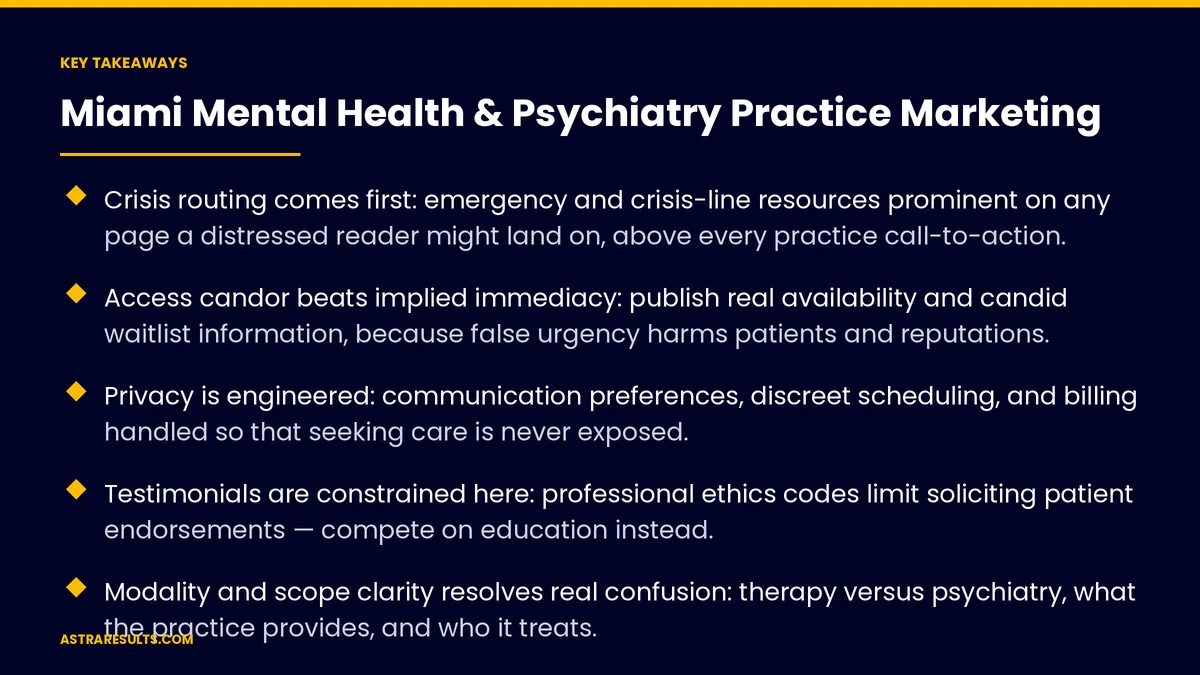
- Crisis routing comes first: emergency and crisis-line resources prominent on any page a distressed reader might land on, above every practice call-to-action.
- Access candor beats implied immediacy: publish real availability and candid waitlist information, because false urgency harms patients and reputations.
- Privacy is engineered: communication preferences, discreet scheduling, and billing handled so that seeking care is never exposed.
- Testimonials are constrained here: professional ethics codes limit soliciting patient endorsements — compete on education instead.
- Modality and scope clarity resolves real confusion: therapy versus psychiatry, what the practice provides, and who it treats.
- Measure access and engagement, never outcomes as marketing claims: first-session attendance, continuity, and candid capacity data.
Published: October 20, 2026 | Reading Time: ~12 minutes | Category: Medical · Behavioral Health
A person in acute distress must find emergency resources immediately, rather than a scheduling form for an appointment three weeks out.
Everything else in this playbook (and there is a great deal else, because access, stigma, privacy, and modality confusion all shape this market powerfully) sits underneath that. The kicker states the ordering: safety before funnel.
The rest follows from three market realities.
Access is the crisis. Demand vastly exceeds supply, waitlists are the norm. The practice that is open about availability serves people better than the one that implies immediacy it can't deliver.
Stigma is still the barrier. Many patients have never told anyone they're looking. That makes privacy an operational requirement and shapes everything from communication preferences to whether a review will ever exist.
The category is saturated with claims. App-based subscriptions, wellness coaching, and interventional treatment marketing have created an environment where a licensed practice's advantage is evidence candor and scope clarity. Marketing guidance for licensed practitioners only. Nothing here is medical or mental-health advice. Diagnosis, treatment selection, medication management, and every clinical statement belong to your licensed clinicians.
Professional ethics codes, Florida board rules, advertising regulations, and privacy law govern every asset, including significant constraints on testimonials and patient information. And compliance and clinical review precede publication of every asset.
In This Playbook
- Crisis Routing Comes First
- Access Honesty in a Waitlist Market
- Why does privacy decide whether mental health patients book?
- Testimonials, Reviews, and the Constraint
- Modality and Scope Clarity
- Evidence Honesty on Treatment
- Stigma, Register, and the Populations
- Referrals, Channels, and Measurement
- A 90-Day Build
Crisis Routing Comes First
The non-negotiable, before any other consideration.
The rule. Any page addressing symptoms, diagnoses, or distress, and realistically the site's home page and contact page too, carries immediate, prominent crisis resources. 988 for the Suicide & Crisis Lifeline (call or text), 911 or the nearest emergency department for medical emergencies, and local crisis lines where the practice serves specific communities.
Placed above any appointment prompt, not in a footer.
The framing. State plainly that a practice appointment is not the right destination for an emergency, and that reaching crisis support is the correct step, because a person in acute distress who encounters a three-week scheduling flow may conclude that help isn't available.
What's banned absolutely. Paid acquisition targeting acute-crisis search terms, content engineered to capture crisis traffic into an appointment funnel, and any urgency creative that trades on distress, the routing-before-capturing standard Astra established in cardiology, at its most consequential application.
The audit. Crisis-resource placement and currency reviewed on calendar as a first-class governance item, because a broken link or an outdated number in this position is a real harm rather than a marketing defect.
Access Honesty in a Waitlist Market
The most patient-serving choice available, and it converts.
The reality. Demand for behavioral health services far exceeds capacity, most practices carry waitlists. Patients making the difficult decision to seek care frequently make five calls and reach five voicemails.
What candor looks like. Publishing actual availability (current wait for a new-patient intake, whether the practice is accepting new patients at all, which clinicians have openings) and updating it, because an inquiry form on a practice that isn't accepting patients wastes the hardest step a patient took.
The waitlist done properly. If there's a list, say what joining it means, how long it typically runs, whether the practice will follow up. What alternatives the person might consider in the meantime, including community resources and other practices, which is the honest-routing move Astra keeps finding builds more trust than any capture.
The intake response standard per the never-voicemail rule. In this vertical, an unanswered call is a person who may not call again. The answered-phone failure is more costly here than anywhere else in Astra.
The telehealth capacity note. Virtual care expanded access, with state licensure limits that the practice states plainly rather than leaving to be discovered.
Why does privacy decide whether mental health patients book?
The operational layer that determines whether people book.
Why it dominates. Many patients have told no one they're seeking care, and the fear of exposure (a message on a shared phone, a statement arriving at a family address, being seen in a waiting room) prevents bookings that no content will recover.
The engineering.
- Communication preferences captured explicitly at first contact (how may we reach you, may we leave a message, may we text, which number)
- Discreet scheduling and waiting arrangements where the facility allows
- Billing and statement handling explained plainly
- Telehealth options that remove the visibility problem entirely for appropriate care
The described-not-performed rule. State the privacy structure calmly on the site, because the patient is explicitly evaluating it, per the discretion register Astra applies wherever privacy is the product.
The digital-privacy dimension. Tracking and analytics in behavioral health carry heightened sensitivity, and what may be collected or transmitted is a legal question for counsel before implementation per the privacy-first measurement standard. This is the vertical where getting that wrong causes real harm.
Testimonials, Reviews, and the Constraint
The place where this vertical differs sharply from every other in the library.
The ethics reality. Professional codes for psychologists, counselors, and physicians generally restrict or discourage soliciting testimonials from current patients. The confidentiality implications of a public patient endorsement are serious, so the review-cultivation playbook Astra uses elsewhere does not transfer here without your counsel and licensing board's guidance.
What that means practically. Reviews will be sparse relative to other verticals. That is normal rather than a deficiency to be engineered around. Never pressure, never incentivize, never request in a way that implies a clinical relationship carries a marketing obligation.
What to compete on instead. Education, clinician credentials and training stated exactly, modality clarity, access candor, and the practice's own description of how care works. All of which persuade a researching patient more than testimonials would anyway.
Responding to negative reviews. With extreme care, since confirming or denying that someone is a patient can itself be a confidentiality breach. A generic response drafted with counsel is the standard approach.
Modality and Scope Clarity
The confusion that costs the most bookings.
What patients don't understand. The difference between psychiatry (physician-led, including medication management), psychology and therapy (talk-based treatment across modalities), and the counseling professions: plus how these work together, whether they can see one without the other, and who prescribes.
The content that helps. A plain-language explanation of the roles, what each provider type does, how collaborative care typically works, and specifically what this practice provides and what it doesn't. The scope-honesty standard applied where the category's opacity is a real barrier.
The modality specificity. Naming the therapeutic approaches clinicians practice, described plainly at educational level, so a patient looking for a specific evidence-based modality can find it, the specificity-beats-generality principle.
The population clarity. Adults, adolescents, children, couples, families: stated explicitly, with the child and adolescent lane requiring particular care. Content addressed to parents rather than minors, no marketing aimed at children, and the minors-protection absolutes Astra holds everywhere.
Evidence Honesty on Treatment
The tone in a category full of certainty for sale.
Medication content. Described at general level as one component of care that a physician evaluates and manages, never as a marketing lever, never with drug names positioned as selling points, and never with implied outcomes, the medication-messaging discipline Astra built for pain management, which applies with equal force here.
Interventional and newer treatments. Where a practice offers treatments such as TMS or ketamine-related therapies, the content must state what's established and what isn't, who is and isn't a candidate, that physician evaluation determines suitability, and what monitoring involves.
With no cure language, no transformation framing, and no urgency, because this specific corner of the market has become the category's most hype-prone and the practices that stay measured will be the ones still credible in five years.
The app-and-coaching boundary. Subscription mental-health apps and coaching services are not clinical care, and a licensed practice's candid description of what licensed treatment involves (assessment, diagnosis where appropriate, a treatment plan, clinical accountability) is both a service to confused consumers and the clearest differentiation available.
No outcome promises, ever. Recovery language stays candid, individual variation is stated. The practice describes process and philosophy rather than results.
Stigma, Register, and the Populations
The tone. Matter-of-fact, non-pathologizing, and free of both clinical coldness and inspirational excess: describing seeking care as an ordinary, sensible step rather than a dramatic one, per the dignity-barrier pattern Astra documents wherever shame delays care.
The men's-engagement gap. Men present later and less often, and content that addresses them practically rather than emotively reaches people generic material misses, the same finding as the urology playbook.
The cultural dimension, at method level. Stigma varies significantly across this region's communities. Content in each language must be written natively rather than translated per the chain rule: therapy conducted in a patient's first language is a clinical requirement rather than a convenience.
This is the vertical where the staff-it-or-don't-say-it rule matters most, since a therapist who doesn't share the language cannot deliver the treatment.
The workplace and executive lane. Professionals worried about career implications need explicit privacy assurance.
The perinatal, geriatric, and caregiver lanes. Each with real need, distinct tones, and referral sources of their own.
Referrals, Channels, and Measurement
The referral web. Primary care above all, plus OB-GYN for perinatal presentations, pediatrics for adolescent care, pain management and cardiology where behavioral health is part of comprehensive care, schools and universities, employee-help programs, and community organizations, served per the courtesy standard with communication handled inside the patient's authorization, which is stricter here than anywhere.
Channels.
- Search carries the education library under named-clinician authorship with YMYL disciplines at maximum, earning the AI answers this market asks ("do I need a therapist or a psychiatrist," "how do I start," "¿cómo encuentro terapia en español?") through the entity work our AI SEO service builds
- Clinician video helps enormously because seeing a calm clinician reduces the fear of the first session
- Paid runs narrowly behind the negatives fortress with crisis terms excluded absolutely, app-subscription and coaching comparison traffic filtered, and no urgency creative
- The profile carries accurate availability and languages
Measurement. first-session attendance (the hardest step, and the truest access metric), inquiry-to-intake conversion and time-to-first-appointment against published availability, continuity and engagement over a course of care, waitlist conversion and candid capacity reporting, the referral ledger, language cohorts read separately, the crisis-routing and privacy audits as first-class KPIs, and cost per attended intake on the ledger standard, with clinical outcomes tracked internally for care quality and never converted into marketing claims.
A 90-Day Build
Days 1–30: Safety, access, privacy
- Crisis resources deployed prominently across the site with placement and currency documented for calendar audit
- Paid campaigns audited to remove any crisis-adjacent targeting
- Real availability published with the waitlist description written plainly
- Communication-preference capture built into first contact
- The tracking stack reviewed with counsel before any measurement change
- Testimonial and review policy set with counsel and licensing-board guidance
Days 31–60: Clarity and education
- The modality-and-scope explainer published under clinician authorship in English and native Spanish
- Clinician credentials and modalities stated exactly
- The first-session walkthrough live to reduce dread
- Treatment-content standards applied to any interventional services with evidence candor and no cure language
- The population and lane pages built with the parent-facing standard for adolescent care
Days 61–90: Web and reads
- The referral web engaged with authorization-compliant communication
- School, EAP, and community relationships built under the participation rules
- AI-answer accuracy checked in both languages
- The first crisis-routing and privacy audits completed
- First clear reads — first-session attendance, time-to-first-appointment, waitlist conversion, referral ledger — and next quarter set on access performance rather than inquiry volume
How Astra Builds Behavioral Health Practices
Astra Results Marketing builds mental health and psychiatry marketing on safety before funnel: crisis resources placed above every call-to-action and audited on calendar, access published plainly in a waitlist market, privacy engineered rather than promised, testimonials handled inside the profession's ethics rather than around them, modality and scope clarified where confusion blocks care, and treatment content held to evidence candor, measured on attended intakes and access clocks, never on outcome claims.
Engagements begin with a safety, access, and privacy audit through our business consulting team.
Related reading
Frequently asked questions
What has to be on every page before anything else?
Crisis resources: 988 for the Suicide & Crisis Lifeline by call or text, 911 or the nearest emergency department for emergencies, and any local crisis lines relevant to the communities you serve, placed above your appointment prompts rather than in a footer, with a plain statement that a practice appointment isn't the right destination for an emergency. Audit placement and currency on calendar. In this position, a broken link is a harm rather than a defect.
Should we advertise on crisis-related search terms?
No. Never target acute-crisis terms in paid acquisition, and never build content designed to capture crisis traffic into a scheduling funnel. A person in acute distress needs crisis support immediately, not an intake form. A practice that routes them correctly is doing the only defensible thing while also earning the trust of every clinician and referral source who notices.
We have a three-week waitlist. Won't publishing that cost us patients?
It costs you inquiries and saves you the ones that matter. Patients making the hardest call of their year deserve to know whether you can help. An inquiry form on a practice not accepting patients wastes the step that was hardest to take. Publish real availability, describe what joining a waitlist means, and point people toward alternatives in the meantime, correct routing builds referral trust that outlasts any single booking.
How do we handle reviews and testimonials given the ethics rules?
Carefully, and with your licensing board's guidance. Professional codes generally restrict or discourage soliciting testimonials from current patients, and public endorsements carry real confidentiality implications. So the review-cultivation approach used in other verticals doesn't transfer. Expect sparse reviews as normal, never pressure or incentivize, and respond to negative reviews only in generic terms drafted with counsel, since confirming someone is a patient can itself breach confidentiality.
What's the highest-value educational content we can publish?
The modality-and-scope explainer: patients don't understand the difference between psychiatry, psychology, and the counseling professions, whether they need one or both, or who prescribes. The confusion stalls care. Explain the roles plainly, name the modalities your clinicians practice, state exactly what your practice provides and doesn't, and add a first-session walkthrough to reduce the dread of starting.
How should we market newer interventional treatments?
With measured evidence candor: state what's established and what isn't, who is and isn't a candidate, that physician evaluation determines suitability, and what monitoring involves, with no cure language, no transformation framing, and no urgency. This corner of the market has become the category's most hype-prone. That means restraint is both the ethical position and the durable competitive one. The practices still credible in five years will be the measured ones.
Ready to Build a Practice That Puts Safety First? Astra Results Marketing builds behavioral health marketing on crisis routing above every call-to-action, candid access, engineered privacy, ethics-compliant reputation work, and evidence-candid treatment content. Measured on attended intakes and access clocks. Start with a safety, access, and privacy audit for your practice. ▸ CALL (786) 321-2866 · ▸ REQUEST YOUR CONSULTATION