 Rated 5 star on

Logistics NLP: Bills of Lading and Customs Docs
Quick answer
Language AI reads bills of lading, commercial invoices, packing lists and certificates of origin, then pulls out parties, containers, weights and ports. It cross-checks documents to catch mismatches before they cause holds. It can suggest tariff classifications, but licensed customs brokers decide. Unclear scans and exceptions go to people.
Every international shipment comes with a stack of documents: bills of lading, commercial invoices, packing lists and certificates of origin. Teams retype and cross-check them by hand, and mistakes cause holds at the port. Language AI can read these documents, pull out the key details and flag mismatches, while licensed brokers handle customs decisions.
Key Takeaways
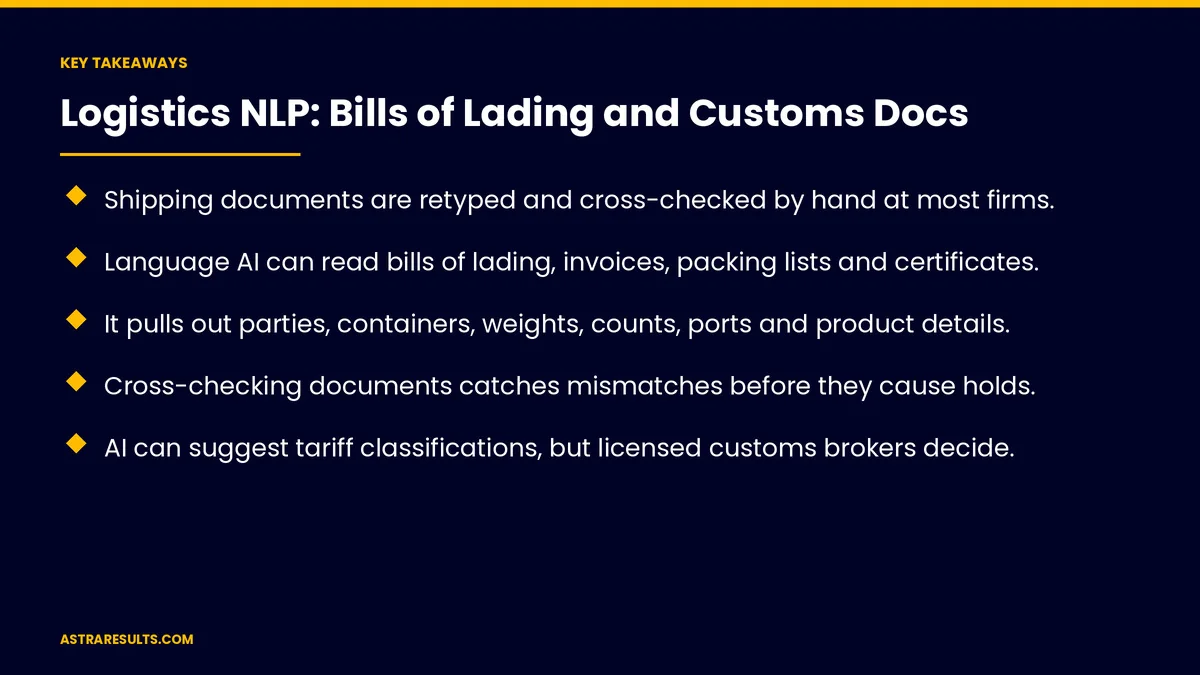
- Shipping documents are retyped and cross-checked by hand at most firms.
- Language AI can read bills of lading, invoices, packing lists and certificates.
- It pulls out parties, containers, weights, counts, ports and product details.
- Cross-checking documents catches mismatches before they cause holds.
- AI can suggest tariff classifications, but licensed customs brokers decide.
- Send exceptions to people and connect clean data to your logistics system.
Published: October 6, 2026 | Reading Time: ~9 minutes | Category: Natural Language Processing
This guide covers language AI for logistics documents: the documents involved, pulling out key details, cross-checking documents, customs preparation, broker decisions, Spanish and Portuguese documents, exceptions, connecting systems, security and what to measure. Put plainly: let AI read and compare the paperwork, send mismatches to people and keep customs decisions with licensed brokers.
In This Playbook
- The documents involved
- Pulling out key details
- Which shipping documents should be cross-checked?
- Customs preparation
- Who makes customs classification decisions?
- Spanish and Portuguese documents
- Exceptions
- Connecting systems
- Security
- Similar uses
- What to measure
- The first three months
The documents involved
Bills of lading. Shipper, consignee, ports and cargo.
Commercial invoices. Values, terms and what's inside.
Packing lists. Pieces, weights and dimensions.
Certificates of origin. Where goods were made.
Arrival notices. Dates and charges.
Pulling out key details
Parties. Shipper, consignee and notify party.
Container and seal numbers. Matched to bookings.
Weights and counts. Gross weight and pieces.
Ports and dates. Loading, discharge and arrival.
What the goods are. For classification and checks.
Which shipping documents should be cross-checked?
Bill of lading versus invoice. Same parties and goods.
Invoice versus packing list. Same quantities.
Weights and counts. Consistent across documents.
Mismatches flagged. Before cargo arrives.
Customs preparation
Product data organized. Descriptions, values and origin.
Suggested classifications. Based on product descriptions.
Missing details flagged. Before filing.
Exports too. As in selling to Latin America.
Who makes customs classification decisions?
Licensed customs brokers decide. Classifications and filings.
AI saves them time. Organized data and flagged issues.
Records kept. What was suggested and what was decided.
Spanish and Portuguese documents
Read in their language. Common in Latin American trade.
Consistent output. Details stored the same way.
Exceptions
Unclear scans. Sent to people.
Mismatches. Reviewed and resolved.
Unusual cargo. Hazardous or restricted goods flagged.
Exception handling is covered in logistics AI.
Connecting systems
Clean data into your logistics system. No retyping.
Tracking updates. For customers, as in logistics websites.
Clean inputs first. As covered in clean inputs first.
Agents can act on it. As in South Florida logistics agents.
Security
Private trade data. Values, parties and terms protected.
Access by role. Only the people who need it.
Vendor terms. How document data is stored and used.
Similar uses
Purchase orders. As in purchase order reading.
Warranty claims. As in warranty claims analysis.
What it costs. As in NLP costs by use case.
What to measure
Time per shipment file. Before and after.
Mismatches caught. Before arrival.
Holds and fees. Fewer over time.
Accuracy. Details checked against reviewers.
Broker time saved. Per entry.
The first three months
Days 1–30: collect and define
Gather sample documents in every language you receive, define the details to pull out and agree on cross-checks.
Days 31–60: read and check
Pull out details automatically, cross-check documents, send exceptions to people and measure accuracy.
Days 61–90: connect
Send clean data to your logistics system, prepare customs data for brokers and track holds, fees and time saved.
How Astra reads logistics documents
Astra Results Marketing builds language AI for logistics documents. We read bills of lading, invoices and packing lists, cross-check them, flag mismatches and prepare customs data so licensed brokers can decide faster.
Engagements begin with a document review through our natural language processing team.
Related reading
Frequently asked questions
What can language AI do with shipping documents?
Read bills of lading, invoices, packing lists and certificates, pull out key details and flag mismatches between them.
Can AI classify goods for customs?
It can suggest classifications from product descriptions, but licensed customs brokers make the decisions and filings.
What mismatches does it catch?
Different parties, quantities, weights or counts across documents, before cargo arrives.
Does it work with Spanish and Portuguese documents?
Yes. It reads them in their language and stores details consistently.
What happens with unclear scans?
They're sent to people, along with mismatches and unusual cargo.
What should we measure?
Time per shipment file, mismatches caught, holds and fees, accuracy and broker time saved.
Ready to stop retyping shipping documents? Astra Results Marketing builds language AI that reads and cross-checks bills of lading, invoices and packing lists, and prepares customs data for your brokers. ▸ CALL (786) 321-2866 · ▸ REQUEST YOUR CONSULTATION





