 Rated 5 star on

What NLP Projects Cost by Use Case
Quick answer
NLP project costs depend on text volume, accuracy needs, input quality and review time. Sorting tickets and analyzing reviews are often the cheapest uses. Reading documents costs more when layouts vary or scans are poor. Contract terms need high accuracy and legal review. Budget for usage fees and review after launch.
Language AI projects range from simple setups that sort messages to large systems that read thousands of complex documents. Costs vary just as widely. Price depends on how much text there is, how accurate results must be, how messy the inputs are and how much people review.
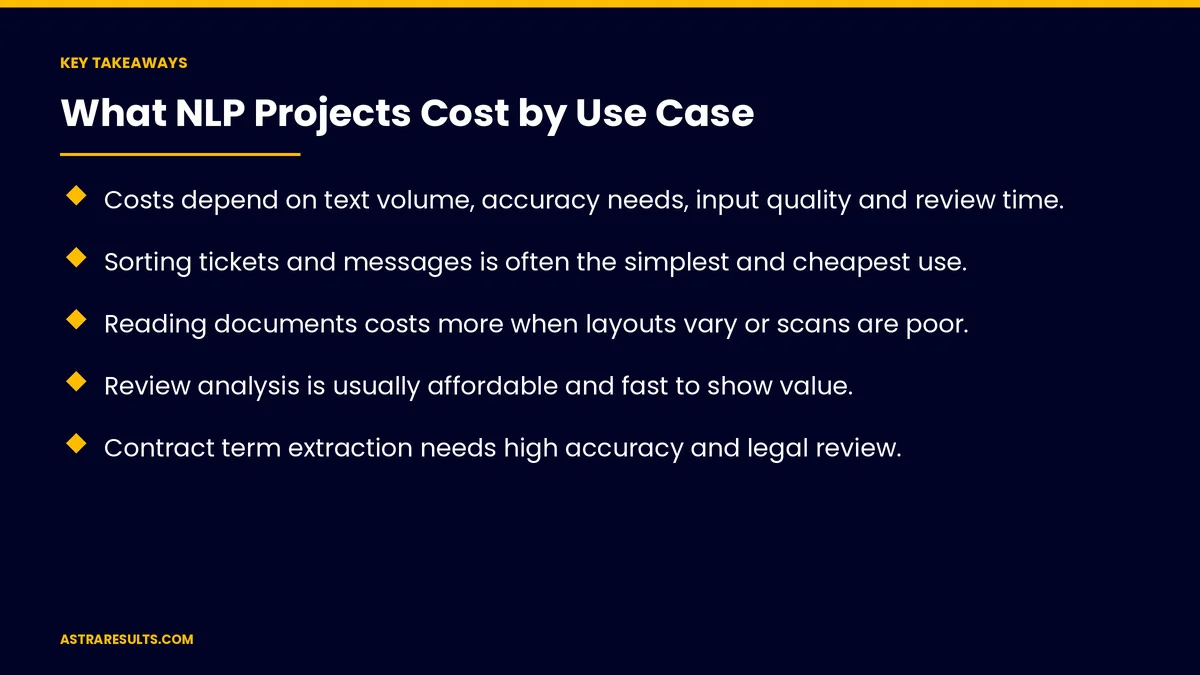
Key Takeaways
- Costs depend on text volume, accuracy needs, input quality and review time.
- Sorting tickets and messages is often the simplest and cheapest use.
- Reading documents costs more when layouts vary or scans are poor.
- Review analysis is usually affordable and fast to show value.
- Contract term extraction needs high accuracy and legal review.
- Upkeep, review time and usage fees continue after launch.
Published: October 31, 2026 | Reading Time: ~9 minutes | Category: Natural Language Processing
This guide covers cost drivers, sorting tickets, reading documents, analyzing reviews, extracting contract terms, setup versus running costs, upkeep and cheaper paths. Put plainly: cost follows volume, accuracy needs and how messy the inputs are, so start with the simplest approach that meets your target.
For the full business case, see making the business case for NLP.
In This Playbook
- The common cost drivers
- Sorting tickets and messages
- Reading documents
- Analyzing reviews
- Warranty and claims text
- Extracting contract terms
- Setup versus running costs
- Why do NLP systems need upkeep after launch?
- Cheaper paths
- How should the value of a language AI project be judged?
- What to measure
- The first three months
The common cost drivers
Volume. How much text, how often.
Accuracy needs. Drafts tolerate errors; decisions don't.
Input quality. Clean emails cost less than blurry scans.
People reviewing. Time spent checking results.
Connections. Sending results into your systems.
Sorting tickets and messages
What it does. Labels and routes messages, as in support ticket routing.
Why it's often cheaper. Short texts and clear categories.
Rules may be enough. As weighed in rules vs NLP classification.
Reading documents
What it does. Pulls details from orders, invoices and shipping papers, as in purchase order reading and shipping documents.
Costs rise with variety. Many layouts, languages or poor scans.
Checks add cost and value. Rules confirming what AI reads.
Analyzing reviews
What it does. Finds themes across many reviews, as in restaurant review analysis.
Often affordable. Ready-made tools may handle it.
Fast value. Themes appear in weeks.
Warranty and claims text
What it does. Sorts failures and spots trends, as in warranty claims analysis.
Costs depend on linking. Connecting claims to production data adds work.
Extracting contract terms
What it does. Finds dates, renewal terms and obligations.
Higher accuracy needed. Mistakes can be costly.
Legal review required. People confirm every term.
Setup versus running costs
Setup. Gathering examples, defining labels, building connections and testing.
Running. Usage fees that grow with volume.
Review time. People checking results, every month.
Why do NLP systems need upkeep after launch?
New categories. As the business changes.
Accuracy checks. Monthly samples.
Model changes. Testing when providers update models.
Five-year view. As covered in what custom software costs.
Cheaper paths
Ready-made tools first. Tested fairly, as covered in off-the-shelf first.
One use case at a time. Prove value before expanding.
Clean inputs. Better forms mean less to fix.
How should the value of a language AI project be judged?
Hours saved after review. The real saving.
Errors avoided. Missed issues and wrong routing.
Faster responses. For customers and staff.
The basics are covered in NLP for business.
What to measure
Cost per item processed. Ticket, document or review.
Accuracy. Checked against reviewers.
Review time. Hours per month.
Hours saved. Net of review.
Usage fees. Month over month.
The first three months
Month one: size the use case
Measure text volume, accuracy needs, input quality and current handling time for one use case.
Month two: test the simplest option
Test rules or ready-made tools fairly against your baseline, including review time.
Month three: decide and budget
Choose the approach, budget setup, running costs and upkeep and track cost per item and hours saved.
How Astra prices language AI
Astra Results Marketing explains what language AI will cost for your use case. We measure volume, accuracy needs and input quality, test the simplest option first and budget setup, running costs and upkeep together.
Engagements begin with a use case review through our natural language processing team.
Related reading
Frequently asked questions
What drives the cost of an NLP project?
Text volume, how accurate results must be, how messy the inputs are, review time and connections to your systems.
Which NLP use cases cost least?
Sorting tickets and messages and analyzing reviews are often the most affordable.
Why do document projects cost more?
Varied layouts, languages and poor scans make reading harder and need more checks.
What continues after launch?
Usage fees, review time, accuracy checks and updates as categories and models change.
How can we keep costs down?
Test rules or ready-made tools first, start with one use case and improve input quality.
What should we measure?
Cost per item, accuracy, review time, hours saved and usage fees.
Want to know what your language AI project should cost? Astra Results Marketing sizes your use case, tests the simplest option first and budgets setup, running costs and upkeep together. ▸ CALL (786) 321-2866 · ▸ REQUEST YOUR CONSULTATION





