 Rated 5 star on

Manufacturer Task Management for Maintenance Crews
Quick answer
AI task management helps manufacturing maintenance crews by turning breakdowns, preventive tasks and inspections into tracked work with a priority, owner and status. Safety issues come first, then production-critical machines. Lockout/tagout steps are built into tasks and never skipped. Shift handoffs summarize open work. Measure repair time, preventive completion and downtime.
When a machine goes down, every minute of lost production costs money. Yet many maintenance teams still track work on whiteboards, paper tags and memory. Preventive tasks slip, shift handoffs miss details and the same machine breaks for the same reason again. Task management built for maintenance crews keeps work visible, prioritized and tracked, with AI helping and supervisors deciding.
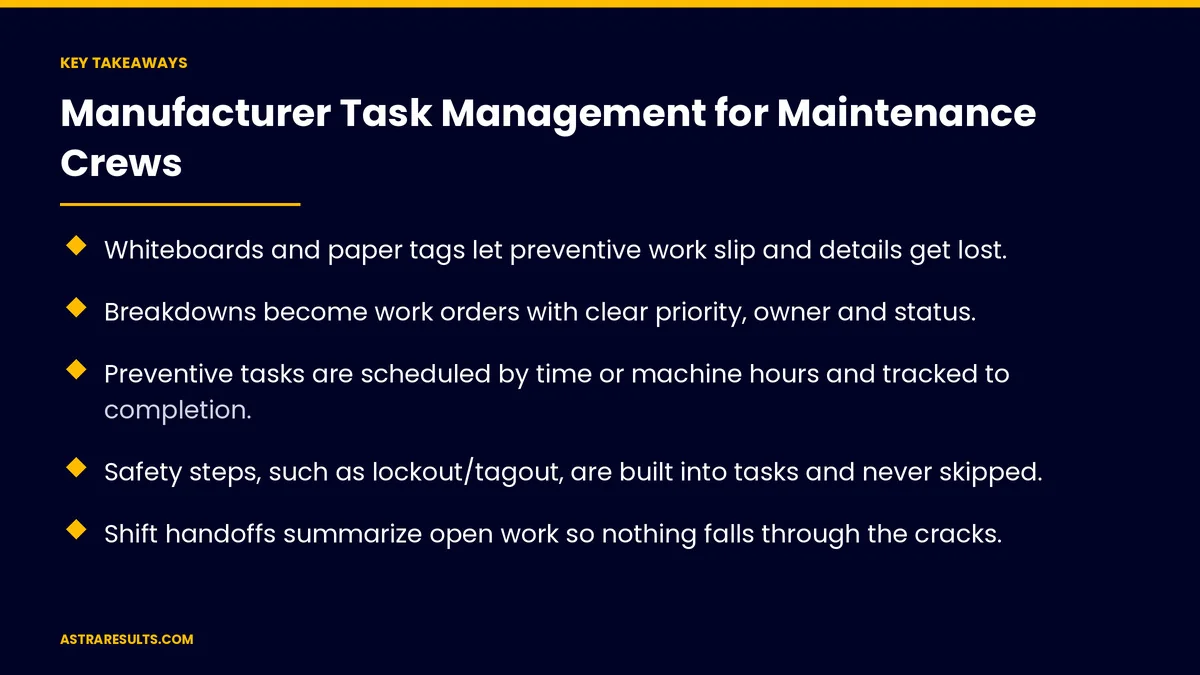
Key Takeaways
- Whiteboards and paper tags let preventive work slip and details get lost.
- Breakdowns become work orders with clear priority, owner and status.
- Preventive tasks are scheduled by time or machine hours and tracked to completion.
- Safety steps, such as lockout/tagout, are built into tasks and never skipped.
- Shift handoffs summarize open work so nothing falls through the cracks.
- Measure repair time, preventive completion, downtime and repeat failures.
Published: October 9, 2026 | Reading Time: ~9 minutes | Category: AI Task Manager
This guide covers task management for manufacturing maintenance: breakdown work orders, preventive maintenance, safety procedures, parts, priorities, shift handoffs, working on the floor, how AI helps, connecting systems and what to measure. Put plainly: turn every breakdown, check and handoff into a tracked task, and fix the causes, not just the symptoms.
In This Playbook
- Why does plant maintenance work slip?
- Breakdown work orders
- Preventive maintenance
- Safety built in
- Parts and spares
- Shift handoffs
- Working on the floor
- How does AI help maintenance crews manage tasks?
- Connecting systems
- What to measure
- The first three months
Why does plant maintenance work slip?
Breakdowns take over. Urgent repairs push preventive work aside.
Paper gets lost. Tags and notes don't follow the work.
Handoffs miss details. The next shift doesn't know what was tried.
Repeat failures. Without history, the same problem returns.
Breakdown work orders
Report fast. Operators report problems from a phone or tablet, with photos.
Clear priority. Safety issues first, then production-critical machines, then routine.
Owner and status. Everyone sees who's on it and what's happening.
Close with notes. What failed, what was done and which parts were used.
Preventive maintenance
Scheduled by time or use. Every month, or every set number of machine hours.
Checklists. Clear steps for each task.
Track completion. On time, late or skipped.
Protect preventive time. Plan it so breakdowns don't crowd it out.
Safety built in
Lockout/tagout steps. Energy control procedures under OSHA's standard are part of the task, not an afterthought.
Required checks. Tasks can't be closed without confirming safety steps.
Permits and approvals. For hot work, confined spaces and other risky jobs.
AI never shortcuts safety. Suggestions never skip or override safety procedures.
Parts and spares
Parts on each task. What's needed and whether it's in stock.
Reorder alerts. Low stock on critical spares.
Scan parts. Barcode scanning for parts used, as with warehouse scanning apps.
Shift handoffs
Summarized open work. What's in progress, waiting or blocked.
What was tried. Notes so the next shift doesn't start over.
AI summaries. Draft handoff notes from the day's updates, as covered in meeting notes to action items.
Working on the floor
Phones and tablets. Tasks, checklists and photos where the work happens.
Offline access. Plant floors often have weak signal.
Simple screens. Big buttons and quick updates, usable with gloves.
English and Spanish. For crews who prefer either.
How does AI help maintenance crews manage tasks?
Turn reports into tasks. From operator messages or machine alerts.
Suggest priority. Based on safety, machine importance and production schedule.
Flag overdue preventive work. Before it becomes a breakdown.
Spot repeat failures. Machines or parts that fail again and again.
Supervisors decide. AI suggests; people assign and approve, as covered in the action layer.
Connecting systems
Machine and production data. Downtime and alerts linked to tasks, as covered in unifying manufacturer data.
Inventory. Parts usage updates stock.
Choosing a partner. Questions to ask are covered in what to ask before hiring a task management partner.
The basics of AI task management are covered in work that moves itself.
What to measure
Average time to repair. From breakdown report to machine running.
Preventive completion. Share of preventive tasks done on time.
Planned versus unplanned work. More planned work usually means fewer surprises.
Downtime. Hours lost by machine and cause.
Repeat failures. The same problem returning. Useful KPI habits are covered in task management KPIs.
The first three months
Days 1–30: set up the basics
List critical machines, preventive schedules and safety procedures. Set up breakdown reporting, priorities and task checklists with lockout/tagout steps built in. Record current downtime and repair times.
Days 31–60: roll out on the floor
Give crews phone and tablet access with offline use, start preventive schedules and add shift handoff summaries. Track parts on tasks.
Days 61–90: add AI and measure
Add AI suggestions for priority, overdue preventive work and repeat failures, with supervisors approving. Compare repair time, preventive completion and downtime with the baseline.
How Astra builds maintenance task management
Astra Results Marketing builds task management for manufacturing maintenance crews. We set up breakdown work orders, preventive schedules, safety steps, parts tracking and shift handoffs, on phones and tablets that work offline.
AI suggests priorities and spots repeat failures, while supervisors stay in charge. Engagements begin with a maintenance workflow review through our AI task manager team.
Related reading
Frequently asked questions
How does task management help maintenance crews?
It turns breakdowns, preventive tasks and inspections into tracked tasks with priority, owner and status, so work doesn't slip and history is kept.
How should maintenance tasks be prioritized?
Safety issues first, then production-critical machines, then routine work, with preventive time protected in the schedule.
Can AI skip safety steps to speed up repairs?
No. Safety procedures such as lockout/tagout are built into tasks, tasks can't close without confirming them and AI suggestions never override them.
How do shift handoffs improve?
Open work is summarized automatically, with notes on what was tried, so the next shift picks up without starting over.
Does it work on the plant floor?
Yes, on phones and tablets with offline access, simple screens usable with gloves and English and Spanish.
What should maintenance teams measure?
Average time to repair, preventive completion, planned versus unplanned work, downtime by machine and repeat failures.
Ready to keep maintenance work visible and on schedule? Astra Results Marketing builds maintenance task management with work orders, preventive schedules, built-in safety steps, parts tracking and shift handoffs, with AI helping and supervisors deciding. ▸ CALL (786) 321-2866 · ▸ REQUEST YOUR CONSULTATION





