 Rated 5 star on

Industry AI + Agents: The Action Layer
Quick answer
Industry AI changes outcomes only when its insights trigger action, and agents provide that action layer. They turn forecasts, scores and alerts into drafts, tasks and orders. Each action gets an approval level: suggest, draft, act with approval or act alone. Low-risk, reversible actions can run alone. Permissions, logs and a stop button keep agents safe.
Many AI projects end in a dashboard. The model forecasts demand, scores risk or flags a problem, and then waits for someone to notice. Busy teams don't always look. The action layer connects industry AI to agents that take the next step, such as drafting the order or sending the reminder, with the right human approval.
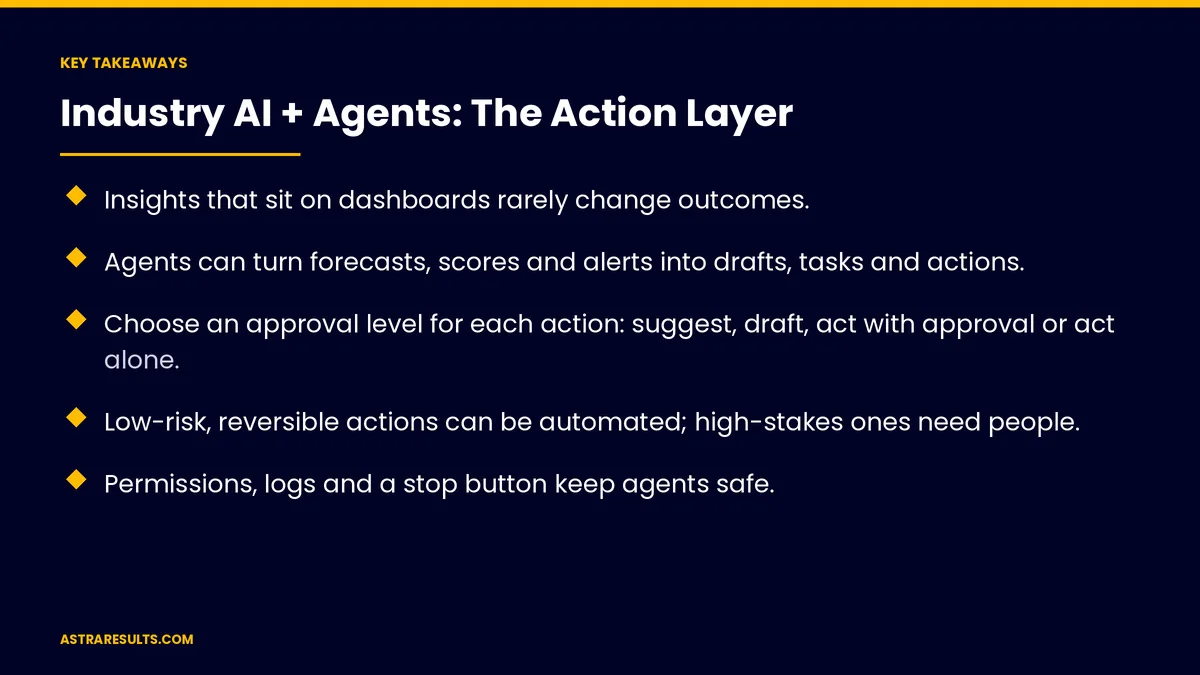
Key Takeaways
- Insights that sit on dashboards rarely change outcomes.
- Agents can turn forecasts, scores and alerts into drafts, tasks and actions.
- Choose an approval level for each action: suggest, draft, act with approval or act alone.
- Low-risk, reversible actions can be automated; high-stakes ones need people.
- Permissions, logs and a stop button keep agents safe.
- Measure how often insights lead to action, and what those actions achieve.
Published: October 8, 2026 | Reading Time: ~9 minutes | Category: Industry-Specific AI
This guide covers how businesses connect AI insights to agents that act: why dashboards fall short, how the action layer works, levels of approval, examples by industry, guardrails and how to measure results. Put plainly: every insight should lead to a clear next step, and someone should decide how much of it the agent takes alone.
In This Playbook
- Why dashboards fall short
- What the action layer does
- Four levels of approval
- Examples by industry
- Choosing what to automate
- Guardrails
- Feedback loops
- Building it step by step
- How do we measure an AI action layer?
- The first three months
Why dashboards fall short
People are busy. Dashboards compete with phones, customers and email.
Insights arrive without steps. "Risk is high" doesn't say what to do.
Timing matters. By the time someone looks, the moment may have passed.
Results go unmeasured. Without a recorded action, nobody knows if the insight helped.
What the action layer does
Watches for signals. Forecasts, scores, detections and alerts from industry AI models, as covered in industry-specific AI.
Decides the next step. Using rules agreed with the team.
Prepares or takes the action. Drafts an order, creates a task, sends a reminder or updates a record.
Records what happened. Every action logged, with its result. How agents work is covered in AI agents that do the work.
Four levels of approval
Suggest. The agent recommends an action; a person decides.
Draft. The agent prepares the action, such as an email or order; a person approves and sends.
Act with approval. The agent proceeds after a quick yes from a person.
Act alone. The agent completes low-risk, reversible actions and reports them.
Start cautious. Most actions begin at suggest or draft, then move up as trust builds.
Examples by industry
Restaurants. A demand forecast triggers drafted supplier orders and prep lists, as in restaurant group AI and restaurant agents.
Franchises. A location falling below its expected range creates a support task for the field consultant, as in location performance models.
Construction. A submittal at risk of delaying a long-lead order triggers a reminder to the subcontractor, as in construction submittal agents.
Insurance. A policy likely to lapse prompts a drafted renewal message for the agent to review, as in insurance agency AI.
Facilities. A camera alert for a blocked fire exit creates a work order, as in intelligent monitoring.
Choosing what to automate
Low risk and reversible. Internal tasks, reminders and notes can often run alone.
Customer-facing. Messages to customers usually start as drafts.
Money and contracts. Orders above set limits, refunds and pricing always need people.
Regulated decisions. Insurance, health and lending decisions stay with qualified people.
Guardrails
Limited permissions. Agents access only the systems and actions they need.
Logs. Every signal, decision and action recorded.
A stop button. Pause agents quickly if something goes wrong, as covered in agent security.
Thresholds. Actions trigger only above agreed confidence or risk levels.
Undo plans. Know how to reverse each action.
Feedback loops
Record outcomes. Did the order arrive on time? Did the customer renew?
Learn from overrides. When people change or reject an action, the reason improves the rules.
Tune thresholds. Too many false alarms waste time; too few miss problems.
Review monthly. Check which actions help and which don't.
Building it step by step
Pick one insight that matters. One where a faster action clearly helps.
Define the action and approval level. Written down with the team.
Connect the systems. The model, the agent and the tools where actions happen.
Pilot and measure. Start small, then expand.
How do we measure an AI action layer?
Action rate. Share of insights that lead to an action.
Time to action. From signal to step taken.
Outcomes. Orders on time, renewals kept, delays avoided.
Override rate. How often people change agent actions.
Hours saved. Time no longer spent checking dashboards and drafting by hand.
The first three months
Days 1–30: choose and define
Pick one insight that often goes unused, such as a forecast or risk score. Define the action it should trigger, the approval level and the guardrails. Record current time to action and outcomes.
Days 31–60: connect and pilot
Connect the model to an agent and the tools where the action happens. Start at the suggest or draft level, log everything and track overrides.
Days 61–90: measure and expand
Compare action rate, time to action and outcomes with the baseline. Raise approval levels for actions that prove reliable, and add the next insight.
How Astra builds the action layer
Astra Results Marketing connects industry AI models to agents that act. We choose the insights that matter, define the next step and approval level for each, connect your systems and add permissions, logs, thresholds and a stop button.
We start with suggestions and drafts, measure outcomes and expand as trust builds. Engagements begin with an insight and workflow review through our industry-specific AI team.
Related reading
Frequently asked questions
What is the action layer?
The connection between industry AI insights, such as forecasts, scores and alerts, and agents that take the next step: drafting orders, creating tasks, sending reminders or updating records.
Why aren't dashboards enough?
People are busy, insights often arrive without clear steps and timing matters. Without an action, an insight rarely changes the outcome.
How much should agents do on their own?
It depends on the action. Low-risk, reversible tasks can run alone. Customer messages usually start as drafts, and money, contracts and regulated decisions stay with people.
What guardrails do agents need?
Limited permissions, logs of every action, a quick way to pause them, confidence thresholds and a plan to undo each action.
How do agents improve over time?
By recording outcomes, learning from the reasons people override actions, tuning thresholds and reviewing results monthly.
Where should we start?
With one insight that often goes unused and a clear action it should trigger, starting at the suggest or draft level.
Ready to turn AI insights into action? Astra Results Marketing connects industry AI to agents that draft, remind and act, with approval levels, permissions, logs and a stop button built in from the start. ▸ CALL (786) 321-2866 · ▸ REQUEST YOUR CONSULTATION





