Rated 5 star on

AI Task Management: Work That Moves Itself
Quick answer
Project software tracks work and still needs somebody to chase people into updating it. AI task management watches what happens in the tools the business already runs, creates the task itself, assigns it, and escalates when it stalls. The goal is not a better board. It is a business where nothing waits to be chased by a person.
Every business has a person whose real job is chasing. They ask whether the quote went out, whether the customer replied, whether the invoice was approved, whether anyone booked the technician. They are usually good at it, and the business runs on them, which is another way of saying the business stops when they are on holiday.
Key Takeaways
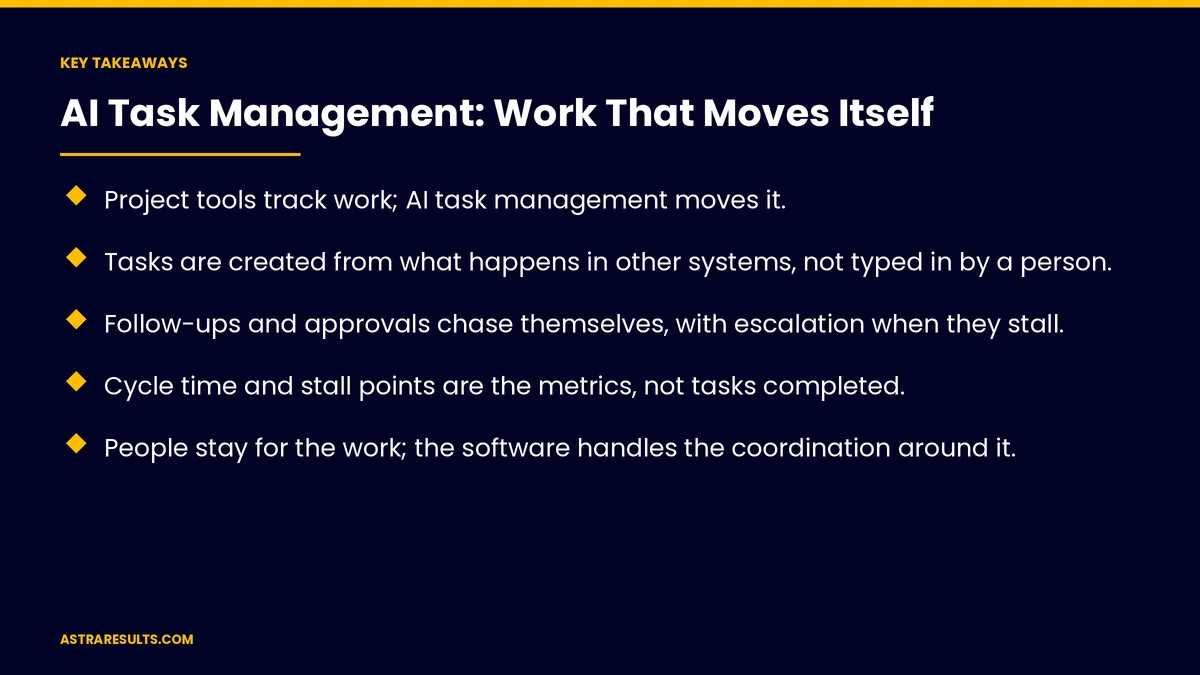
- Project tools track work; AI task management moves it.
- Tasks are created from what happens in other systems, not typed in by a person.
- Follow-ups and approvals chase themselves, with escalation when they stall.
- Cycle time and stall points are the metrics, not tasks completed.
- People stay for the work; the software handles the coordination around it.
- Start with the one handoff where things go missing most often.
Published: September 5, 2026 | Reading Time: ~13 minutes | Category: AI Task Manager
Project software did not fix this. It gave everyone a board to update and then required someone to chase people for updating it. AI task management is different in one specific way: the system watches what is actually happening in the business's other tools and moves work forward itself. This guide covers what that means in practice. Put plainly: the goal is not a better board; it is a business where nothing waits to be chased.
Guidance for owners and operators. Nothing here is legal or employment advice. Systems that monitor work assignment, performance or employee activity carry obligations that vary by jurisdiction and should be reviewed with counsel.
In This Playbook
- The limits of project software
- What "moves itself" means
- Where things stall
- What the system needs to work
- Measuring the right things
- The people question
- Where to start
- The work this leaves alone
- Three months, step by step
- What Astra does here
The limits of project software
- What it does well. A shared view of who is doing what, a record of decisions, a place for files.
- What it does not do. Know whether anything actually happened. The board says a task is in progress because someone dragged a card. The quote may or may not have been sent.
- The update tax. Everyone maintains the board alongside doing the work, and the board's accuracy depends on discipline that decays.
- The chaser. Because the board cannot be trusted, someone checks. That person is the real task management system.
- What changes with AI. The system reads the underlying tools — email, CRM, calendar, accounting, document storage — and infers state from events rather than from someone's status update, discussed in connected systems.
What "moves itself" means
- Tasks created from events. A deal reaches a stage, an email arrives, a document is signed, an invoice ages past terms — each creates the task that should follow, assigned to the right person, with the context attached.
- Follow-ups that fire without being remembered. The quote sent Tuesday with no reply by Friday produces a follow-up task, or sends the follow-up itself if that is the rule.
- Approvals that route and escalate. Sent to the right approver with the context, escalated after a defined wait, and recorded when decided, discussed in automating approvals.
- Handoffs that carry everything. The next person receives what they need rather than a notification telling them to go find it.
- Closure detected, not reported. When the underlying event happens — payment received, document signed, appointment attended — the task closes itself.
- The effect. The board reflects reality because it is built from reality rather than from status updates.
Where things stall
Worth naming, because these are the places to start.
- Between people. Sales to operations, operations to billing, estimator to scheduler. Each handoff is a place work waits for someone to notice.
- Waiting on a customer. The quote, the document, the deposit, the choice. Nobody owns chasing it, so it sits.
- Waiting on an approval. A manager's inbox, a decision that takes two minutes and waits four days.
- Waiting on a dependency. Material, a subcontractor, a permit, a report.
- After hours and across shifts. The thing that finished at 6pm and nobody picks up until 9am the next day.
- Holiday and absence. The work that quietly stops because the person who moves it is away, discussed in key-person risk.
What the system needs to work
- Connection to where work happens. Email, calendar, CRM, accounting, document storage, and whatever operational system the business runs on.
- Rules the business writes. What triggers a task, who owns it, how long before it escalates, and to whom. These encode how the business already works, or how it has decided to work.
- Clean ownership. Every task type has a role attached. "Someone" is not an owner.
- Escalation paths. A defined wait and a named next person, so nothing sits indefinitely.
- Boundaries. What the system does alone — creating, routing, reminding, closing — and what needs a person, which is the subject of what software decides alone.
- A log. What was created, routed, escalated and closed, and on what basis.
Measuring the right things
Task counts measure activity. These measure flow.
- Cycle time by work type. How long from trigger to completion, which is the number the customer experiences.
- Stall points. Where work waits longest, by stage and by role. This is the diagnostic that pays for the system.
- Wait time versus work time. Most work is not slow because it takes long; it is slow because it waits. Separating these reveals that.
- Escalation rate. How things had to be chased by the system, which should fall as rules improve.
- Overdue by role. Not to punish, but to reveal a person who is structurally overloaded.
- On-time completion by work type, compared to the baseline before the system.
The people question
- What it takes away. The chasing, the status meetings, the "did anyone…" messages, the mental load of remembering what is outstanding.
- What it does not take away. The work itself, the judgment, the customer conversation.
- The monitoring line. A system that shows where work stalls is operationally useful. A system that reports on individuals' activity minute by minute is a different thing with different legal and cultural consequences, and the difference should be deliberate.
- The trust requirement. If the team believes the system exists to catch them out, they will work around it, and the data becomes useless — the same dynamic as field workforce tracking, laid out in monitoring and trust.
- The plain framing to the team. This removes the chasing, shows where the business is slow, and does not measure how fast anyone types.
Where to start
- The one handoff that goes wrong most often. Every business knows it. Sales to operations, or quote to follow-up, or job complete to invoice.
- Instrument it first. Measure the current cycle time and where it waits, before changing anything.
- Automate the routing and the chasing for that handoff only. One work type, one set of rules.
- Prove it with the numbers. Cycle time before and after, wait time removed.
- Then the next one. Each addition is cheaper because the connections and the discipline exist.
- What not to do. Roll out a whole-company system in one go, which produces a lot of notifications and no measurable change.
The work this leaves alone
- Businesses with one or two people. The coordination overhead it removes does not exist yet.
- Work that is unstructured. Creative and exploratory work resists task decomposition, and forcing it produces theatre.
- Teams with no agreement on the process. The system encodes a process; if there are three versions of it, that argument has to happen first, according to discovery before building.
- As a substitute for hiring. If the team is under-resourced, removing coordination overhead helps at the margin and does not solve it.
Three months, step by step
Days 1–30: instrument
The handoff that fails most identified. Current cycle time and wait time measured. The systems where work happens connected read-only. Task types, owners and escalation rules written for that one handoff.
Days 31–60: automate one flow
Tasks created from events for that handoff, routed with context, with follow-ups and escalation. Running alongside the existing process, with the log reviewed weekly.
Days 61–90: measure and extend
Cycle time and wait time compared to the baseline. Stall points reviewed with the team rather than at them. The second handoff chosen and added.
What Astra does here
Astra Results Marketing starts by measuring the handoff that fails most rather than deploying a system across the company, because a whole-company rollout produces notifications and no measurable change. The rules encode how the business already works, with an owner per task type and a named escalation path.
The system reads the tools where work happens so the state reflects reality rather than status updates, and reporting leads with cycle time and stall points rather than task counts. Where monitoring could shade into individual performance surveillance, the boundary is set deliberately and with counsel. Engagements begin with a handoff and cycle-time assessment through our AI task manager team.
Related reading
Frequently asked questions
How is this different from project management software?
Project tools give everyone a board to update and then depend on the discipline to update it, so someone still has to chase people to keep it accurate. AI task management reads the systems where work happens — email, CRM, calendar, accounting, documents — and infers state from events. The board reflects reality because it is built from reality rather than from status updates.
What does "work that moves itself" mean concretely?
Tasks created from events rather than typed in: a deal reaching a stage, a document being signed, an invoice ageing past terms. Follow-ups that fire without anyone remembering. Approvals routed with context and escalated after a defined wait. Handoffs that carry everything the next person needs. And closure detected from the underlying event — payment received, appointment attended — rather than reported.
Where does work usually stall?
Between people at handoffs like sales to operations or operations to billing; waiting on a customer for a quote, document or deposit that nobody owns chasing; waiting on an approval that takes two minutes and sits four days; waiting on a dependency; across shifts, where something finishing at six is picked up at nine; and during absence, where work quietly stops because the person who moves it is away.
What should be measured?
Cycle time by work type, which is what the customer experiences. Stall points by stage and role, which is the diagnostic that pays for the system. Wait time separated from work time, because most work is slow from waiting rather than from effort. Escalation rate, which should fall as rules improve. And overdue by role, to reveal structural overload rather than to punish.
Does this become employee surveillance?
It can, and the line should be drawn deliberately. A system that shows where work stalls is operationally useful; one that reports individual activity minute by minute is a different thing with different legal and cultural consequences that counsel should review. Practically, a team that believes the system exists to catch them out works around it and the data becomes useless.
Where should a business start?
With the one handoff that goes wrong most often — every business knows which it is. Measure its current cycle and wait time before changing anything, automate routing and chasing for that handoff only, prove it with before-and-after numbers, then add the next. A whole-company rollout in one go produces a lot of notifications and no measurable change.
READY TO STOP BEING THE PERSON WHO CHASES? Astra Results Marketing measures the handoff that fails most often, encodes the rules your business already runs on, and reports cycle time and stall points rather than task counts. Astra Results Marketing · 1101 Brickell Ave, Miami, FL 33131 · +1 (786) 321-2866 · [email protected] Find us on Google · Yelp ▸ CALL (786) 321-2866 · ▸ REQUEST YOUR CONSULTATION