 Rated 5 star on


Manufacturer Data: ERP, Floor, Quality Unified
Quick answer
Manufacturers can join ERP, shop floor and quality data once shared identifiers are clean. Part numbers, work orders, lot numbers and machine IDs make the data joinable. Collect machine data through read-only connections on separate networks. A unified view shows OEE, scrap costs and downtime causes, and speeds lot traceability during recalls.
In most plants, the answers exist but live in different places. Orders and costs sit in the ERP. Machine counts and downtime live on the shop floor. Inspection results sit in quality spreadsheets. When a customer reports a defect, someone spends a day finding which lot, machine and shift. Joined data answers that in minutes.
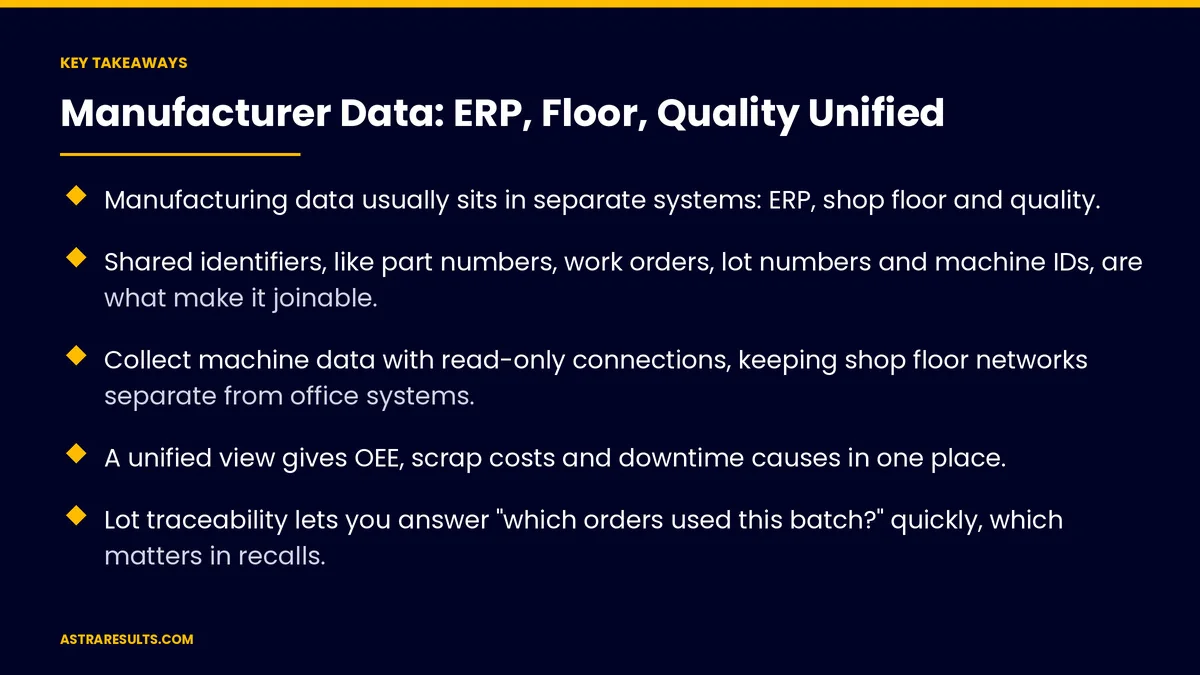
Key Takeaways
- Manufacturing data usually sits in separate systems: ERP, shop floor and quality.
- Shared identifiers, like part numbers, work orders, lot numbers and machine IDs, are what make it joinable.
- Collect machine data with read-only connections, keeping shop floor networks separate from office systems.
- A unified view gives OEE, scrap costs and downtime causes in one place.
- Lot traceability lets you answer "which orders used this batch?" quickly, which matters in recalls.
- Start with one line or one question, prove the value, then expand.
Published: October 19, 2026 | Reading Time: ~10 minutes | Category: Data Engineering
This guide covers how manufacturers unify ERP, shop floor and quality data: the shared identifiers that make it possible, collecting machine data safely, the views that matter most like OEE and traceability, and how to start. Put plainly: link every order, machine and inspection with shared IDs, and the questions that took a day take minutes.
In This Playbook
- Where manufacturing data lives
- What links manufacturing data across systems?
- Collecting machine data safely
- Bringing it together
- The views that matter
- Traceability
- What comes next
- Plant numbers to track
- The first three months
Where manufacturing data lives
ERP. Orders, bills of materials, inventory, purchasing and costs.
Shop floor. Machine counts, cycle times, downtime, alarms and operator entries.
Quality. Inspections, test results, defects, nonconformance reports and corrective actions.
Maintenance. Work orders, repairs and parts used on each machine.
Spreadsheets. The glue that holds it together today, maintained by a few people.
What links manufacturing data across systems?
Part and product numbers. The same code in every system.
Work orders. Linking a customer order to what was produced and when.
Lot and batch numbers. Tracing materials in and products out.
Machine and line IDs. Linking output, downtime and quality to equipment.
Time stamps. Consistent clocks so events line up across systems.
Clean them first. Duplicate or inconsistent codes are the main reason unification projects stall, as covered in the foundation every AI project needs.
Collecting machine data safely
Read-only connections. Pull data from machines and controllers without the ability to change settings.
Keep networks separate. Shop floor equipment should stay on its own network, with a controlled, one-way path for data to the office.
Edge devices. Small gateways near machines collect and forward data.
Start with what exists. Many machines already record counts and states. Older ones may need simple sensors.
Involve operations. Plant engineers and maintenance should approve every connection.
Bringing it together
A pipeline to one place. Data from each system collected into a central warehouse on a schedule, as explained in data pipelines explained.
Matching rules. How records join, which system owns each field and what happens when they disagree, as covered in planning an integration.
Near real time where needed. Floor dashboards may refresh every few minutes; cost reports nightly.
Build or buy. Off-the-shelf manufacturing software covers some needs. Compare it fairly with a custom layer over five years, as in what custom software costs.
The views that matter
OEE. Overall equipment effectiveness combines availability, performance and quality into one measure per line or machine.
Downtime causes. Why machines stop, ranked by lost time.
Scrap and rework cost. Waste tied to products, machines, shifts and materials.
First-pass yield. The share of units right the first time.
Order status. Where each customer order stands, ready to share with customers, like the tracking in logistics customer apps.
Traceability
Forward. Which customer orders used a given lot of material?
Backward. Which materials, machines and operators made a given product?
Fast answers. In a recall or complaint, minutes instead of days.
Linked inspections. Quality results attached to the lots they tested.
What comes next
Quality insights. Spotting which machines, materials or shifts drive defects.
Visual inspection. Cameras that check parts on the line, as covered in computer vision.
Predictive maintenance. Once machine data is clean and connected, models can flag likely failures, using the layers in the ML stack explained.
Plant numbers to track
OEE by line. Before and after the project.
Scrap rate and cost. Trending down as causes become visible.
Downtime hours. By cause, and how fast the biggest causes shrink.
Traceability time. Minutes to answer a lot or recall question.
Report hours saved. Time no longer spent assembling spreadsheets.
The first three months
Days 1–30: one line, one question
Pick one production line and one question, such as scrap cost by machine. List the systems involved, check and clean shared identifiers, and record how the answer is found today.
Days 31–60: connect safely
Set up read-only machine data collection with operations approval. Build the pipeline from ERP, floor and quality into one place. Create the first dashboard for that line.
Days 61–90: use and expand
Use the dashboard in daily and weekly meetings. Measure OEE, scrap and report hours saved. Add traceability, then plan the next line.
How Astra unifies manufacturing data
Astra Results Marketing helps manufacturers join ERP, shop floor and quality data into one trusted view. We clean shared identifiers, collect machine data safely with read-only connections, build pipelines into one place and create the dashboards supervisors use.
We start with one line and one question, prove the value with OEE, scrap and traceability, and expand from there. Engagements begin with a data and plant walk-through through our data engineering team.
Related reading
Frequently asked questions
Why is manufacturing data hard to combine?
It lives in separate systems, such as ERP, shop floor and quality, often with inconsistent part numbers, work orders and lot codes. Shared, clean identifiers are what make it joinable.
Is it safe to connect machines to our data systems?
It can be, with read-only connections, separate shop floor networks, a controlled one-way path for data, and approval from your plant engineers for every connection.
What is OEE?
Overall equipment effectiveness: a single measure combining availability, performance and quality for a machine or line. Unified data makes it accurate and up to date.
How does unified data help with traceability?
It links materials, lots, machines, operators and inspections to orders, so you can quickly find which orders used a batch or what made a given product.
Should we buy manufacturing software or build a custom layer?
Off-the-shelf software covers many needs. A custom layer makes sense for unique processes or deep integrations. Compare the options fairly over five years.
Where should we start?
With one production line and one valuable question, such as scrap cost by machine. Prove the value there before connecting more lines and systems.
Ready to see orders, machines and quality in one view? Astra Results Marketing cleans shared identifiers, collects machine data safely, joins ERP, shop floor and quality into one place, and builds OEE, scrap and traceability views your supervisors use daily. ▸ CALL (786) 321-2866 · ▸ REQUEST YOUR CONSULTATION





